
In short: Meditation reached the West over more than a century: first as translated books that Thoreau read beside Walden Pond, then through Swami Vivekananda’s speech in Chicago in 1893, D. T. Suzuki’s books on Zen, the Beat writers, the hippie movement, the psychedelic experiments at Harvard, and finally the secular mindfulness that Jon Kabat-Zinn brought into a hospital in 1979. Each stage carried meditation further, and each one changed it a little along the way.
Read in Vietnamese: Thiền ở phương Tây: từ Vivekananda, hippie, psychedelics đến mindfulness
If you have ever opened a meditation app or joined a mindfulness session at work, you are standing at the end of a long road: from a cabin in Massachusetts to a stage in Chicago, a mountain shack in California and a hospital clinic. This is how meditation came to the West, who carried it, and what it gained and lost on the way. Our history of meditation gives the wider picture.
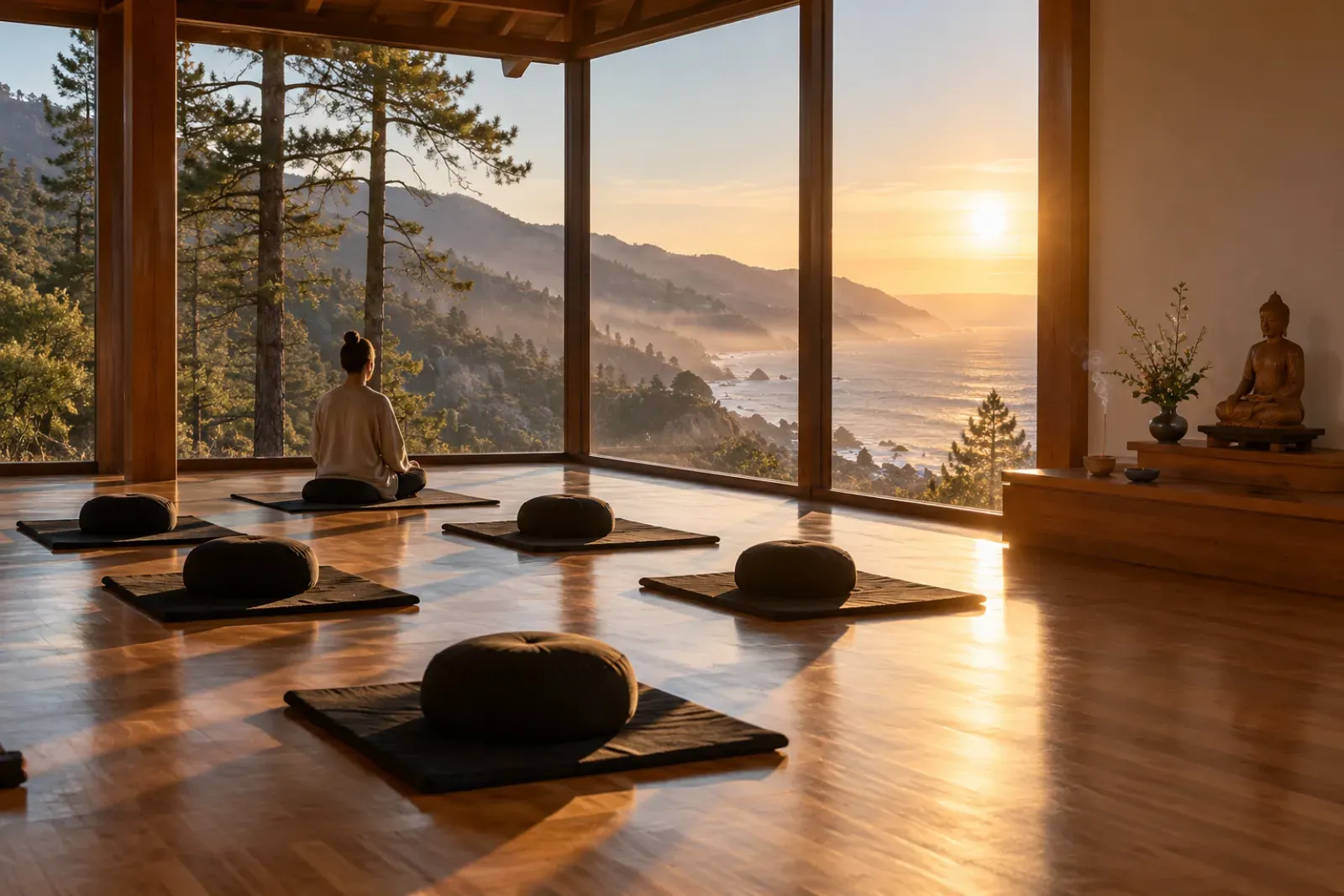
Before 1900: Asian books beside Walden Pond
Meditation did not arrive in the West with a teacher. It arrived first as books. In the mid-nineteenth century, the American Transcendentalists, writers who put the inner life at the centre, among them Ralph Waldo Emerson and Henry David Thoreau, eagerly read translations of Indian and Chinese scriptures.
In Walden (1854), written in a small cabin beside a pond, Thoreau describes bathing his mind each morning in the philosophy of the Bhagavad Gita. That was not yet a sitting practice, but it planted a first seed. (For the Gita and the older Indian roots of meditation, see meditation in Hinduism.)
In 1875, Helena Blavatsky and Henry Steel Olcott founded the Theosophical Society in New York, a blend of many spiritual sources that turned Western eyes towards Asia; Olcott was one of the earliest Americans of European descent to become a Buddhist.
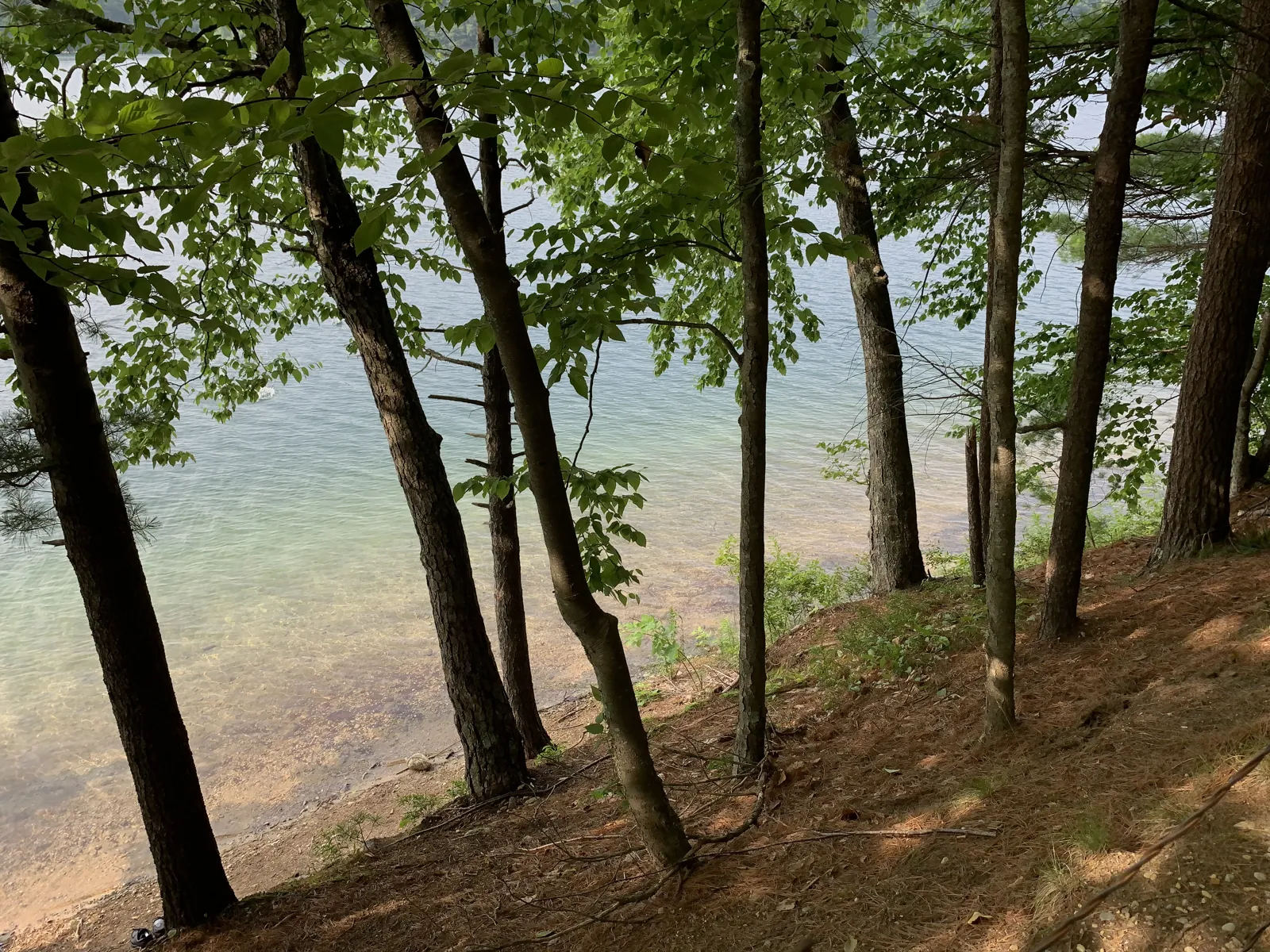
1893: Vivekananda in Chicago, then D. T. Suzuki
One date comes up again and again: 11 September 1893. At the World’s Parliament of Religions in Chicago, a thirty-year-old Indian monk in an orange robe, Swami Vivekananda, opened with the words “Sisters and Brothers of America”. Close to seven thousand people applauded. He spoke about tolerance between religions, and his book Raja Yoga (1896) helped shape what the West came to understand by the word “yoga”.
On the Buddhist side, the most influential figure was the Japanese scholar Daisetz Teitaro Suzuki (1870–1966). His English books presented Japanese Zen, which stresses seeing reality directly beyond words, as a fresh way of looking at life. When he lectured at Columbia University in 1952–1953, the composer John Cage was in the audience, along with many other artists and writers.
The 1950s: the Beat Generation and Alan Watts
In the 1950s, Zen entered American literature through the Beat Generation, young writers tired of tidy post-war suburban life. Jack Kerouac read the sutras and kept sitting despite aching knees. In 1956 he shared a cabin on Mount Tamalpais with the poet Gary Snyder, who had studied Zen in Japan; the result was The Dharma Bums (1958), with Snyder as Japhy Ryder and its dream of a “rucksack revolution”.
Alongside them was Alan Watts (1915–1973), a British-born former Anglican priest. Through his radio talks in Berkeley and books such as The Way of Zen (1957), he “translated” Eastern ideas for the young people of the San Francisco Bay Area, from the Beats to the hippies who came after them.

The 1960s: hippies, The Beatles and San Francisco Zen Center
In the 1960s, meditation stepped off the page and into daily life as the counterculture and the hippie movement spread. Young people protested the war in Vietnam, questioned consumer culture and looked East for answers.
In 1959 the Zen teacher Shunryu Suzuki (1904–1971) came to San Francisco to look after a Japanese temple. Young Americans kept coming to sit with him, and in 1962 they founded San Francisco Zen Center. His talks became Zen Mind, Beginner’s Mind (1970): meet everything as if for the first time.
In February 1968, all four Beatles went to Rishikesh, at the foot of the Himalayas, to study Transcendental Meditation (TM, a technique built on a silently repeated mantra) with Maharishi Mahesh Yogi. The course was planned for three months, but they left one by one; Lennon and Harrison departed in mid-April amid disputes around the Maharishi. Still, many “White Album” songs were written there, and the sight of the world’s most famous band meditating made countless people curious.
Psychedelics and spirituality: a chapter to tell accurately
No honest history of meditation in the West can skip psychedelics, the group of mind-altering substances that includes psilocybin and LSD. We tell this part as history only, not to encourage anyone to use them. In Vietnam, psilocybin, LSD and related substances are on the list of banned narcotics, including for medical use.
In 1960, Harvard psychology lecturers Timothy Leary and Richard Alpert started the Harvard Psilocybin Project. On Good Friday 1962, Walter Pahnke, a physician and minister doing his doctorate under Leary, gave psilocybin to half of twenty divinity students before a service at Marsh Chapel, Boston University, and a control pill to the rest; he reported more mystical-type experiences in the psilocybin group. More than twenty-five years later, Rick Doblin re-interviewed most participants and pointed out weaknesses in the methods. In 1963 Harvard dismissed both Leary and Alpert; the substances spilled into hippie culture, and in the early 1970s the US and the UN placed them under the strictest control, almost halting research for decades.
What stands out is that many people who tried these substances later turned to meditation, wanting to reach unusual states of consciousness while fully sober. Richard Alpert went to India in 1967, met Neem Karoli Baba and became Ram Dass. In a 1988 interview he said what pulls us “down” is clinging to our thoughts, and meditation loosens that grip. From 1970 he practised seriously, mostly in the Theravāda tradition, and Be Here Now (1971) became a companion for a generation.
Esalen, Tibetan teachers and the vipassanā wave
In 1962, Michael Murphy and Richard Price founded the Esalen Institute at Big Sur, California, where meditation, yoga, psychotherapy and science met; Esalen calls itself the birthplace of the “human potential movement”.
After 1959, many Tibetan lamas had to leave their homeland. Chögyam Trungpa (1939–1987) studied at Oxford from 1963, taught in North America from 1970 and in 1974 founded the Naropa Institute in Boulder, Colorado. Its first summer faculty included Ram Dass and Allen Ginsberg.
Trungpa was brilliant and deeply controversial. In 1990 the journalist Katy Butler wrote that he drank heavily, sometimes taught drunk and openly had sexual relationships with students; his successor, Ösel Tendzin, knew he had HIV yet had sex with students, infecting at least one. Many students still value Trungpa’s teaching, but Butler’s article became a lesson in how a community can look away from a teacher’s wrongdoing.
The vipassanā (insight meditation: seeing clearly what is happening in body and mind) of Theravāda Buddhism came back with young Westerners who had gone to Asia to practise; the Mahayana and Theravada guide explains where that tradition sits. In 1975, Joseph Goldstein, Jack Kornfield and Sharon Salzberg founded the Insight Meditation Society in Massachusetts. S. N. Goenka, of Indian descent and born in Burma, began teaching courses in 1969 and taught his first course in the West in France in 1979. His ten-day silent retreats, run on donations, now take place in many countries.
Thích Nhất Hạnh: a Vietnamese bridge
One Vietnamese monk holds a very special place in this story: the Zen master Thích Nhất Hạnh (1926–2022), who carried the word “mindfulness” around the world. In the early 1960s he studied at Princeton and taught at Columbia. In 1966 he returned to the United States to call for peace in Vietnam and met Martin Luther King Jr. In 1967, King nominated him for the Nobel Peace Prize, calling him “an apostle of peace and nonviolence”.
Thirty-nine years of exile followed. In 1982 he founded Plum Village in south-west France, with down-to-earth practice: breathing with awareness, walking meditation, and stopping to take three breaths whenever a bell rings. In 2018 he returned to Từ Hiếu Temple in Huế, where he passed away in 2022. To many Westerners he is the gentlest face of meditation; to Vietnamese people he is the bridge between Vietnamese Zen and the world.
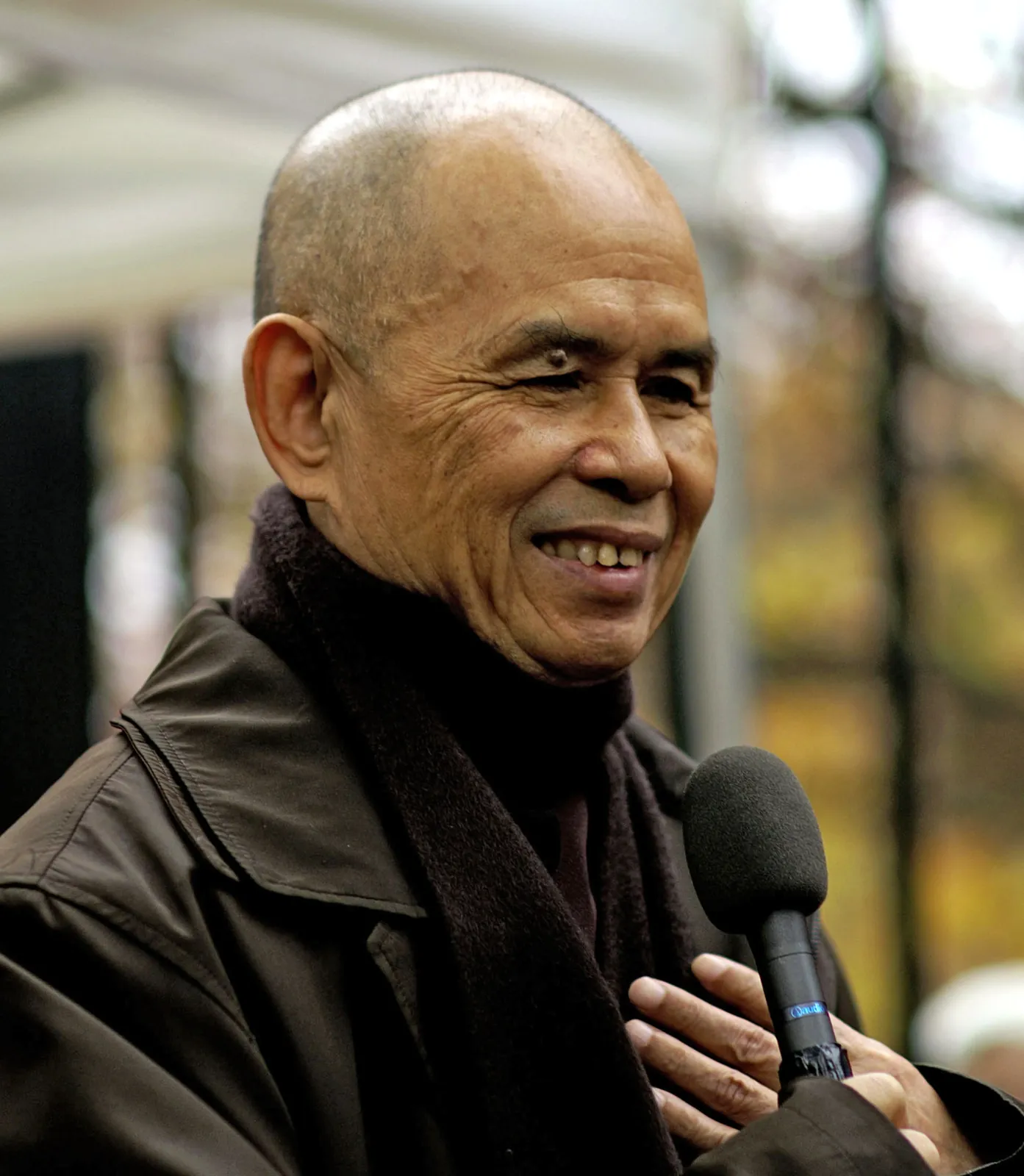
Going secular: from the hospital to the phone app
From the mid-1970s, meditation was lifted out of its religious setting. Herbert Benson, a Harvard cardiologist, measured the heart rate and breathing of people practising TM and drew from it a simple relaxation method that needed no religious belief. His book The Relaxation Response (1975) sold millions of copies.
In 1979, Jon Kabat-Zinn, a molecular biologist who had studied Zen with the Korean teacher Seung Sahn, opened a stress reduction clinic at the University of Massachusetts Medical Center. His eight-week course, later called MBSR (Mindfulness-Based Stress Reduction), became the model for countless mindfulness programmes; its first practice is the body scan.
Today mindfulness is taught in companies, schools and apps such as Headspace and Calm. What does the research say?
Ōmni Evidence Scale: Promising, for mindfulness meditation programmes and anxiety, low mood and pain. A review of 47 randomised trials found small to moderate effects, with no advantage over other active approaches such as exercise or therapy.
Psychedelics have also returned to the laboratory. In 2006, Roland Griffiths’ team at Johns Hopkins University published the first study since the 1970s to give psilocybin to people who had never used it. In 2019 the university opened a dedicated research centre. As of October 2026, psilocybin has still not been approved as a medicine by the US Food and Drug Administration (FDA).
The critics
The journey was not all light, and some of the sharpest voices came from inside. In 2013, Ronald Purser and David Loy’s “Beyond McMindfulness” argued that mass-market mindfulness had been cut from its ethical roots to sell it to companies; in his 2019 book McMindfulness, Purser added that a stress-management skill can help people endure their circumstances rather than change them. Supporters answer that the secular door still teaches many people to sit still for the first time, and some go on to find the roots.
There is also cultural appropriation: when an Asian tradition is repackaged, who speaks for it, and who benefits? And there is power: the stories of Trungpa and the Maharishi remind us that teachers are human, and communities should never turn anyone into a god.
Today: from John Lilly’s tank to float therapy
In 1954, the neuroscientist John C. Lilly built the first water isolation tank at the US National Institute of Mental Health (NIMH), to find out what the brain does when almost all outside stimulation is removed. A man of his era, fascinated by consciousness, he at times experimented with substances in the tank himself.
In 1972 Glenn Perry, who had attended a Lilly workshop, designed the first tanks for ordinary people. Modern float research is done only with fully sober participants.
From 1973, Lilly’s house in Malibu had as many as five tanks, and a stream of well-known guests came to try them. The Nobel Prize-winning physicist Richard Feynman wrote in his memoir Surely You’re Joking, Mr. Feynman! that he floated in a tank at Lilly’s house about a dozen times, for some two and a half hours each, in the mid-1970s. Lilly’s tank logs also record floats by the psychologist Stanislav Grof and his wife Christina, the researcher Ralph Metzner and the film director Alejandro Jodorowsky. In 1979, Glenn Perry opened the first commercial float centre, in Beverly Hills.
Today’s float therapy grew out of that tank. You lie on warm water at 33–34 °C, close to skin temperature, in a dark and quiet room, held up by dense, mineral-rich Epsom salt. Because the water carries you, the body lets go quickly, and for many beginners it is a first taste of the stillness long-time meditators describe.
Think of a float as an elevator that takes you up the first few levels of meditation, not a shortcut to enlightenment, and not a replacement for a daily practice. In our meditation hub you can start with simple guided practices, or try a float meditation for letting the body go.
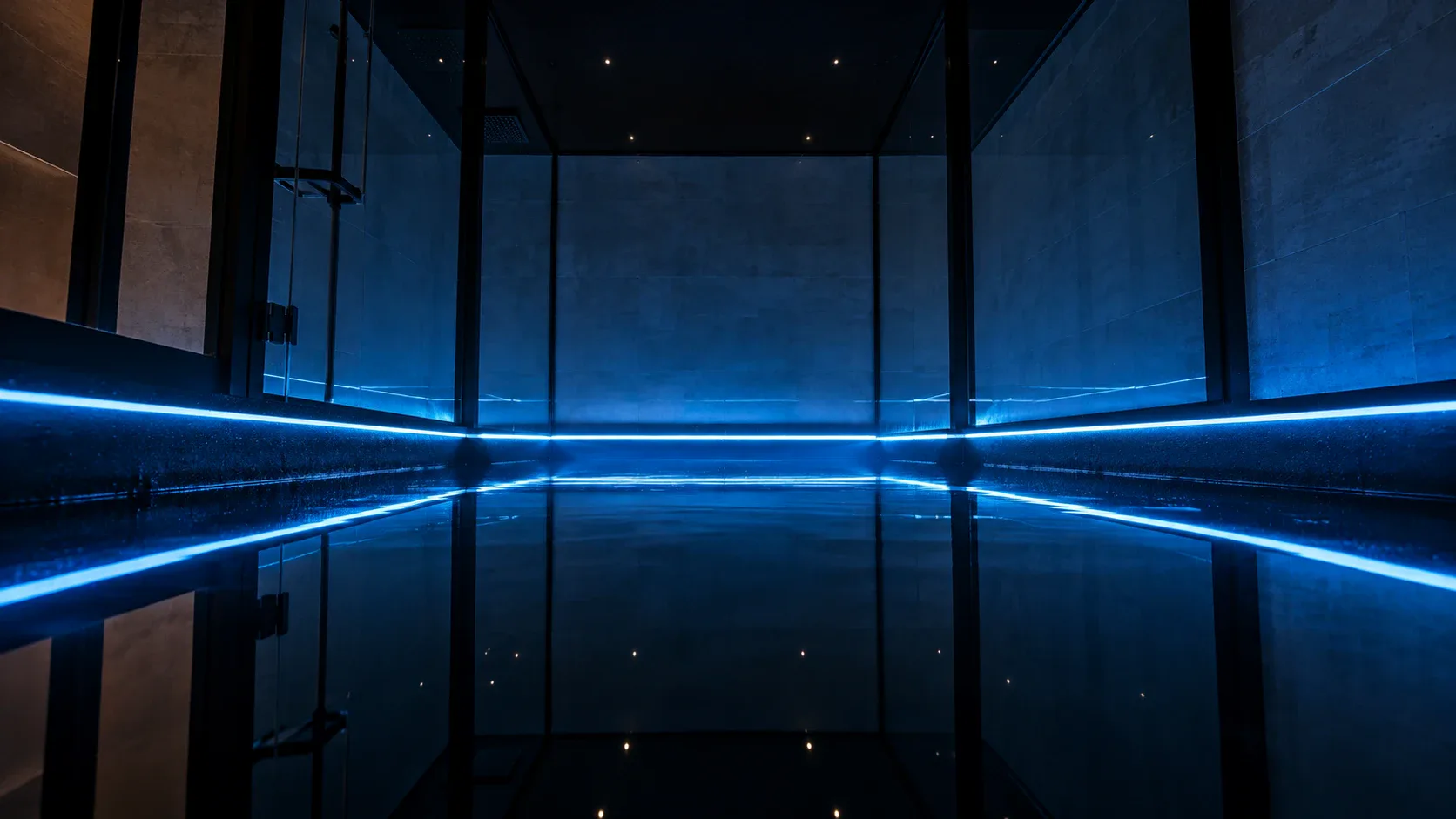
At Ōmni Space – Float Saigon, at 16C Quốc Hương in Thảo Điền, each private float room has about 25 cm of water and around 500 kg of Epsom salt. If you are curious how stillness feels when the body no longer has to hold itself up, you can book a float here.
Float PlanRunning on empty?Take the one-minute Float Plan quiz: tell us how you feel and what you need, and get a simple plan for your first session.Make my Float PlanFrequently asked questions
When did meditation come to the West?
The ideas arrived in the mid-nineteenth century through translated books. The moment most often cited is Swami Vivekananda’s speech in Chicago in 1893. The practice itself only spread widely from the 1950s and 1960s, with the Beat writers, the hippie movement and centres such as San Francisco Zen Center.
Where does mindfulness come from?
“Mindfulness” is the English translation of the Pāli word sati, a core idea in Buddhism. The secular form most people know today comes mainly from Jon Kabat-Zinn’s MBSR programme, started in 1979 at the University of Massachusetts, along with the influence of teachers such as Thích Nhất Hạnh and the vipassanā tradition.
What did the hippie movement have to do with meditation?
Young people in the 1960s counterculture turned to meditation, yoga and Buddhism as an alternative to war and consumerism. The Beatles’ trip to Rishikesh in 1968, together with places such as San Francisco Zen Center and Esalen, took meditation from a small circle to a much wider public.
How are psychedelics and meditation connected?
Historically, many Westerners, Ram Dass among them, tried psychedelics and then turned to meditation to reach unusual states of consciousness while fully sober, through their own practice. Science studies both today, but most psychedelics are banned in Vietnam, while meditation is a path that needs no substance at all.
Written by the team at Ōmni Space – Float Saigon in Thảo Điền, from the Vietnamese article on Float Vietnam. General information on history and culture, not medical advice; checked on 5 November 2026.
Sources
- Thoreau HD (1854). Walden. Project Gutenberg.
- Victorian Web. Helena Petrovna Blavatsky (Theosophical Society, 1875).
- Smithsonian National Museum of Asian Art. September 11, 1893.
- Hayes M (2025). D. T. Suzuki’s Columbia lectures. Tricycle.
- Tricycle. Jack Kerouac and Buddhism.
- Berkeley Historical Plaque Project. Alan Watts.
- San Francisco Zen Center. About Zen Center.
- The Paul McCartney Project. The Beatles in India (1968).
- Psychedelic Review. Ram Dass (Richard Alpert).
- Doblin R (1991). Pahnke’s “Good Friday Experiment”: a long-term follow-up and methodological critique. Journal of Transpersonal Psychology 23(1).
- An interview with Ram Dass (1988, Nature & Health; republished by Kahpi).
- Esalen Institute. About.
- Naropa University. Chögyam Trungpa Rinpoche, founder.
- Butler K (1990). Encountering the shadow in Buddhist America. Common Boundary; republished by Tricycle.
- Salzberg S. Metta Hour Ep. 148: Insight Meditation Society 45th anniversary.
- Vipassana Research Institute. Spread of Vipassana around the world.
- Plum Village. Thich Nhat Hanh biography.
- Tricycle (2022). Herbert Benson dies.
- Lion’s Roar. Jon Kabat-Zinn: the man who prescribes the medicine of the moment.
- Goyal M et al. (2014). Meditation programs for psychological stress and well-being: a systematic review and meta-analysis. JAMA Internal Medicine 174(3): 357–368.
- Johns Hopkins Center for Psychedelic and Consciousness Research. History.
- Tricycle (2013). David Loy takes on “McMindfulness”.
- Edwards M (2020). The road beyond McMindfulness. openDemocracy.
- Aeon. Climb in, float off, zone out (John Lilly, NIMH 1954, Glenn Perry 1972).
- Houghton Library, Harvard. John C. Lilly’s Malibu tanks (from 1973).
- Qualia Computing. Extracts from Lilly’s tank log in The Deep Self (1977): Grof, Metzner, Jodorowsky, Feynman.
- True REST. History of flotation (Glenn Perry, first commercial centre, Beverly Hills 1979).
- Feynman RP (1985). Surely You’re Joking, Mr. Feynman! W. W. Norton.
Leave a Reply