
In short: “Body lets go” is Floor 1 on our map of float meditation. Dense, mineral-rich Epsom salt water supports your whole body, giving your shoulders, jaw and back permission to finally stop working so hard, while thoughts still come and go in waves and gradually settle. Most first floats stop here, and that alone can be a very deep rest. At home, you can practise the same idea in five minutes: soften the body from head to toe and let each out-breath last a little longer than the in-breath.
Read in Vietnamese: Buông thân: tầng 1 của Thiền Nổi và cách thả lỏng cơ thể thật sự
You finally lie down after a long day in Saigon: a morning of calls, an afternoon in an over-cooled office, then a hot, noisy ride home. You tell yourself you are relaxed. And then you notice your shoulders are still slightly raised, your jaw is tighter than it needs to be, and your lower back has not quite landed. Maybe you have your first float booked and are wondering what will actually happen to your body once you lie on the water. This lesson looks at why true physical relaxation can be surprisingly hard to find on land, what happens on the first floor of a float, what the research says, and a 5-minute practice you can try in bed tonight.
Why is it so hard to truly relax your body?
All day long, some of your muscles are quietly working in the background. Your shoulders and neck help hold your head up. Your back keeps you upright in front of a screen. Your jaw may tighten a little each time you concentrate, read a message or sit in traffic.
When you lie down in bed, most of those muscles finally get a break. But not all of them. Your shoulders, hips and heels still press into the mattress, and gravity has not gone anywhere. So you can genuinely feel relaxed while your shoulders remain half raised and your jaw is still holding on.
Deep physical relaxation begins when the body has almost nothing left to hold. On an ordinary day in a busy city, that state is surprisingly rare. And that is exactly what Floor 1 is about.
Floor 1, “Body lets go”, on the map of float meditation
On our Meditation Hub, we imagine the mind as a tall building. Each floor represents a deeper level of stillness, and each floor contains a few “rooms”: experiences people often meet along the way. Sitting meditation is the stairs: you climb step by step under your own power. A float is the elevator: the water takes care of much of the physical work, and each session may stop at a different floor depending on the day.
Floor 1 is called Body lets go: the water holds you. Guests often describe three things:
- Body: the shoulders, jaw and back gradually soften.
- Mind: thoughts rise and fall, one wave at a time.
- Time: you still sense it quite clearly; you can usually guess how long you have been lying there, even if your guess is sometimes wrong.
Đức, Ōmni’s founder, describes the first minutes this way. The first ten minutes or so are mostly about getting used to being held by the water. Your body may drift gently to one side and then the other, and many people are surprised to discover their legs resting naturally at the surface. Then the body becomes still, and it can begin to feel as though you are suspended in mid-air. Some people also start hearing their own breathing or heartbeat with unusual clarity. If you are curious about that sensation, read what weightless feels like in a float.

The water does the hardest part
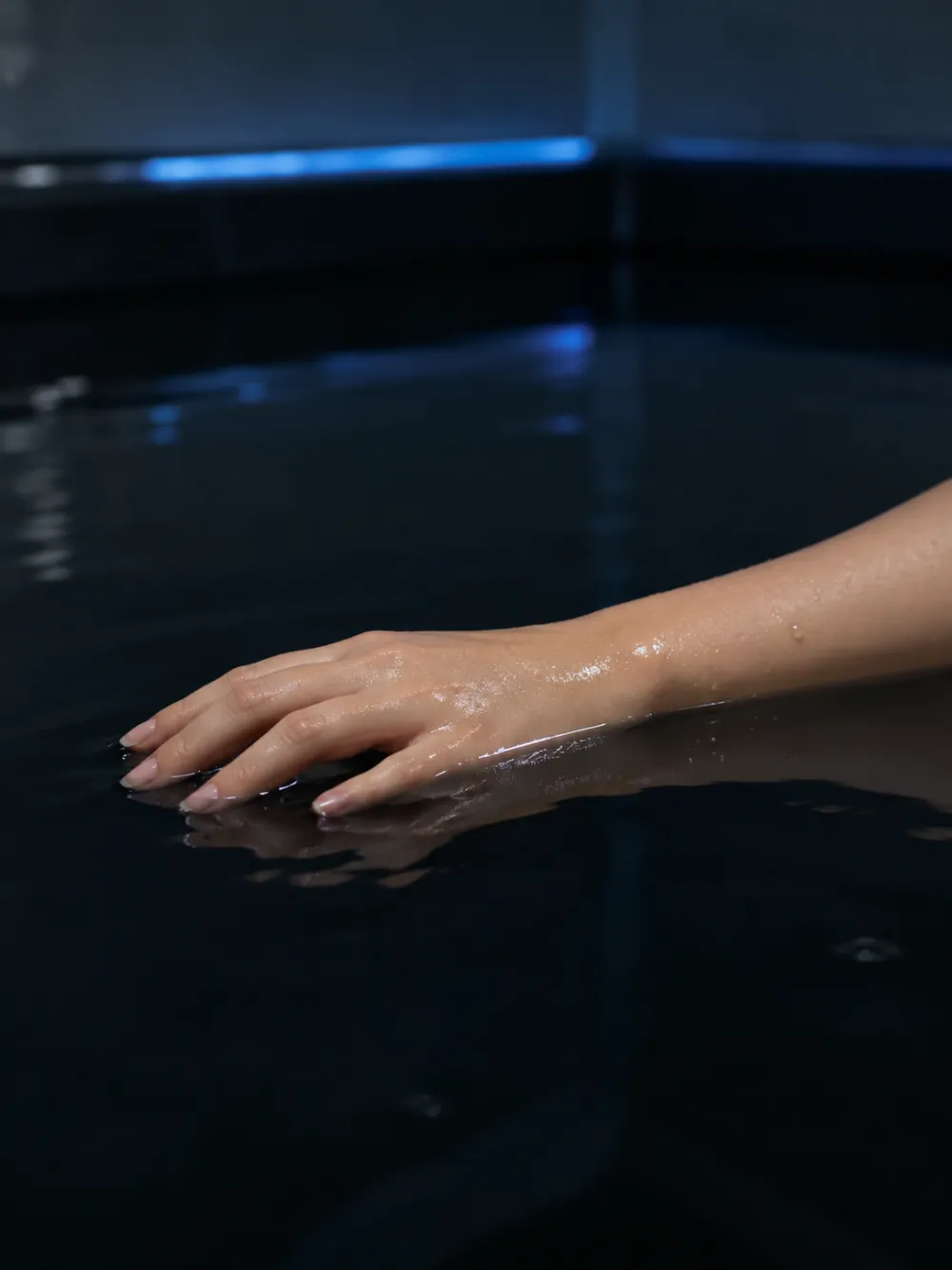
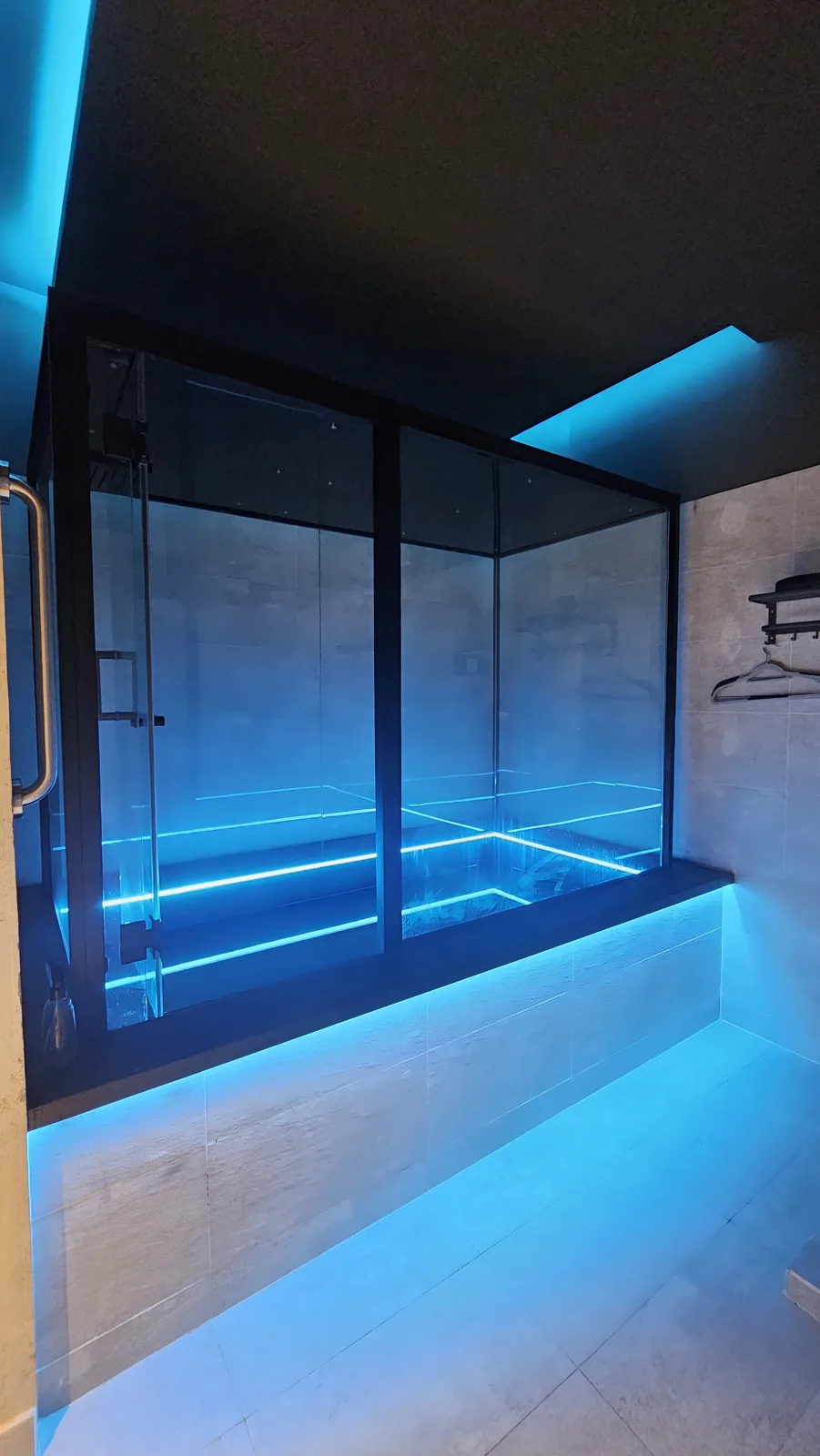
Each float pool at Ōmni Space holds about 500 kg of dense, mineral-rich Epsom salt dissolved in about 25 cm of water, kept at about 33–34 °C. The salt water supports your whole body, so almost no part of you needs to push back against gravity. There is no position to maintain, and you do not have to make yourself lie still.
People learning sitting meditation often spend a long time simply teaching the body to become still. In the natural-breath path taught at the Pa-Auk meditation centres in Myanmar, beginners are said to pass through three stages of leg pain, from sharp to bearable. In the water, you bypass much of that physical work: the body is already fully supported, so letting go can begin in your very first float.

Research points in a similar direction. In a randomised crossover study of 31 people with high anxiety sensitivity, a single 90-minute float clearly lowered anxiety and muscle tension compared with a control session, and people felt more serene afterwards. In a 2021 German trial of 99 people with chronic pain, pain dropped right after each float. To be fair, after 12–24 weeks the floating group was not clearly different from the control group. In a Swedish randomised pilot trial, 65 working adults who floated 12 times over seven weeks reported less stress and anxiety and better sleep than a waiting group.
Put simply: that light, loose feeling can appear right after a float, while making it something more familiar usually means coming back more than once. See how often should you float.
Ōmni Evidence Scale: Strong evidence, for float and stress. We rate it Strong because, on top of these trials, user experience is overwhelmingly positive: in a 2025 survey of regular floaters, 92% reported relaxation and 77% less stress, echoed by thousands of reviews, Reddit threads and forums, and by athletes and public figures who float. See how we rate evidence on the Ōmni Evidence Scale.
Ōmni Evidence Scale: Promising, for float and pain right after a session; Early evidence, for longer-lasting relief from chronic pain, which did not last to weeks 12–24 in the 2021 trial.
Thoughts come and go in waves
The body usually lets go first. The mind tends to follow later.
On Floor 1, thoughts still come. But instead of feeling like one endless stream, they often arrive more like waves: something from work appears, pulls a few lines of inner conversation behind it, then gradually fades. A small quiet gap opens. Then another wave rolls in.
Đức compares it to a sine wave. In a first float, the waves may sit so close together that it feels as if you “thought the whole time”. Look more closely, though, and there are small gaps between them. As floating becomes more familiar, those gaps can widen, and the quiet can become deeper and longer. When the waves go flat towards the end of a session, you have stepped onto Floor 2, “Quiet mind”.
You do not need to push thoughts away. Simply notice, “ah, thinking”, and let the thought pass like a wave. There is no need to judge whether you are thinking too much or too little.
Two rooms you may find on Floor 1
Heavy, then light. At some point, the body may feel as though it is sinking into an invisible mattress, so heavy that lifting a finger seems unnecessary. Then the heaviness can fade and the body becomes light as a feather. It is one way the moment of muscular letting go can feel from the inside.
An old feeling drifts back. A memory, or a feeling you have not thought about in years, may surface briefly and then leave again, like another wave. This room does not belong only to Floor 1; you can meet it on any floor. Let it come and go, breathe out slowly, and there is no need to explain it immediately. If you want to meet whatever appears with a little more warmth, the loving-kindness meditation lesson is a good companion.
Why your second float often feels different
A first float contains a lot that is new: earplugs, a neck pillow, darkness, and the unfamiliar feeling of being completely supported by water. So part of your attention is naturally still exploring the room and learning what this experience feels like. Before your visit, before your first float walks you through it.
From the second float, that settling-in period is usually shorter. The body seems to “recognise” the experience, so it can let go sooner and leave more of the session available for going deeper.
Đức says floating is more like exercise than a one-time experience: the more you do it, the more familiar it becomes, and some days you feel great while others you feel tired. The value is not only in one remarkable session, but in what stays with you afterwards and in returning regularly. Many people find it is somewhere between the second and fourth float that the body really learns how to let go.
A 5-minute practice: let your body let go
You can practise Floor 1 at home, either in bed or on the floor. Read this slowly, or ask someone to read it to you.
- Lie on your back, with a thin pillow under your head and another under your knees so your lower back feels supported.
- Breathe out longer than you breathe in: in for 4, out for 6, a few times.
- Soften from head to toe: forehead, eyes, jaw, tongue, shoulders, arms, hands, belly, back, hips, legs. At each place, breathe out once and allow it to soften a little more.
- When a thought comes, simply notice it, then return to the part of the body you were softening.
Lie on your back on your bed or a mat. Let a thin pillow support your head, and another one rest under your knees. Allow your arms to lie by your sides, palms facing up or down, whichever feels easier. Close your eyes. [pause 5 seconds]
Let’s begin with the breath. Breathe in through your nose for a count of four. Then breathe out slowly for a count of six. [pause 6 seconds]
Again. In for four. Out for six, letting the out-breath last a little longer than the in-breath. [pause 6 seconds]
One more time, in your own rhythm. Then allow the breath to return to normal. [pause 6 seconds]
Now we will move through the body, from the top of the head all the way down to the feet. At each place, breathe out once and let that part soften a little more. Nothing needs to be forced. [pause 5 seconds]
Your forehead. Let it become smooth and wide. [pause 6 seconds]
Your eyes. Let them rest heavily and easily in their sockets. [pause 6 seconds]
Your jaw. Let your teeth part slightly, while your lips rest gently together. Let your tongue lie soft in your mouth. [pause 10 seconds]
Your shoulders. Breathe out and let them drop away from your ears. Then see if they can drop just a little more. [pause 10 seconds]
Your arms. Upper arms, elbows, forearms. Let their weight be held for you. [pause 6 seconds]
Your hands. Let the fingers uncurl. Nothing to hold. [pause 6 seconds]
Your belly. Let it rise and fall by itself. There is no need to hold it in. [pause 10 seconds]
Your back. Feel the bed or the floor supporting it. Let the lower back settle into that support. [pause 10 seconds]
Your hips. Let them become wide and heavy. [pause 6 seconds]
Your legs. Thighs, knees, calves. Let their weight sink down. [pause 6 seconds]
Your feet. Let them fall gently outwards. [pause 6 seconds]
If a thought has appeared, that is fine. Notice it, “ah, thinking”, and let it pass like a wave. Then return to the body. [pause 5 seconds]
Now feel the whole body at once, from the top of your head to your feet. Heavy, supported, with nothing left to hold. Let the ground do the work. [pause 25 seconds]
Take a slightly deeper breath. Gently move your fingers and toes. [pause 8 seconds]
When you are ready, roll onto one side and slowly sit up. Notice how your body feels now.
Want a longer guided version? Try the 10-minute body scan, which invites you to notice each part of the body rather than soften it, or the NSDR (yoga nidra) reset for deep rest. To practise the long out-breath on its own, see our breathwork guide.
Practising at home is like taking the stairs; floating is like taking the elevator. The two can support each other: as your body becomes more familiar with letting go at home, it may also find its way there more easily in the water.
Where to start: try it at Ōmni in Thảo Điền
If you are in Saigon (Ho Chi Minh City), your first float will most likely stop on Floor 1, and that alone can already be a very deep rest. Ōmni’s suggestion, based on our guests’ experience rather than a study prescription: use the 5-minute practice above on evenings when your shoulders simply will not come down, and choose a float when you want to give your body a chance to have almost nothing left to hold.
- Where and when: Ōmni Space – Float Saigon, 16C Quốc Hương, Thảo Điền. Open 9:00–21:00 every day; the last float starts at 20:00.
- Prices: a single 60-minute float is 1,500,000 VND; the couple room is 2,200,000 VND per room for 60 minutes. Everything else is on the price page.
- In the room: you control the lights yourself, every guest gets earplugs, and a Halo neck pillow is available for a tense neck. Allow about 30 extra minutes for a short guide and showers.
- Booking: on the booking site. Visiting Saigon? See our visitors page. New to floating? Read what float therapy is.
Not ready to float yet? You can begin with the short practices on our Meditation Hub.
Safety notes
- Gentle for most people. Softening the body and breathing out slowly are safe for most people. If a practice makes you uneasy, open your eyes, move a little and stop.
- Pain. Let a painful spot be as it is; do not push into it. If pain increases, stop and follow your doctor’s advice.
- Not a replacement for care. Floating and relaxation practice do not replace treatment for pain, anxiety or insomnia, but they can support it alongside your doctor’s plan. Do not change or stop medication on your own.
- For floating: every guest fills in a health questionnaire, fully and honestly, at every visit.
If you feel overwhelmed or unsafe, call 115 for emergency help in Vietnam.
Float PlanRunning on empty?Take the one-minute Float Plan quiz: tell us how you feel and what you need, and get a simple plan for your first session.Make my Float PlanFAQ
What is Floor 1, “Body lets go”, in float meditation?
It is the first floor on our map of float meditation. The water supports the body, so the shoulders, jaw and back gradually let go, while thoughts still rise and fall in waves and slowly settle.
Can I really relax in my first float?
Yes. The water fully supports your body, so letting go can begin from the very first session. Your mind may still be busy; from the second float, the experience is usually more familiar and the body often settles sooner.
How can I relax my body at home?
Lie on your back, breathe out longer than you breathe in, and soften the body one part at a time from head to toe. The body scan and NSDR lessons on our Meditation Hub offer guided versions you can follow.
Is it a problem if I keep thinking during the float?
No. Thoughts arriving in waves are normal on Floor 1. Notice them and let them pass; with practice, the quiet gaps between the waves can gradually become longer.
How long does the relaxed feeling last?
Studies found that muscle tension and pain dropped clearly right after a float, but in the pain trial the relief did not last to weeks 12–24. That is one reason regular floating may matter more than judging the experience from a single try.
Written by the team at Ōmni Space – Float Saigon in Thảo Điền. General information, not medical advice; checked on 29 October 2026.
Sources
- Feinstein JS, Khalsa SS, Yeh H et al. (2018). The elicitation of relaxation and interoceptive awareness using floatation therapy in individuals with high anxiety sensitivity. Biological Psychiatry: Cognitive Neuroscience and Neuroimaging 3(6): 555–562.
- Loose LF, Manuel J, Karst M, Schmidt LK, Beissner F (2021). Flotation restricted environmental stimulation therapy for chronic pain: a randomized clinical trial. JAMA Network Open 4(5): e219627.
- Kjellgren A, Westman J (2014). Beneficial effects of treatment with sensory isolation in flotation-tank as a preventive health-care intervention: a randomized controlled pilot trial. BMC Complementary and Alternative Medicine 14: 417.
- Hilpert K, Chis Ster I (2025). Experiences and perceptions of regular floatation-REST users: results from an online survey. Journal of Clinical Images and Medical Case Reports 6(5): 3600.
- Float Vietnam (2026). Các tầng Thiền Nổi: the map of float meditation floors (in Vietnamese).
Leave a Reply