
In short: Mahāyāna (“Great Vehicle”) and Hīnayāna are two names that appear in Mahāyāna scriptures and treatises in India from around the beginning of the Common Era. A “vehicle” (yāna) is a carriage that takes people across from suffering; mahā means great, while hīna originally means “abandoned, inferior”. Because “Hīnayāna” was a label given by one side, with a dismissive tone, the surviving tradition of the early schools is today called Theravāda (or, in Vietnam, Nguyên thuỷ or Nam tông). Both share the Four Noble Truths, the Noble Eightfold Path, and ethics, concentration and wisdom; they differ in their scriptures, their ideal practitioner (the arhat or the bodhisattva) and how they explain emptiness.
Read in Vietnamese: Đại thừa và Tiểu thừa là gì? Giải nghĩa kỹ chữ “đại”, chữ “tiểu” và chữ “thừa”
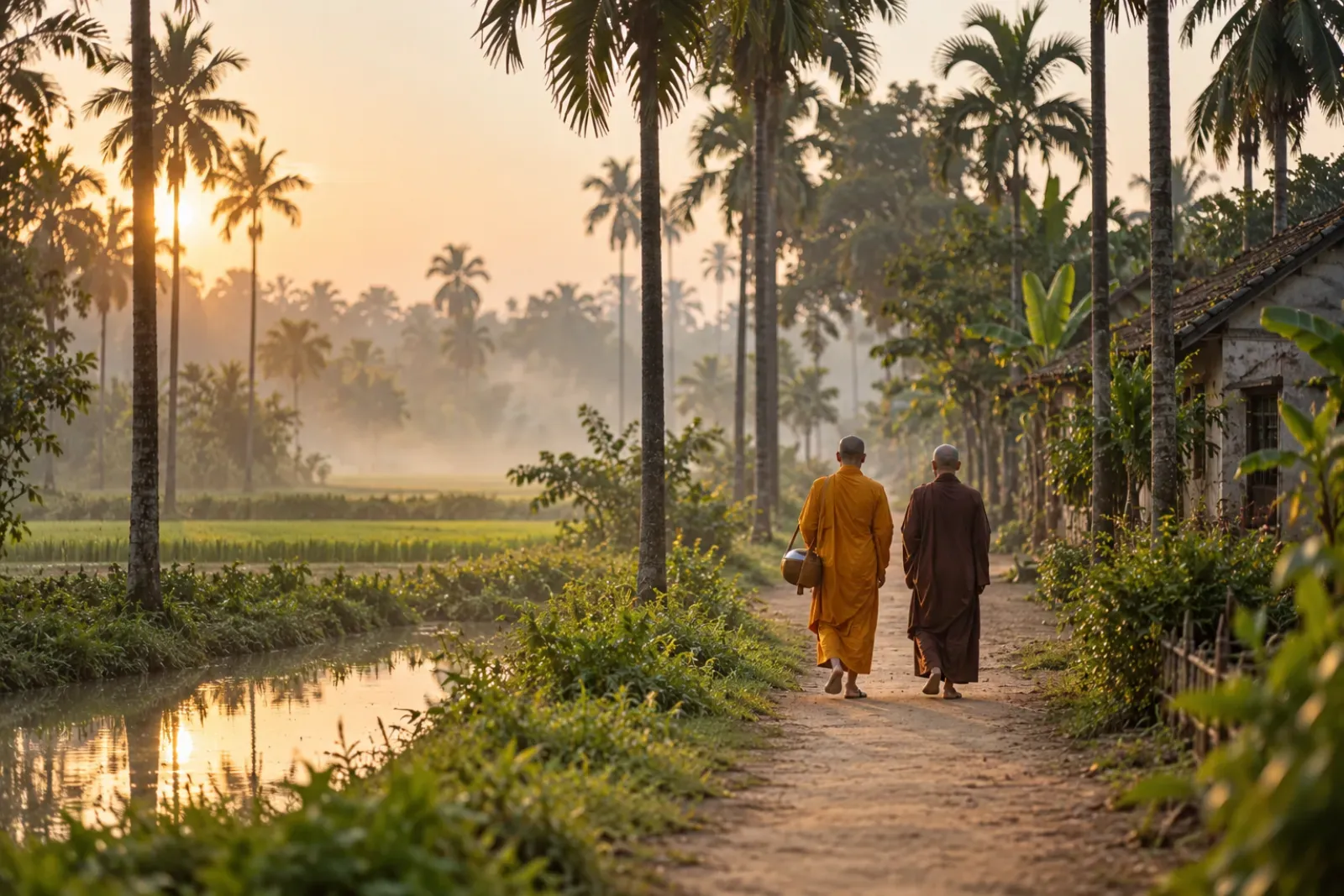
In Vietnam you will meet both worlds of Buddhism: Mahāyāna pagodas in Saigon and saffron-robed monks at Khmer Theravāda temples in the south. A guidebook may call one the “Greater” and the other the “Lesser” Vehicle, a shorthand with a sharper edge than most visitors realise. This guide unpacks the three key words, what scholars say, how the traditions compare, and how each practises the same breath meditation.
What does “vehicle” (yāna) mean? The three vehicles in the sūtras
“Vehicle” translates the Sanskrit yāna, a carriage or means of travel, from the verb yā, “to go”. The Buddha’s teaching is likened to a carriage that takes people from the shore of suffering to the shore of freedom. So “vehicle” is about a path and a destination, not about a church or institution.
Mahāyāna sūtras often speak of three vehicles. The vehicle of the hearers (śrāvakayāna) is the path of disciples who heard the Buddha teach the Four Noble Truths and became arhats. The vehicle of the solitary buddhas (pratyekabuddhayāna) is the path of those who awaken on their own by contemplating dependent origination, usually described as not going out to teach. The bodhisattva vehicle (bodhisattvayāna) is the path of those who vow to become a buddha in order to bring all beings across.
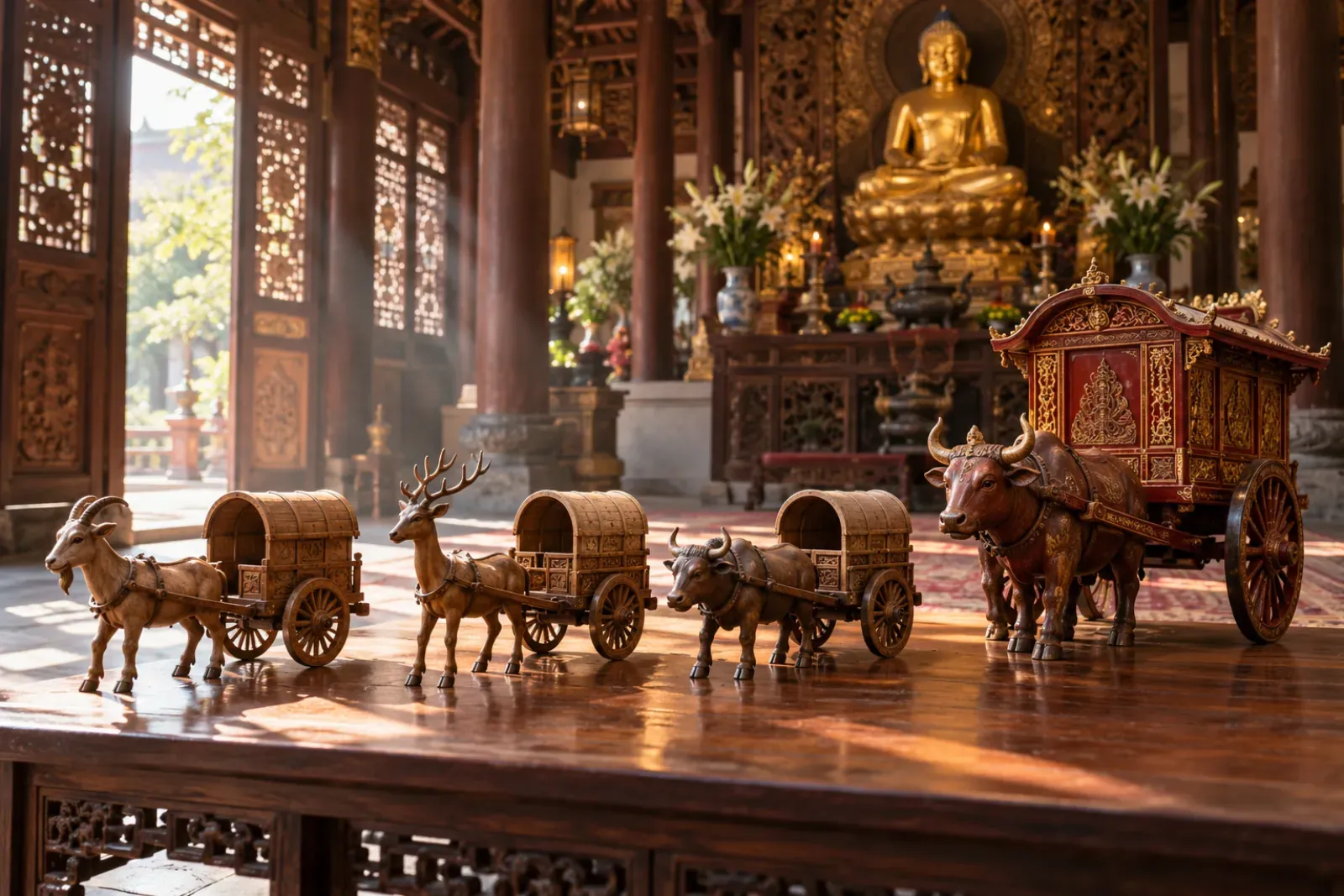
The best-known story of the three carts is in chapter 3 of the Lotus Sūtra, “Parable”. A rich man’s house is on fire, but his children, absorbed in play, will not come out. He promises goat carts, deer carts and ox carts outside the gate, and they rush out to safety. Then he gives each child the same great, richly adorned ox cart. The sūtra explains: the goat cart is the hearers’ vehicle, the deer cart the solitary buddhas’ vehicle, the ox cart the bodhisattva vehicle; and the great cart given to all is the One Vehicle, the single buddha vehicle. The three are skilful means (upāya, ways of guiding that suit each person) out of the burning house of suffering; the earlier chapter “Skilful Means” says there is only one buddha vehicle, no second or third.
So the smaller carts are steps to the same place, not discarded. In this very chapter, Śāriputra, an arhat, is told by the Buddha that he will one day become a buddha.
What does “great” (mahā) mean?
Mahā means great or vast. Mahāyāna’s greatness has two layers: a great destination (buddhahood, not only one’s own nirvāṇa) and a great carrying capacity (all beings). The word itself looks down on no one; it also names the Mahāsāṃghika, an early school that was not Mahāyāna.
What does hīna mean, and why does it sound so harsh?
“Hīnayāna” is often translated as “Lesser Vehicle” or “Small Vehicle”. But the original word hīna is much heavier. It is the past participle of the verb hā, “to leave”. Classic Sanskrit–English dictionaries such as Monier-Williams and Apte give its first meaning as left behind, abandoned; then deficient, lacking; then low, base, inferior.
The Pāli scriptures use the word in exactly this sense. In his first sermon, the Discourse on Turning the Wheel of the Dhamma (Saṃyutta Nikāya 56.11), the Buddha calls indulgence in sensual pleasure hīna: low, vulgar, the way of ordinary people. The Pāli texts also use the phrase “returning to the low life” (hīnāya āvattati) for a monk who disrobes.
So when Mahāyāna texts set hīna beside mahā, it is not a neutral contrast between “small” and “big”. It is closer to “the inferior vehicle”, “the vehicle left behind”. The scholar Donald S. Lopez Jr. calls Hīnayāna plainly a pejorative term, and notes that the schools given this name never called themselves that. The Chinese translation 小乘, “small vehicle”, softened the edge somewhat.
Vietnamese pagodas often explain Hīnayāna as a one-person cart for saving oneself, and Mahāyāna as the great cart for saving oneself and others. It is easy to remember, but it is a picture drawn from the Mahāyāna side, not how Theravāda describes its own path.
Who used the word Hīnayāna, and what do scholars say today?
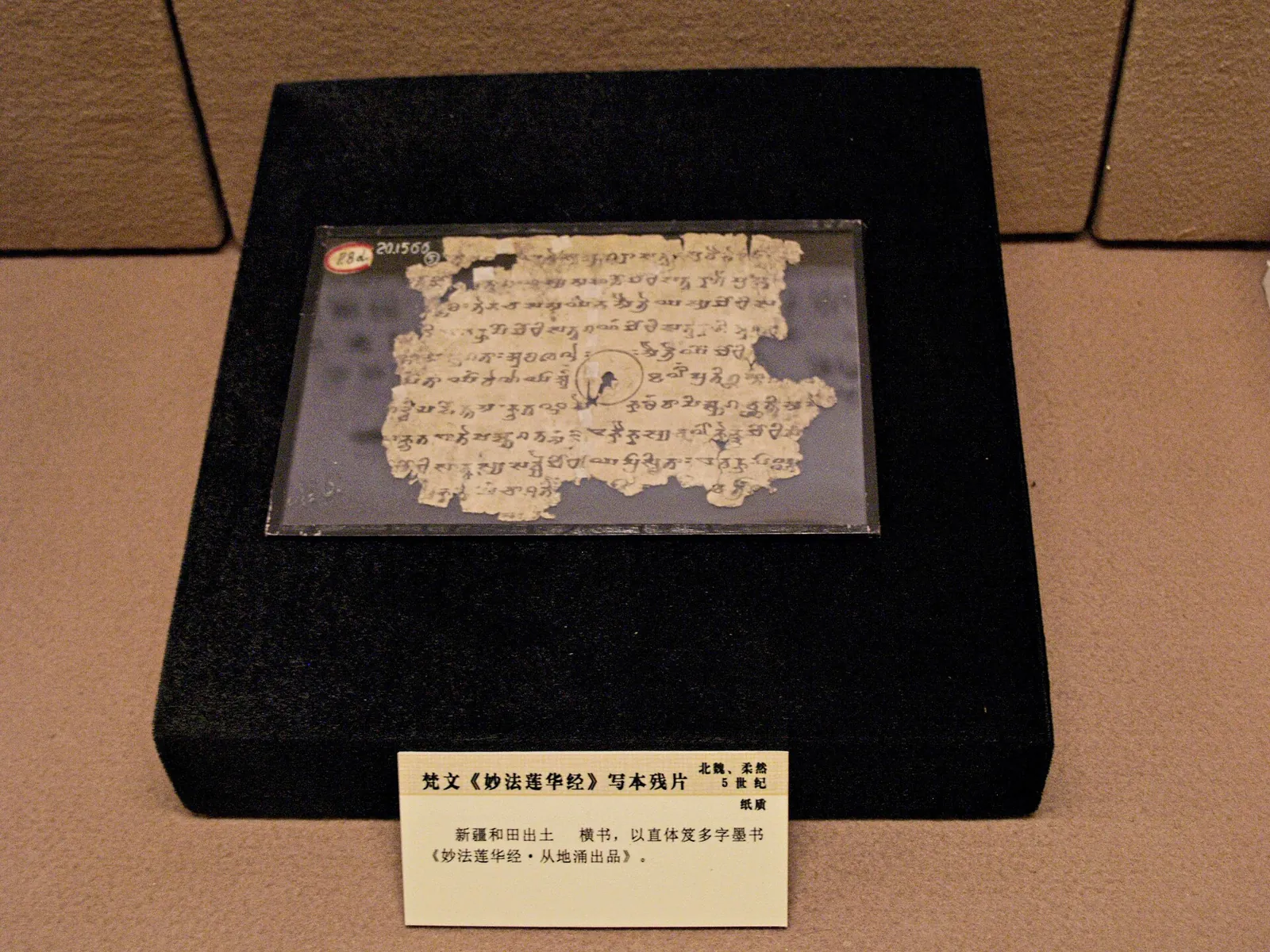
The term appears in, and was used by, Mahāyāna scriptures and treatises, not the texts of the schools it named. In Kumārajīva’s Chinese translation of the Lotus Sūtra (406 CE), a verse in the chapter “Skilful Means” says that if the Buddha used the small vehicle to save even one person, that would be stinginess. The Dazhidu lun (Treatise on the Great Perfection of Wisdom), traditionally attributed to Nāgārjuna (though scholars such as Étienne Lamotte doubt this), was also translated by Kumārajīva around 402–406 and uses the pair Mahāyāna–Hīnayāna quite often.
Modern scholarship reads these lines more carefully. Jonathan Silk, in “What, if Anything, is Mahāyāna Buddhism?” (Numen, 2002), argues that when “Hīnayāna” appears in the texts it never refers to a real, existing institution, but to an opponent in an argument, roughly “whoever the speaker disagrees with”. He cites the monk Yijing, writing in 691: those who worship bodhisattvas and read Mahāyāna sūtras are called Mahāyāna; those who do not are called Hīnayāna. From this, the scholar Takakusu observed that the same school could count as Mahāyāna in one place and Hīnayāna in another.
Jan Nattier, in A Few Good Men (2003), studied an early Mahāyāna sūtra, the Ugraparipṛcchā, and concluded that early Mahāyāna was a particular spiritual vocation pursued inside the existing monastic community: a demanding path for the few, not yet a separate church.
Today scholars usually replace Hīnayāna with more neutral names, such as Nikāya Buddhism (proposed by Professor Masatoshi Nagatomi at Harvard) or Mainstream Buddhism.
Why call it Theravāda?
Because it is the tradition’s own name, and fits the history better. Theravāda means “the teaching of the elders” (thera: elder; vāda: doctrine).
In Vietnam it is usually called Nguyên thuỷ (“original”) or Nam tông (“southern school”), because it spread south through Sri Lanka and Southeast Asia, while Mahāyāna is called Bắc tông (“northern school”), having spread north through Central Asia and China. It also avoids a common mix-up: Theravāda is not everything once called “Hīnayāna”.
The early schools: is Theravāda all of “Hīnayāna”?
No. Theravāda is the only survivor of roughly eighteen early schools in India.
According to tradition, about a hundred years after the Buddha’s passing, after the Second Council at Vesālī, the monastic community split into the Sthavira (the elders, who wanted to keep the old ways) and the Mahāsāṃghika (the “great community”). From these two roots many schools branched off, such as the Sarvāstivāda, Sautrāntika and Pudgalavāda. “Eighteen” is a convention; old sources list more.
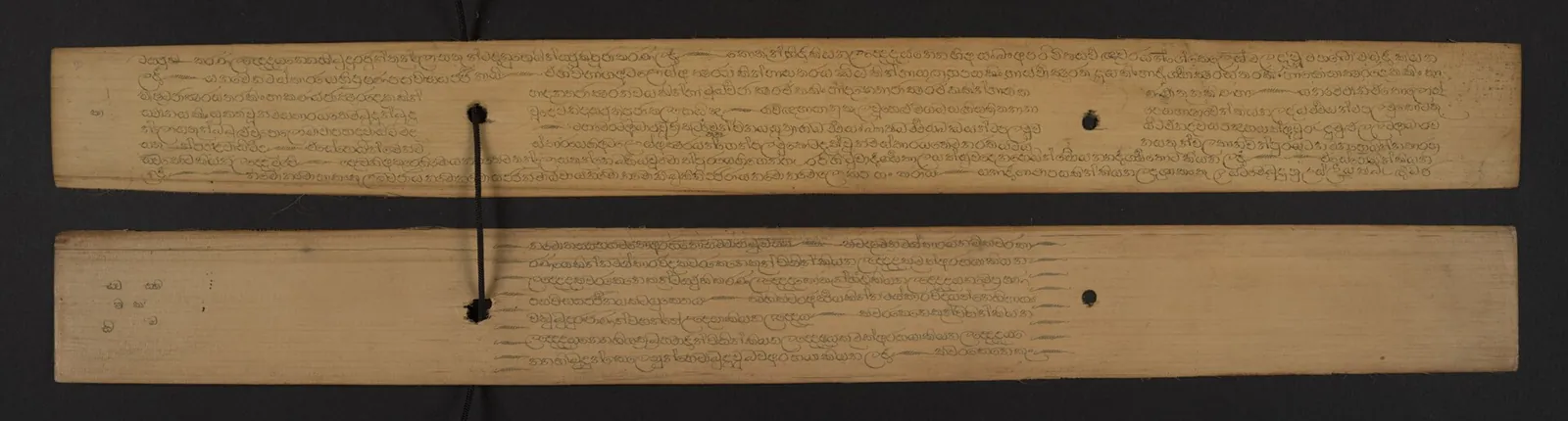
A branch of the Sthavira went with the elder Mahinda to Sri Lanka around the 3rd century BCE. The Pāli Canon was written down on palm leaves there around the 1st century BCE. This is the ancestor of Theravāda; the other schools gradually faded. These dates are estimates based on tradition.
How are Mahāyāna and Theravāda alike, and how do they differ?
Both rest on the Four Noble Truths, the Noble Eightfold Path, the three trainings of ethics, concentration and wisdom, and the teachings of impermanence, non-self and dependent origination, and both revere the historical Buddha, Śākyamuni.
| Theravāda (Nguyên thuỷ, Nam tông) | Mahāyāna (Đại thừa, Bắc tông) | |
|---|---|---|
| Shared ground | Four Noble Truths, Eightfold Path, ethics–concentration–wisdom | Four Noble Truths, Eightfold Path, ethics–concentration–wisdom |
| Main scriptures | Pāli Canon: the Nikāyas, Vinaya, Abhidhamma | Āgamas (parallel to the Nikāyas) plus the Perfection of Wisdom, Diamond, Lotus, Avataṃsaka, Vimalakīrti sūtras… |
| Scriptural languages | Pāli | Sanskrit, Chinese, Tibetan |
| Ideal practitioner | Arhat: one who has fully ended greed, hatred and delusion | Bodhisattva: one who vows to become a buddha to free all beings |
| On “emptiness” | Non-self of persons and phenomena | Emptiness (śūnyatā) of all phenomena, Madhyamaka philosophy |
| Where it is common | Sri Lanka, Myanmar, Thailand, Laos, Cambodia, Theravāda communities in Vietnam | China, Korea, Japan, Vietnam, Tibet, Mongolia |
Do not read the lines in this table too rigidly. Theravāda also knows the bodhisattva path: the Buddha himself was a bodhisattva in his past lives. And the Pāli Canon has discourses named after emptiness, such as the Lesser Discourse on Emptiness (Majjhima Nikāya 121).
How does each tradition meditate?
Theravāda teaches calm (samatha, letting the mind settle) and insight (vipassanā, seeing body and mind arise and pass away) side by side, through mindfulness of breathing, the four foundations of mindfulness and loving-kindness. East Asian Mahāyāna developed Chan/Zen, which points directly to the nature of mind through kōans, huatou (the “head of a phrase”) and “just sitting” (shikantaza), alongside the Pure Land practice of reciting the Buddha’s name.
The branch that uses mantras, mudrās and visualisation in Tibet has its own methods, and so does Buddhism in Vietnam, which is largely Mahāyāna alongside Khmer and Vietnamese Theravāda communities. Both get their own articles in this series; for the wider picture, see the history of meditation.
How to practise mindfulness of breathing in both traditions
Mindfulness of breathing (ānāpānasati) has been preserved almost intact by both traditions. Theravāda follows the Ānāpānasati Sutta (Majjhima Nikāya 118); Mahāyāna in Vietnam often follows the teaching of Plum Village. The technique is broadly the same; it differs mainly at the opening and the close. Beginners can practise 10–15 minutes a day.
- Find a quiet place and sit upright. The sutta describes a monk going to the forest, the root of a tree or an empty hut, sitting cross-legged with the body straight and mindfulness set up in front. At home, a quiet corner and a chair are enough.
- Mahāyāna adds an opening vow. Many pagodas begin by taking refuge in the Three Jewels and arousing the wish to practise for oneself and for others (bodhicitta). If you are not Buddhist, you can quietly set a kind intention.
- Know the long and short breath. Breathing in long, know you are breathing in long; breathing out short, know you are breathing out short. Do not control the breath, just know it. Plum Village teaches the silent words: “Breathing in, I know I am breathing in. Breathing out, I know I am breathing out.”
- Feel the whole body with each in-breath and out-breath.
- Calm the body. Breathing in and out, let the activity of the body settle. These four steps are the first of the sutta’s sixteen; stopping here is plenty for a beginner.
- Close. Theravāda sessions often end with a few minutes of spreading loving-kindness; Mahāyāna sessions often end by dedicating the merit of the practice to all beings. This part is sacred, not just a relaxation exercise.
Two common mistakes: trying to breathe “correctly”, which makes the breath forced, and scolding yourself every time the mind wanders. Wandering is normal. Notice it, then gently bring the mind back. For a guided start, see our breathwork guide.
Common misunderstandings
“Hīnayāna is selfish.” This comes from the image of a one-person cart. In the Pāli texts, the Buddha sends his first arhat disciples out to wander “for the welfare of the many”. Loving-kindness, compassion, sympathetic joy and equanimity are core Theravāda practices.
“Mahāyāna came later, so it isn’t the Buddha’s teaching.” Historians date Mahāyāna sūtras from around the start of the Common Era; the tradition holds they are the Buddha’s words, handed down in their own way. We record both views.
What can ordinary people learn from both traditions today?
After all the names and history, the two traditions meet at something simple: one breath known clearly, and a kind heart.
Some people find extra support for the body in floating. At Ōmni Space in Thảo Điền you lie in about 25 cm of water with around 500 kg of dense, mineral-rich Epsom salt, at 33–34 °C, close to skin temperature, in a dark, quiet private float room. Because the body is held, it can let go faster, and the mind has more room to follow the breath. Think of it as a lift to the levels of float meditation: not a shortcut to awakening, and no replacement for the path of ethics, concentration and wisdom that both traditions walk. To begin with the basics, visit our meditation hub.
Float PlanRunning on empty?Take the one-minute Float Plan quiz: tell us how you feel and what you need, and get a simple plan for your first session.Make my Float PlanFrequently asked questions
What does Hīnayāna mean?
Hīnayāna is the name Mahāyāna texts used for the path of the hearers and solitary buddhas, who aim for arhatship or solitary awakening. The Sanskrit hīna means left behind or inferior, so it is a dismissive label, not a name any school used for itself. The surviving tradition is properly called Theravāda.
What is Mahāyāna Buddhism?
Mahāyāna, the “Great Vehicle”, is the branch of Buddhism that took shape in India around the beginning of the Common Era, centred on the bodhisattva ideal, with additional scriptures such as the Perfection of Wisdom, Lotus and Avataṃsaka sūtras. Most Buddhism in Vietnam is Mahāyāna.
Is Theravāda the same as Hīnayāna?
Not really. Theravāda is the only survivor of around eighteen early schools, while “Hīnayāna” in Mahāyāna texts is a label used in argument, often for whoever the writer disagreed with.
Which is higher, Mahāyāna or Theravāda?
This article does not rank them. Each has its own scriptures and reasoning, and both rest on the Four Noble Truths, the Noble Eightfold Path, and ethics, concentration and wisdom.
Written by the team at Ōmni Space – Float Saigon in Thảo Điền. General information on history and culture; early dates are estimates based on tradition. Checked on 5 November 2026.
Sources
- Kubo T, Yuyama A (trans.) (2007). The Lotus Sutra (Taishō 262). BDK English Tripiṭaka, Numata Center.
- Lopez DS Jr. (1995). “The H Word”. Tricycle.
- Silk JA (2002). What, if Anything, is Mahāyāna Buddhism? Problems of Definitions and Classifications. Numen 49(4): 355–405.
- Nattier J (2003). A Few Good Men: The Bodhisattva Path according to The Inquiry of Ugra. University of Hawai’i Press.
- “Hīna”: definitions (Monier-Williams, Apte, PTS). Wisdom Library.
- Dhammacakkappavattana Sutta (Saṃyutta Nikāya 56.11). SuttaCentral.
- Ānāpānasati Sutta (Majjhima Nikāya 118). SuttaCentral.
- Cūḷasuññata Sutta (Majjhima Nikāya 121). SuttaCentral.
- “The First Four Exercises of Mindful Breathing”. Plum Village App.
- Ronkin N. “Abhidharma”. Stanford Encyclopedia of Philosophy.
- “Theravada Buddhism: A Chronology”. Access to Insight.
- “What is Theravada Buddhism?”. Tricycle.
- “What is Mahayana Buddhism?”. Tricycle.
- Herrick MN. “The Lotus Sutra’s Burning House”. Tricycle.