
In short: Yes, a float can help golfers recover. Golf’s rotating swing loads the lower back, and Saigon’s heat adds to the strain. In trials, pain dropped right after each float, and stress fell clearly. In Ho Chi Minh City (Saigon), float in the afternoon after a morning round, or on the rest day between rounds.
A 6 a.m. tee time, the first drive drawing a line across the morning sky, and by the back nine the sun sits on your shoulders. By the third round in three days, your lower back starts to speak up. Here is what 18 holes in Saigon heat really ask of your body, and how to give your back and mind a full reset between rounds, so the next tee time feels as light as the first.

What 18 holes ask of your back, and the rest of you
- The lower back takes the most. A 2014 review found that low back problems make up 18% to 54% of golf injuries across studies, so many researchers call low back pain the most common golf injury. It blames the forceful, one-sided swing and playing or practising too much.
- The swing is a big load. In an early lab study cited in that review, eight golfers swinging a five-iron loaded the lower spine with about eight times body weight, against about three times for running. These are estimates from a small group, but they show why the back keeps the score.
- Elbows, shoulders and wrists too. In a one-year study of 588 Australian amateurs, the lower back was hurt most (18.3% of injuries), then the elbow and forearm (17.2%), foot and ankle (12.9%) and shoulder (11.8%). Most injuries built up over time, and playing more raised the risk.
- Over half of golfers get hurt at some point. A 2024 review of 20 studies and 9,221 golfers found a lifetime injury rate of 56.6% in amateurs and 73.5% in professionals. Two studies saw more injuries in amateurs playing more than three or four rounds a week.
- It is also a long walk. Walking 18 holes took about 12,000 steps in a Mayo Clinic study, and about 17,000 for young competitive golfers walking with a caddie in a 2025 trial (about 6,300 when riding a cart).
Add a long flight, hotel beds and two to four rounds in a few days, and fatigue stacks up: the back that felt fine on day one is tight by day three.
Golf in Saigon heat: early tee times, water and shade
Most golfers here tee off early to beat the midday sun, and for good reason. A sports-science consensus says heat adds strain and lowers endurance; it advises adapting over one to two weeks, starting well hydrated and limiting fluid loss. Even at a cool 19 °C, the 2025 golf trial found core temperature ran higher when players walked.
- Start hydrated. The American College of Sports Medicine advises drinking in the hours before activity and losing no more than about 2% of body weight. Weigh yourself before and after a round to see how much you sweat.
- Replace what you lost. After the round, drink and eat to make up the deficit, with some salt or electrolytes after a sweaty day.
- Flying in from a cooler country? Your body has not adapted yet. Use a cart and the shade, and skip the extra nine.
- Know the warning signs. Dizziness, confusion or nausea in the heat need medical care, not a float. Our Saigon heat guide explains humidity and heat illness.
Well-known courses in and around the city include Tân Sơn Nhất Golf Course, Vietnam Golf & Country Club and Long Thành Golf in neighbouring Đồng Nai. Check tee times and conditions directly with each club.
What the float research says for golfers
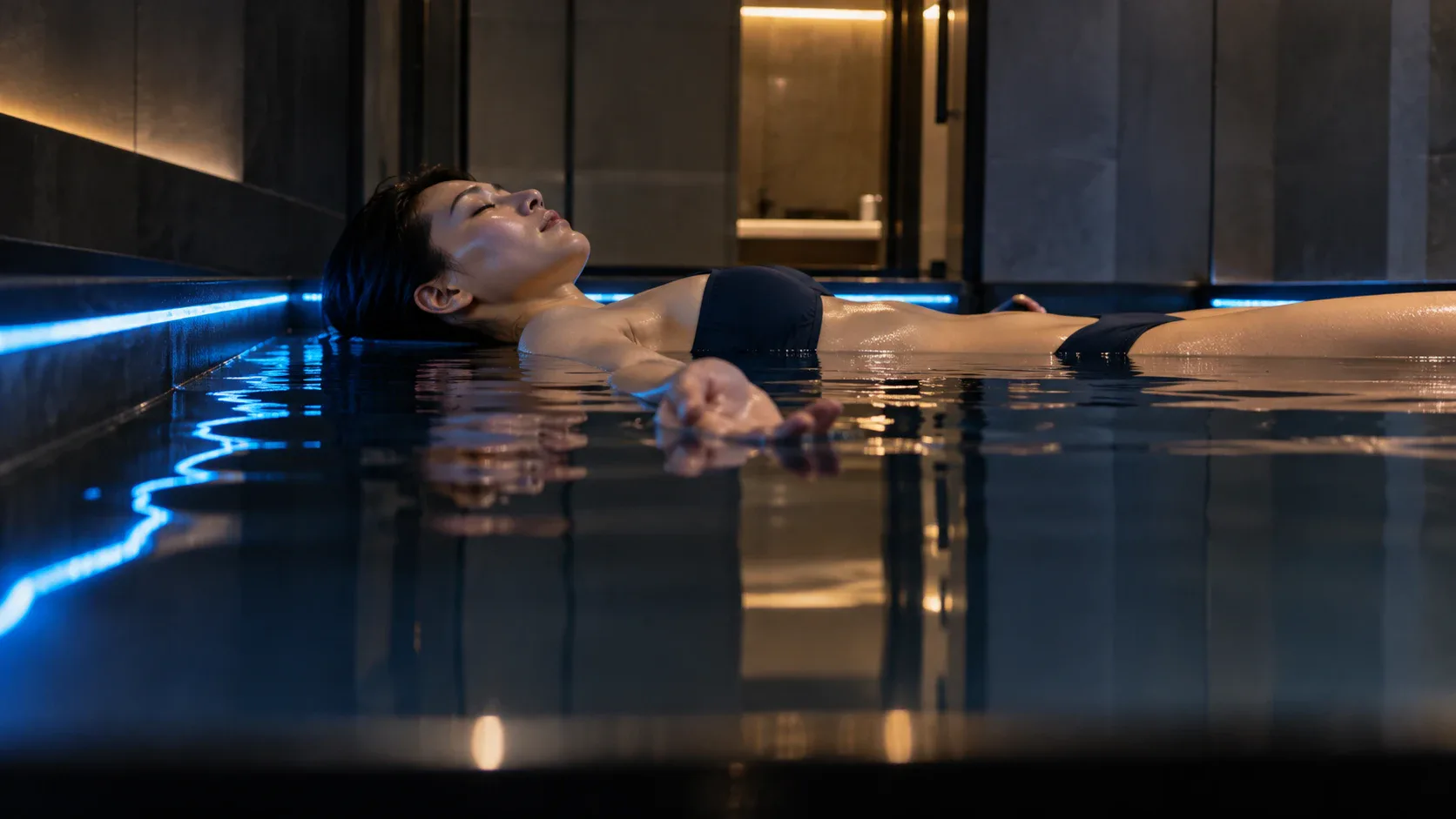
A float means lying on your back in about 25 cm of water with around 500 kg of dense, mineral-rich Epsom salt, warmed to 33–34 °C, close to skin temperature. The spine no longer carries your head and body, and the private room can be fully dark and quiet.
Back pain and stiffness. The largest trial, from Germany in 2021 with 99 people living with chronic pain, found something every golfer will like: pain dropped clearly right after each float session. You walk out with a lighter back the same afternoon, with no need to wait weeks. That relief had not lasted to week 12 or 24, so floating regularly, when your body asks for it, is how you keep it. Swedish trials agree: nine floats over three weeks eased the worst neck and back muscle-tension pain, and 12 sessions worked as well as 33. Our back and neck pain guide has the details.
Stress and the mind. In a Swedish randomised trial, 65 working adults who floated 12 times in seven weeks reported less stress, anxiety and pain, and better sleep, than a waiting group. In a 2018 study from the Laureate Institute for Brain Research, 50 people with anxiety or stress-related conditions felt clearly less anxious after a single one-hour float (a promising result, though that study had no comparison group).
Precision and skill. We could not find any study of floating in golfers. The closest are small studies in precision sports. Twenty archers who floated for 45 minutes before shooting felt less effort, and the elite archers shot more consistently, a marginal gain according to one reviewer. Tennis players who floated while listening to a mental imagery recording served more accurately in matches than players who used the imagery alone. Basketball players who did the same in a float were rated higher by their coaches, though very few were measured at the end.
So, can a float help your golf? Yes, it can likely support it. The water takes the weight off every vertebra and lets the muscles that power your swing finally let go. A quiet, dark hour calms a nervous system switched on since the first tee. And it is an ideal space to replay your best swing or rehearse your putting routine, the kind of mental rehearsal the tennis and basketball studies used. Many guests walk out looser and with a clearer head.
Float therapy is a young but very active research field: randomised controlled trials have shown clear effects on anxiety, stress, muscle tension and sleep, and new clinical studies are still under way.
Ōmni Evidence Scale: Strong evidence, for float and stress. We rate it Strong because, on top of these trials, user experience is overwhelmingly positive: in a 2025 survey of regular floaters, 92% reported relaxation and 77% less stress, echoed by thousands of reviews, Reddit threads and forums, and by athletes and public figures who float. See how we rate evidence on the Ōmni Evidence Scale.
Ōmni Evidence Scale: Promising, for float and stress-related muscle pain in the short term. Small trials saw pain ease right after floating, but the relief did not last months without more sessions.
Ōmni Evidence Scale: Early evidence, for float and performance or skill in precision sports. Archery, tennis and basketball gains come from single small studies, and none tested golf.
How a float fits a golf trip in Saigon and Ho Chi Minh City
This table is Ōmni’s suggestion, from the research above and our guests’ experience, not a study prescription.
| When | Float | Around it |
|---|---|---|
| Arrival day | 60–90 minutes in the afternoon or evening, to loosen a back stiff from the flight | Drink water, eat lightly, early night before the first tee time |
| After a morning round | An afternoon float, after lunch and plenty of fluids | Shower off sunscreen first; wait if you are sunburnt or have raw blisters |
| Rest day between rounds | 90 minutes, with a short infrared sauna before if you like | Easy walk, gentle stretching, no extra range session |
| Last day before the flight | Float, then a long shower before you leave | Allow about 60–90 minutes by Grab to the airport; see our late-night flight guide |
The weekly golfer at home in Saigon. Weekend golf and a weekday desk? Start with a few floats close together, then come every two to four weeks, or after your heaviest golf weekends; see how often should you float. More in our athlete recovery guide and float therapy vs chiropractic.
Sauna and cold plunge after a round
- Cold for sore legs and back. We rate cold plunge for muscle soreness as Promising; see our ice bath guide.
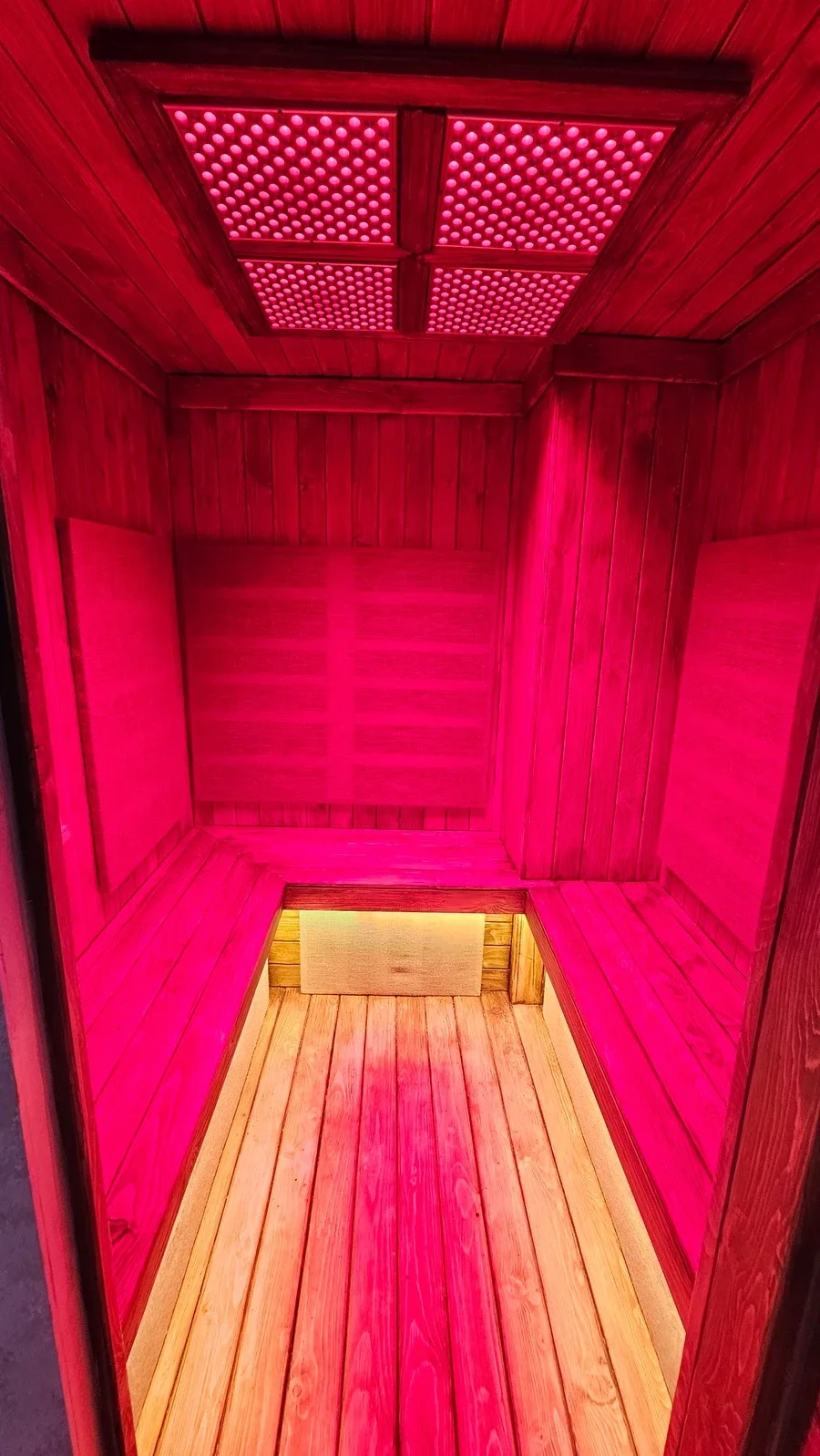
- Heat to loosen up. An infrared sauna warms tight muscles. After a day in the Saigon sun, keep it short, drink before and after, and step out if you feel light-headed.
- What order? No study has tested the best order. Many guests use the sauna first, then float to wind down. See our contrast therapy guide.
See the infrared sauna and cold plunge pages.
Safety: when to see a doctor first
A float is deep rest, not medical treatment. See a doctor first if you have:
- a sudden, acute back injury on the course, or pain after a fall;
- numbness, tingling or weakness in your arms or legs;
- changes in your bladder or bowels, or numbness around your genitals or bottom (this is an emergency: call 115 in Vietnam);
- fever, or weight loss you cannot explain;
- pain that is worse at night, or not getting better after about six weeks.
Also:
- Skin: fresh cuts, blisters from the grip and sunburn will sting in the salt. Wait until they settle.
- The 19th hole: do not float after drinking. Come back the next day.
- Health questionnaire: every guest fills one in, fully and honestly, at every visit.
Where to try it in Saigon: groups, booking and prices
Ōmni Space – Float Saigon is at 16C Quốc Hương, Thảo Điền. We are open 9:00–21:00 every day, and the last float starts at 20:00. Every guest gets earplugs, and a Halo neck pillow is there for a tight neck.
- Golf groups: we can host up to five people at the same time (three single float rooms and one couple room). For larger golf groups, we arrange times with you.
- Language: our staff speak English, and printed guides are available in several languages.
- Booking: on the booking site, by Zalo or by Messenger. Visiting? See our visitors page.
- Payment: card, bank transfer or cash.
- Luggage: we can store up to four suitcases on your last day.
- Prices: a single 60-minute float is 1,500,000 VND; the couple room is 2,200,000 VND per room for 60 minutes. Everything else is on the price page.
Allow about 30 extra minutes for a short guide and showers. New to floating? Read what float therapy is and before your first float.
Visiting Vietnam? See how a float fits your trip →
FAQ
Is float therapy good for golfers’ lower back pain?
It can help. In a 2021 trial, pain dropped right after each float, and earlier trials eased muscle-tension pain in the back. Float regularly to keep the relief. For an acute injury or leg numbness, see a doctor first.
When should I float on a golf trip?
The afternoon after a morning round, the rest day between rounds, or the last day before your flight. Eat and drink first.
Can floating improve my golf game?
It can likely support it. No study has tested golfers, but small studies in archery, tennis and basketball found steadier or more accurate play, and floating gives you a weightless spine, a calmer nervous system and a quiet space to rehearse your swing.
Can our golf group float together?
Up to five people can float at once (three single rooms and one couple room). For bigger groups, we arrange times with you.
How much does a float cost in Ho Chi Minh City?
A single 60-minute float is 1,500,000 VND. The couple room is 2,200,000 VND per room for 60 minutes. Other options are on our price page.
Written by the team at Ōmni Space – Float Saigon in Thảo Điền. General information, not medical advice; checked on 20 October 2026.
Sources
- Williamson TR, Kay RS, Robinson PG, Murray AD, Clement ND (2024). Epidemiology of musculoskeletal injury in professional and amateur golfers: a systematic review and meta-analysis. British Journal of Sports Medicine 58(11): 606–614.
- McHardy A, Pollard H, Luo K (2007). One-year follow-up study on golf injuries in Australian amateur golfers. American Journal of Sports Medicine 35(8): 1354–1360.
- Lindsay DM, Vandervoort AA (2014). Golf-related low back pain: a review of causative factors and prevention strategies. Asian Journal of Sports Medicine 5(4): e24289.
- Kobriger SL, Smith J, Hollman JH, Smith AM (2006). The contribution of golf to daily physical activity recommendations: how many steps does it take to complete a round of golf? Mayo Clinic Proceedings 81(8): 1041–1043.
- O’Donnell A et al. (2025). Riding a golf cart versus walking: a study on the physiological and performance differences in tournament golf. European Journal of Sport Science 26(1): e70099.
- Racinais S et al. (2015). Consensus recommendations on training and competing in the heat. British Journal of Sports Medicine 49(18): 1164–1173.
- American College of Sports Medicine; Sawka MN et al. (2007). Exercise and fluid replacement (position stand). Medicine & Science in Sports & Exercise 39(2): 377–390.
- Loose LF, Manuel J, Karst M, Schmidt LK, Beissner F (2021). Flotation restricted environmental stimulation therapy for chronic pain: a randomized clinical trial. JAMA Network Open 4(5): e219627.
- Kjellgren A, Sundequist U, Norlander T, Archer T (2001). Effects of flotation-REST on muscle tension pain. Pain Research and Management 6(4): 181–189.
- Bood SÅ et al. (2007). Effects of flotation REST on stress related muscle pain: are 33 flotation sessions more effective than 12 sessions? Social Behavior and Personality 35(2): 143–156.
- Kjellgren A, Westman J (2014). Beneficial effects of treatment with sensory isolation in flotation-tank as a preventive health-care intervention: a randomized controlled pilot trial. BMC Complementary and Alternative Medicine 14: 417.
- Feinstein JS et al. (2018). Examining the short-term anxiolytic and antidepressant effect of Floatation-REST. PLoS One 13(2): e0190292.
- Norlander T, Bergman H, Archer T (1999). Primary process in competitive archery performance: effects of flotation REST. Journal of Applied Sport Psychology 11(2): 194–209.
- Coaching Science Abstracts (San Diego State University). Flotation-REST has marginal benefits for archers.
- McAleney PJ, Barabasz A, Barabasz M (1990). Effects of flotation restricted environmental stimulation on intercollegiate tennis performance. Perceptual and Motor Skills 71(3): 1023–1028.
- Wagaman JD, Barabasz AF, Barabasz M (1991). Flotation REST and imagery in the improvement of collegiate basketball performance. Perceptual and Motor Skills 72(1): 119–122.
- Hilpert K, Chis Ster I (2025). Experiences and perceptions of regular floatation-REST users: results from an online survey. Journal of Clinical Images and Medical Case Reports 6(5): 3600.
Leave a Reply