
In short: You cannot sink in the Dead Sea because its water contains about 340 grams of dissolved salt in every litre, roughly ten times more than the ocean, making it about a quarter denser than fresh water. Your body simply rides higher. People have travelled there for health for a long time, and a systematic review found the strongest evidence for psoriasis, where the region’s filtered sunlight appears to matter just as much as the water. The real danger is not sinking, but swallowing or inhaling that brine. Few other places let you float quite like this; a float room, filled with dense, mineral-rich Epsom salt water in a dark, quiet space, is probably the closest version you can book for an hour. We run a float centre, so we are not neutral.
Part of the Ōmni Recovery Library · Recovery by Water
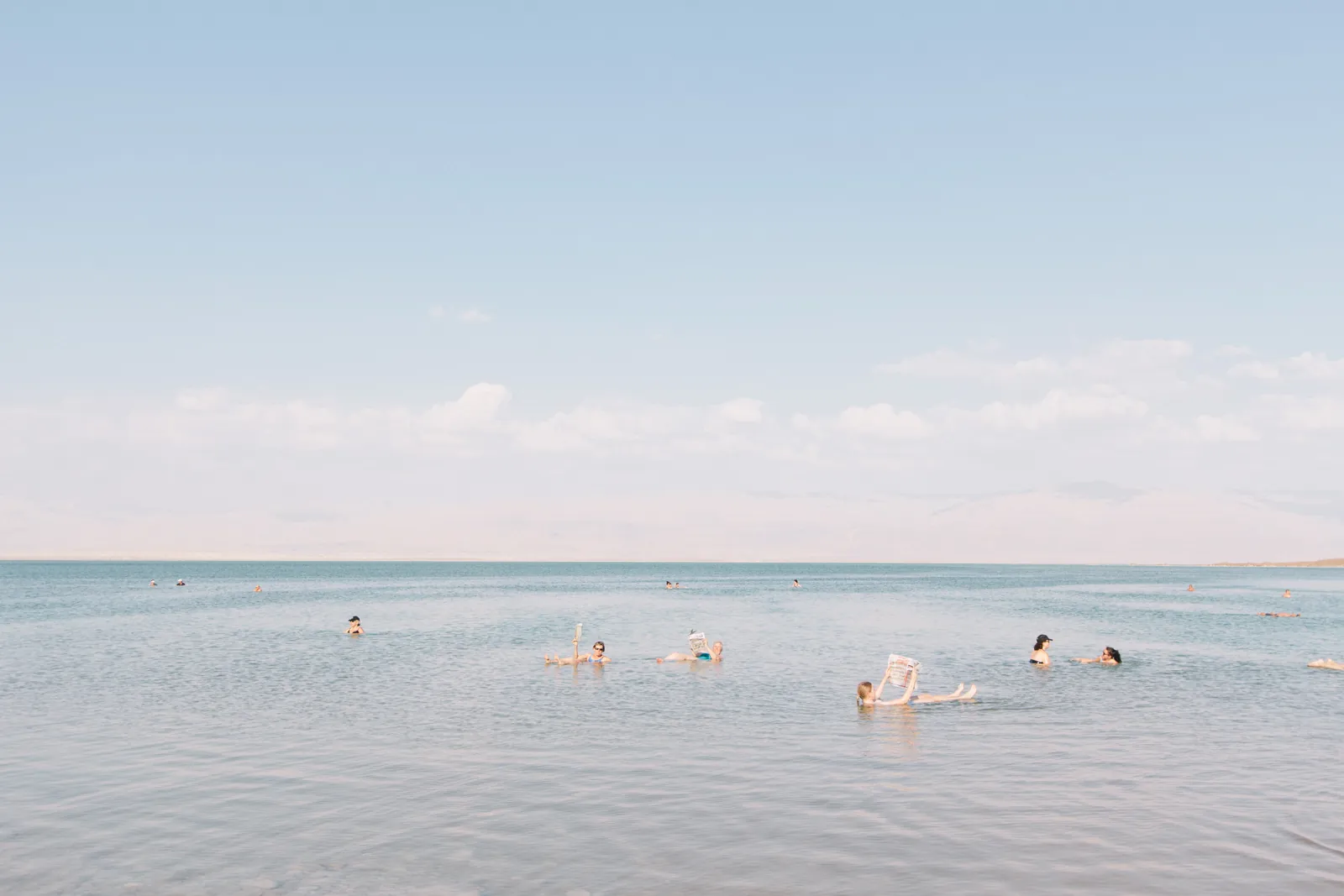
You have probably seen the photo: someone lying back on the Dead Sea, reading a newspaper as if the water were a sofa. Maybe it is on your travel list, or maybe you have simply wondered how a sea can seem to refuse to let you go under. This article explains the simple physics behind it, what research actually says about the famous Dead Sea health trips, the one risk worth knowing about, and where else you can experience that same effortless lift, including an hour in a float room in Saigon.
Ōmni Evidence Scale: Promising, for Dead Sea treatment of psoriasis (a systematic review of mostly small studies, where sun and water work together). Early evidence, for thalassotherapy, the wider family of sea-based treatments. Strong evidence, for float and stress. See how we rate evidence on the Ōmni Evidence Scale.
Why can’t you sink in the Dead Sea?
Whether something floats comes down to one simple comparison: is it denser than the liquid around it? Most people are only slightly less dense than fresh water, which is why, in a normal pool, your body sits fairly low and your legs tend to drift downward. Now dissolve a huge amount of salt into that water. The same volume of water becomes heavier, so it pushes upward more strongly on whatever is resting in it.
The Dead Sea takes this to an extreme. In a 2018 study of its brine, researchers from Jordan and Germany measured about 340 grams of dissolved salts per litre and a density of 1.241 kg per litre. The open ocean holds roughly 35 grams per litre. So the Dead Sea is about ten times saltier than the sea you know, and about a quarter denser than fresh water. A body that only just floats in a pool suddenly sits remarkably high: your hips, knees and even your toes can break the surface, and sitting upright as though there were an invisible chair underneath you becomes possible.
Not the same salt as a float room
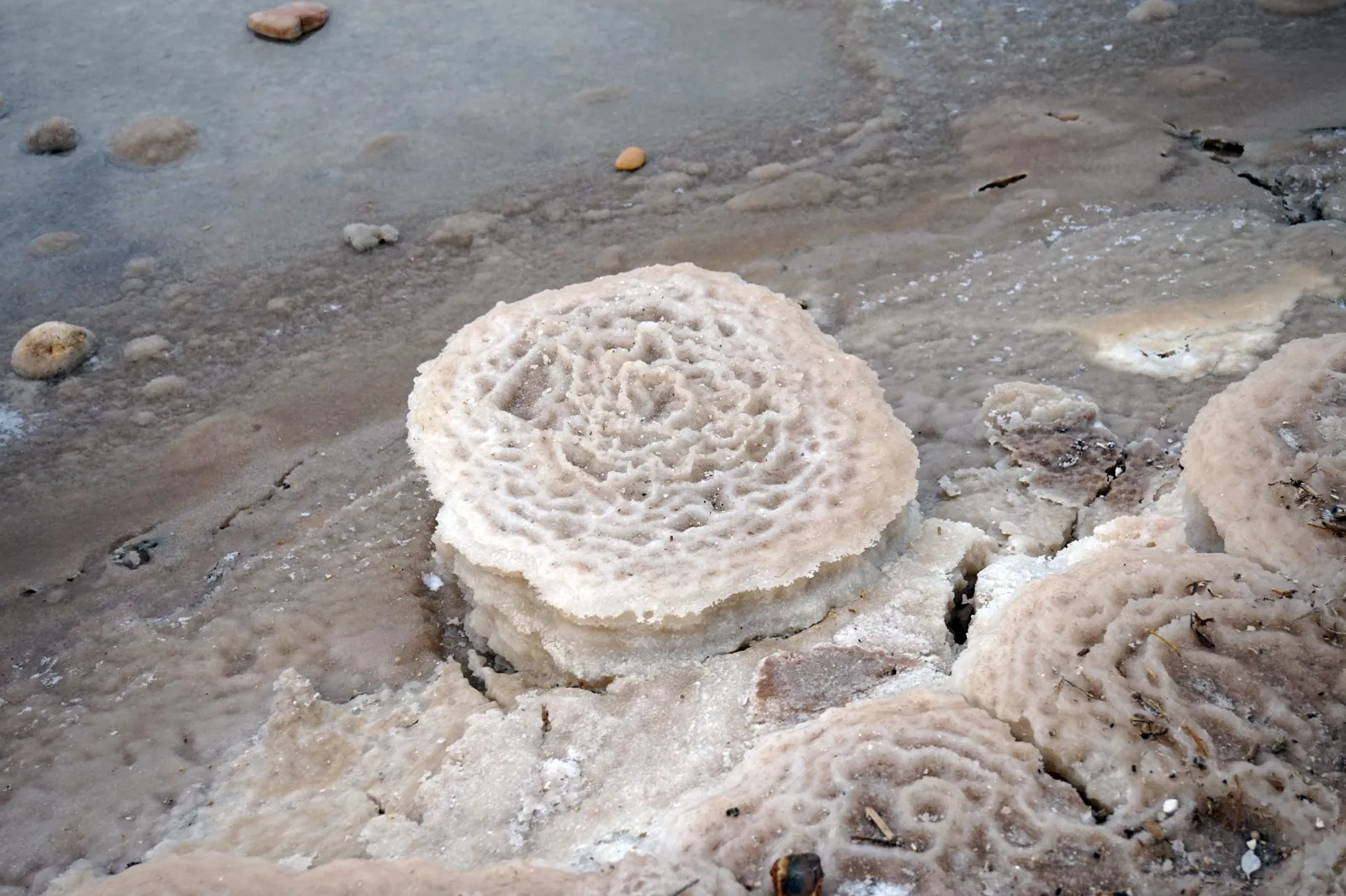
The Dead Sea’s salt is not table salt, and it is not Epsom salt either. Its brine is dominated by chlorides, rich in magnesium and sodium, with calcium and potassium, and very little sulfate. Epsom salt, used in float rooms, is magnesium sulfate. Both make water dense enough to support the body, but the experience is different: Dead Sea water can sting sharply in any small cut or in the eyes, while a float room is designed for your skin to rest comfortably in the water for an hour. More on that below.
A sea that keeps getting lower
The Dead Sea is actually a lake, sitting at the lowest exposed point on land on the border of Jordan, Israel and the West Bank, and it is shrinking. Guinness World Records, citing Israel’s Environmental Protection Ministry, puts it at an average of around 436 metres below sea level and falling by about 1.1 metres a year. Much of the Jordan River’s water is now diverted before reaching it, while the desert sun continues to evaporate the lake.
From health trips to thalassotherapy: what people go there for
For decades, people with skin and joint problems have spent several weeks by the Dead Sea, bathing, covering themselves in its black mud and, importantly, spending time in the sun. The location itself plays a part. Sunlight there travels through an extra 400-plus metres of air, which filters out more of the burning UVB rays, allowing people to spend longer in sunlight than they could at sea level.
The broader idea of using the sea for health has a name in France: thalassotherapy, from the Greek thalassa, sea. The word was coined in 1865 by a French medical student, Joseph La Bonnardière, who joined two Greek roots, and thalasso centres with seawater pools and algae wraps still line parts of the French coast, from Saint-Malo to Arcachon.
What science says
- Psoriasis is the strongest case. A 2012 systematic review of the Dead Sea research, by researchers in Israel, found what they called bona fide evidence that Dead Sea treatment is especially effective for psoriasis, crediting the combination of local sunlight and bathing in the water. Most studies were small, many lacked a control group, and much of the research comes from researchers close to the region.
- Joints: some encouraging signals. The same review found Dead Sea mud and bathing beneficial in studies of rheumatoid arthritis, psoriatic arthritis, ankylosing spondylitis and knee osteoarthritis. These were generally short studies involving relatively few participants.
- Thalassotherapy in general is still thin. A 2025 narrative review found only 16 clinical studies that met its criteria. Results leaned positive, especially for psoriasis and fibromyalgia, but the authors called for better research on effect sizes, long-term benefits and risks.
- Floating itself was not the thing being tested. Almost none of this research isolates the sensation of floating. Most of the measured benefits relate to sunlight on the skin and minerals in the water, rather than the feeling of weightlessness itself.
Ōmni Evidence Scale: Promising, for Dead Sea treatment of psoriasis: a systematic review leans clearly positive, but the studies are mostly small and uncontrolled. Early evidence, for thalassotherapy and for Dead Sea treatment of joint conditions.
The one real risk: water where it should not go
You will not sink, but the water can still be dangerous if it gets where it should not. The main risk comes when someone rolls onto their front and swallows or inhales the brine. At Soroka University Medical Center in southern Israel, doctors reviewed 69 people treated after near-drowning in the Dead Sea. Their median age was 68. Most had abnormal blood levels of calcium and magnesium, 29 developed a lung inflammation, and 11 needed a breathing machine. Most recovered fully. The same 2012 review notes that swallowing large amounts of the water is toxic and can disturb heart rhythm.
The practical advice follows naturally: stay on your back, do not swim on your front or dive, keep the water away from your face, and rinse with fresh water afterwards. A splash in the eyes stings intensely. The sun is the other quieter risk: even though it is filtered, it remains strong, and the review recorded more sun damage to the skin of people treated there.
Where else can you float like that?
There are not many places. The ocean, at about 3.5 percent salt, gives you a little extra lift, but nothing close to the Dead Sea. To reach that kind of buoyancy naturally, you generally need a closed basin in a dry, hot climate, where water evaporates faster than rivers can replace it.
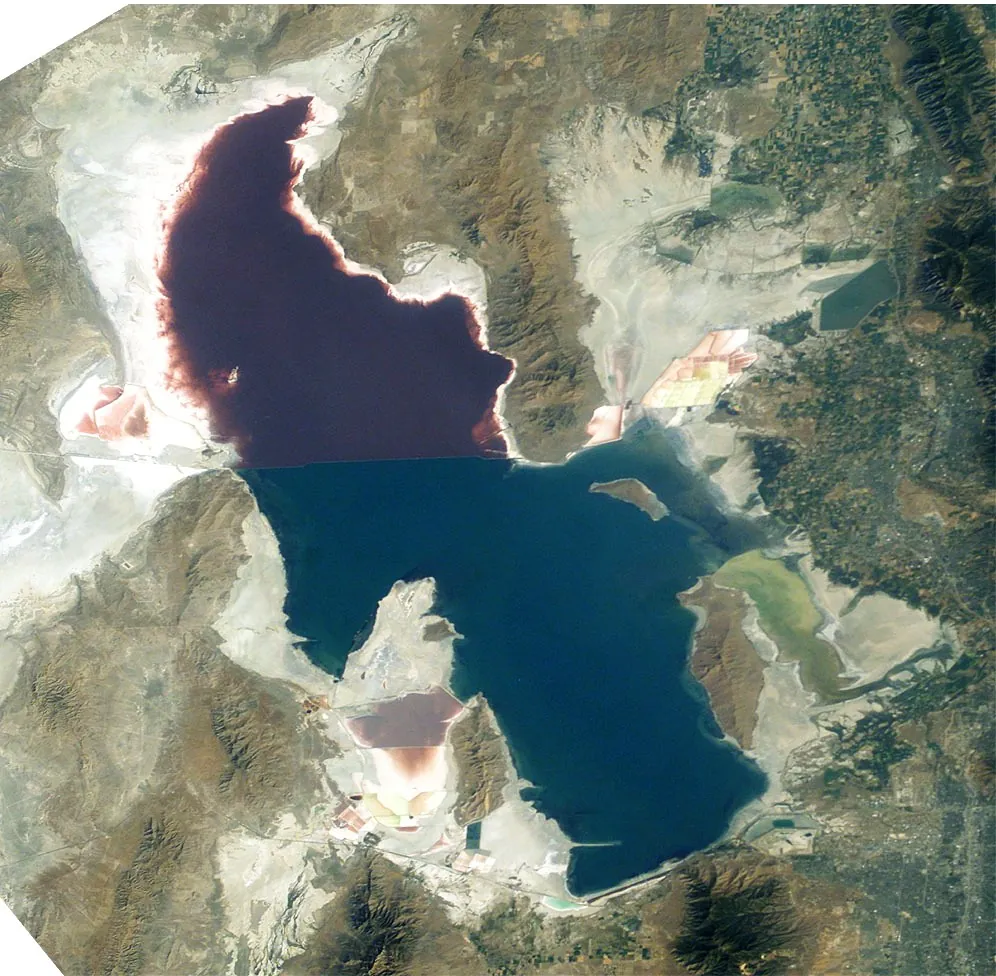
One example is Utah’s Great Salt Lake. In 1959 a railway causeway split it in two. The southern arm receives almost all the river water and has averaged about 142 grams of salt per litre since 1966; the cut-off northern arm has averaged about 317 grams per litre and is often at or near saturation, close to Dead Sea levels. You can even see the difference from space: the north turns pink, thanks to salt-loving microbes that thrive there.
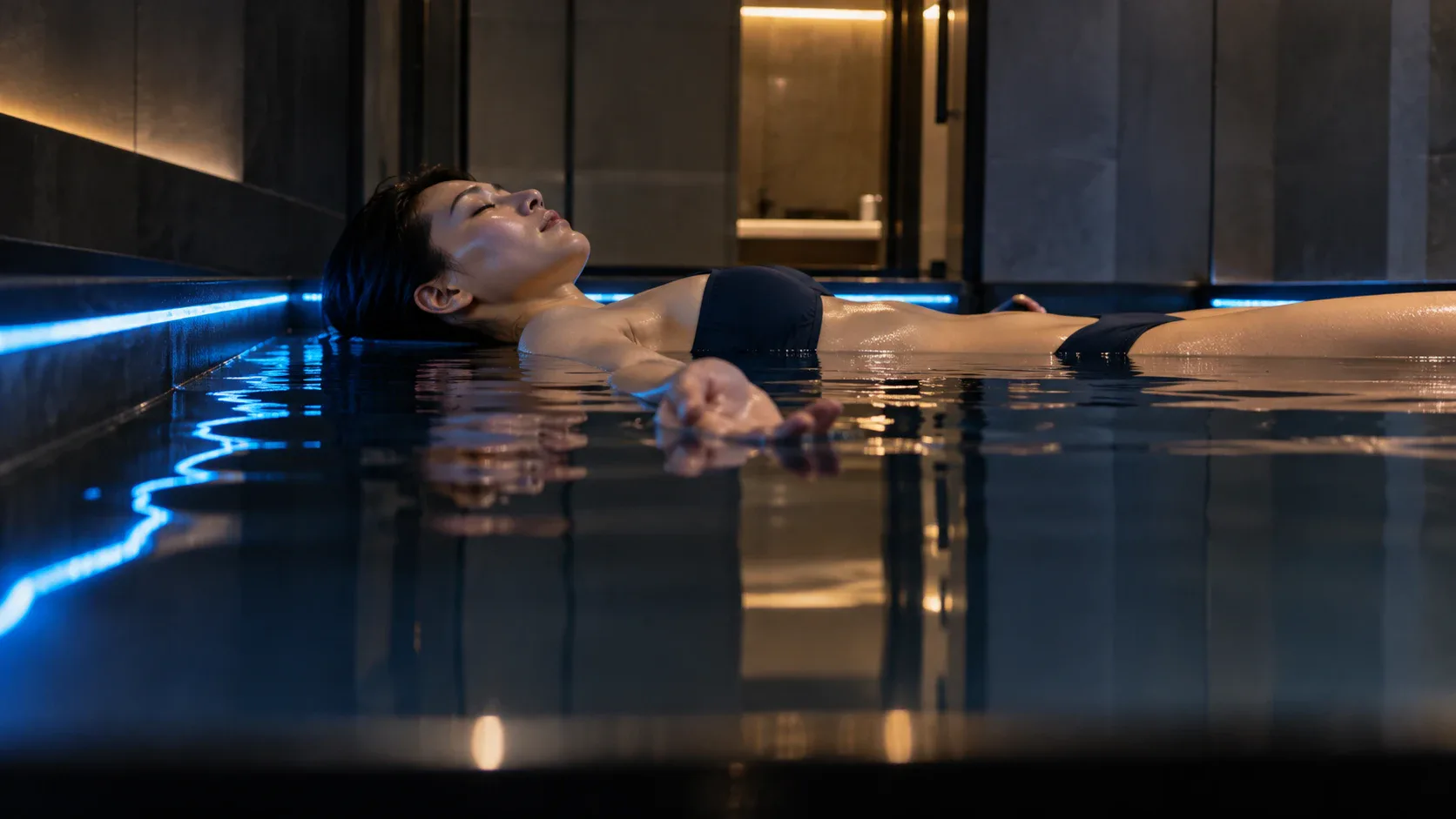
And then there are the places we build. A float room recreates the Dead Sea’s most memorable trick, that effortless lift, while removing almost everything around it: the crowds, glare, wind and deep water. If you are curious about trying the effect in a bath, a pool or the sea at home, Float Vietnam has a guide: Can you float at home, in a bath, a pool or the sea?
Dead Sea or float room: how they compare
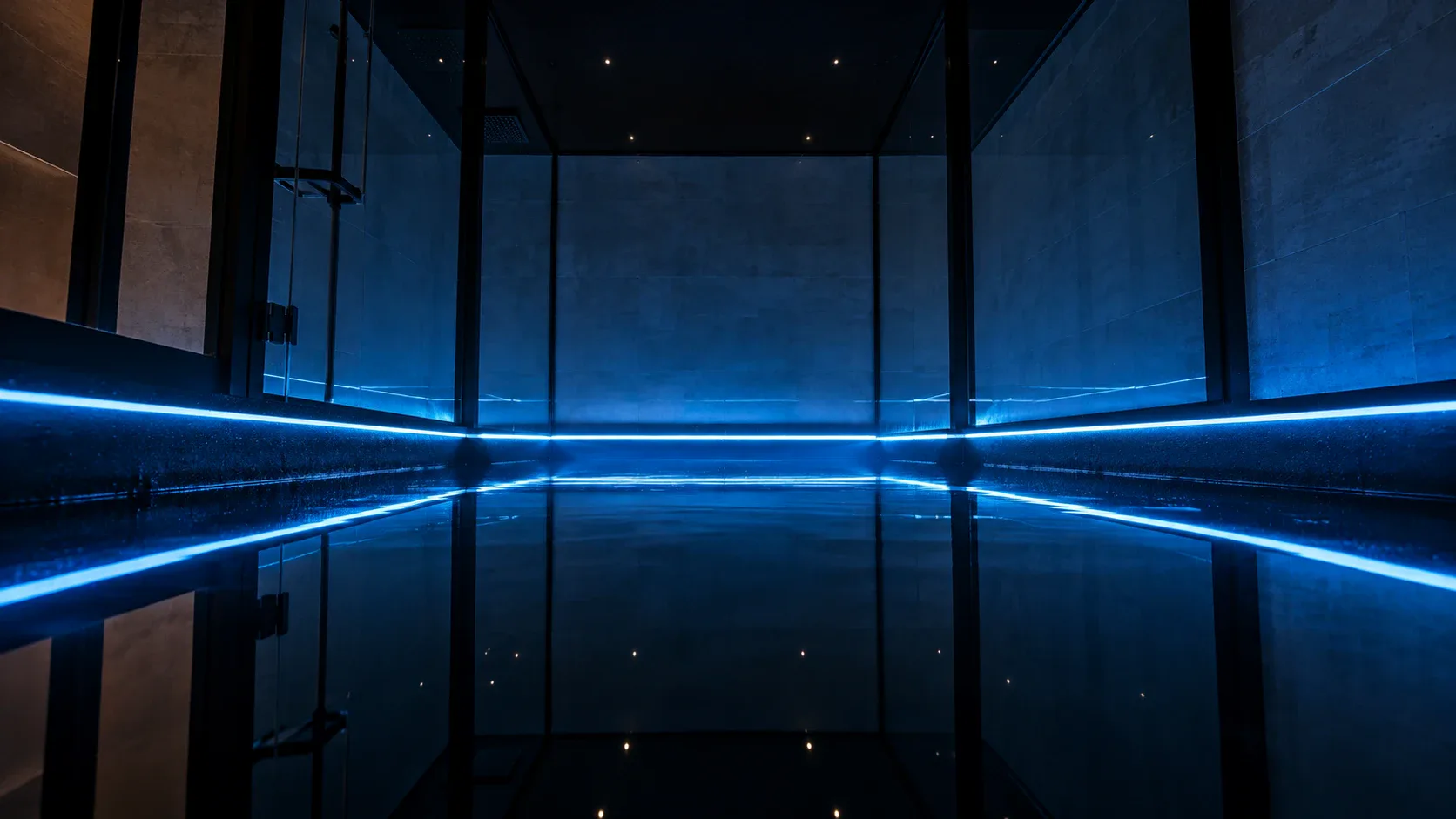
At Ōmni, each float pool holds about 500 kg of dense, mineral-rich Epsom salt dissolved in about 25 cm of water, warmed to 33–34 °C, close to skin temperature. During Thiền Nổi (float therapy), the boundary between skin and water can gradually become less noticeable, and many people describe a sense of weightlessness. The lights go down, the room becomes quiet, and you rest in the water for 60 or 90 minutes.
| Dead Sea | Float room | |
|---|---|---|
| What keeps you up | About 340 g of mostly chloride salts per litre | About 500 kg of Epsom salt (magnesium sulfate) in a shallow pool |
| Depth | Open lake, deep water | About 25 cm; you cannot go under |
| Temperature | Depends on season and weather | 33–34 °C, close to skin temperature |
| Light and sound | Bright sun, beach, other people | Dark and quiet, if you choose |
| Main exposure | Sun plus minerals | Reduced light, sound and gravity |
| Best evidence | Promising, for psoriasis (sun plus water) | Strong evidence, for stress |
Resting in dense salt water inside a dark, quiet room has a research history of its own, stretching back to the 1970s. A 2005 meta-analysis of 27 flotation studies found positive effects on stress-related body measures and wellbeing, while a Swedish randomised pilot trial found that 65 working adults who floated 12 times over seven weeks reported less stress and anxiety and better sleep than a waiting group.
Ōmni Evidence Scale: Strong evidence, for float and stress. We rate it Strong because, alongside these trials, user experience is overwhelmingly positive: in a 2025 survey of regular floaters, 92% reported relaxation and 77% less stress, echoed by thousands of reviews, Reddit threads and forums, and by athletes and public figures who float.
What we think at Ōmni (and, yes, what we sell)
We sell float sessions, so keep that in mind as you read this part. If you ever have the chance to visit the Dead Sea, go: lying back on that water beneath a desert sky is one of the strangest and most delightful sensations a body can experience. But the part people often remember most, being supported without having to do anything, does not require a flight to Jordan. Ōmni Space in Thảo Điền comes from the team behind Float Vietnam, the country’s pioneer float centre since 2017. A single float costs 1,500,000 VND for 60 minutes or 2,000,000 VND for 90 minutes; the couple room, one large square pool for two, adds 700,000 VND for the second person. New to it? Start with what float therapy is.
Ōmni Space – Float Saigon is at 16C Quốc Hương, Thảo Điền. We are open 9:00–21:00 daily; the last float starts at 20:00, and walk-ins are welcome until 18:00.
Float PlanRunning on empty?Take the one-minute Float Plan quiz: tell us how you feel and what you need, and get a simple plan for your first session.Make my Float PlanFAQ
Why can’t you sink in the Dead Sea?
Its water contains about 340 grams of dissolved salt per litre, roughly ten times more than the ocean, making it about a quarter denser than fresh water. The human body is much less dense than that, so it naturally rides high on the surface.
Is floating in the Dead Sea good for your skin?
For psoriasis, the evidence is promising: a systematic review found Dead Sea treatment especially effective, largely through the combination of filtered sunlight and bathing. The studies were small, and the review also recorded more sun damage to the skin.
Can you drown in the Dead Sea?
Yes, even though you cannot sink easily. Rolling onto your front and swallowing or inhaling the brine can cause serious lung and heart problems. Stay on your back, do not dive, and keep the water away from your face.
Is a float room the same as the Dead Sea?
It recreates the effortless lift, not the place itself. A float room uses about 500 kg of Epsom salt in roughly 25 cm of water at 33–34 °C, in a dark, quiet private room, for 60 or 90 minutes. The Dead Sea adds desert sun, open water and a different mix of salts.
Where can I float like in the Dead Sea in Saigon?
In a float room. Ōmni Space in Thảo Điền has private float rooms, from 1,500,000 VND for 60 minutes. Our team is happy to show you around on site.
Written by the team at Ōmni Space – Float Saigon in Thảo Điền, Vietnam’s pioneer float centre since 2017. We sell floats, not Dead Sea trips. General information, not medical advice; sources checked on 30 October 2026.
Sources
- Abu-Qubu J, Merkel B, Dunger V, Rimawi O (2018). Variation of the chemistry of the Dead Sea brine as consequence of the decreasing water level. Aquatic Geochemistry 24: 121–135.
- Guinness World Records. Lowest body of water exposed: the Dead Sea (checked 30 October 2026).
- Katz U, Shoenfeld Y, Zakin V, Sherer Y, Sukenik S (2012). Scientific evidence of the therapeutic effects of Dead Sea treatments: a systematic review. Seminars in Arthritis and Rheumatism 42(2): 186–200.
- Antonelli M, Donelli D (2025). A narrative review of thalassotherapy and the health benefits of seawater and coastal climates. International Journal of Biometeorology 69: 517–526.
- Futura Santé. Faut-il avoir un problème médical pour partir en séjour de thalasso? (origin of the word thalassotherapy, 1865; checked 30 October 2026).
- Saidel-Odes LR, Almog Y (2003). Near-drowning in the Dead Sea: a retrospective observational analysis of 69 patients. Israel Medical Association Journal 5(12): 856–858.
- White JS, Null SE, Tarboton DG (2015). How do changes to the railroad causeway in Utah’s Great Salt Lake affect water and salt flow? PLOS ONE 10(12): e0144111.
- van Dierendonck D, te Nijenhuis J (2005). Flotation restricted environmental stimulation therapy (REST) as a stress-management tool: a meta-analysis. Psychology & Health 20(3): 405–412.
- Kjellgren A, Westman J (2014). Beneficial effects of treatment with sensory isolation in flotation-tank as a preventive health-care intervention: a randomized controlled pilot trial. BMC Complementary and Alternative Medicine 14: 417.