
In short: A 2025 review in PLOS ONE pooled 11 randomised trials of cold water (7–15 °C) in healthy adults. People felt less stressed 12 hours after a cold dip, slept a little better in one small study and reported a better quality of life, but mood did not change, while inflammation markers rose in the first hour. Ten of the 11 trials used baths or plunges; only one used showers, and it was by far the biggest: in the Netherlands, people who finished their shower cold took 29% fewer sick days off work, without actually being ill less often. A cold shower is the free, everyday version; a cold plunge is colder, deeper and easier to dose. Both begin with the same cold shock, so breathe slowly and never hold your breath.
You have probably heard both sides. One says a 30-second blast of cold at the end of your shower gives you the benefit for free. The other says it barely counts unless you are sitting in a tub of ice. If you are wondering whether to buy a plunge membership, keep turning the shower tap cold, or skip the whole thing, here is what the trials actually measured, where showers and plunges genuinely differ, and the one risk they both share.
Part of the Ōmni Recovery Library · Recovery by Temperature · Ōmni Evidence Scale: Early evidence
How people actually do it
The cold shower. The familiar version, popularised by Wim Hof and tested in a large Dutch trial, is simple: take your normal warm shower, then finish with 30 to 90 seconds of the coldest water your tap can give you. No equipment, no booking, no cost. In that Dutch trial, conducted in January when the ground was cold, tap water was about 10–12 °C. In a tropical city like Saigon, the “cold” water from the tap is usually much warmer than that, and that difference matters.
The cold plunge. Here, you lower yourself up to the shoulders into a tub or pool of chilled water, usually somewhere between 7 and 15 °C, for anything from 30 seconds to a few minutes. Athletes have used ice baths for decades to feel less sore after hard training; the wellness version tends to be shorter, with more emphasis on the sharp jolt of alertness afterwards.
What 11 trials actually found
In January 2025, Cain and colleagues at the University of South Australia published a systematic review and meta-analysis in PLOS ONE, looking at cold-water immersion for health and wellbeing in healthy adults. They only included randomised trials using water at 15 °C or colder for at least 30 seconds, whether by shower, bath or plunge. Eleven trials qualified, covering 3,177 people in total.
Here is what came out of them, in plain English:
- Stress: lower 12 hours after cold-water immersion, with a large effect. But not immediately, not at 1 hour, and not at 24 or 48 hours. That is one positive time point out of five.
- Inflammation: markers actually went up immediately after the cold and one hour later. That is an acute stress response, not proof of harm, but it is the opposite of the simple claim that “cold reduces inflammation” in the short term.
- Immune function: no measurable change in the first hour. The longer-term finding about “fewer sick days” comes from one trial, which we will get to below.
- Sleep: better sleep quality in one small study of 20 young men who used cold water after training in the heat. There were no data in women.
- Quality of life: slightly higher scores in the large shower trial.
- Mood: no difference.
Two details are worth keeping in mind before those results start sounding bigger than they are. First, 3,018 of the 3,177 people came from a single trial. Second, apart from that trial, every participant across the other ten studies was male. The authors themselves describe the evidence base as small and not very diverse, and call for better trials.
The cold shower trial: 3,018 Dutch adults
The only shower study in the review also happens to be the biggest cold-water trial ever conducted. In early 2015, Buijze and colleagues in Amsterdam randomly assigned 3,018 working adults, aged 18 to 65 and new to cold showers, to four groups: finish every shower with 30, 60 or 90 seconds of cold water for 30 days in a row, or simply carry on as usual.
The cold-shower groups reported 29% fewer days off sick from work. But they did not report fewer days of actually being ill. The authors’ interpretation was that people may have felt well enough to keep working through a cold. Thirty seconds worked as well as ninety. Nearly four in five completed the 30 days, and 64% were still taking cold showers by choice at the end of the three-month study; the benefit people mentioned most often was more energy, sometimes compared to coffee.
There are important limits. Nobody can be blinded to whether they are standing under a cold shower, sick days were self-reported, and the authors say plainly that a placebo effect cannot be ruled out. Even so, for a free habit that takes 30 seconds, it is an unusually large and real-world trial.
Shower or plunge: what is really different?
Nobody has yet run a wellbeing trial that puts cold showers and cold plunges directly against each other. So the fairest comparison is not “which one wins?”, but how the dose differs, how the physics differs, and what each one has actually been tested for.
How much of you gets cold. A shower mainly cools the area of skin under the stream; a plunge surrounds almost your whole body at once. In a 2016 lab study, a 15-minute cold shower at about 21 °C after hard exercise did cool overheated people faster than simply sitting still, but the researchers concluded that it should only be used when proper cold-water immersion is not available.
How cold the water is. A plunge can hold a set temperature. A shower gives you whatever comes through the pipes. The Dutch trial used winter tap water at 10–12 °C; a rooftop tank in the tropics may produce water that barely feels cool.
What each has been tested for. Showers: sick days, quality of life and energy, in one large trial. Plunges: muscle recovery after sport, where a 2022 meta-analysis of 52 studies found less soreness and better recovery of power 24 hours after hard exercise; plus the short-term stress and sleep findings above. Our site rates the plunge for muscle recovery Promising, and for mood and alertness Early evidence.
Training the gasp. This is where showers and plunges meet. In a small 2005 study by Clare Eglin and Mike Tipton, six cold showers at 10 °C over four days reduced how strongly people gasped and panted when they later entered 10 °C water. Showers at 15 °C did not. So a genuinely cold shower may take the edge off your first plunge; a lukewarm one probably will not.
The risk both share: cold shock
Put a large area of skin into cold water and the body responds immediately with the cold shock response: an involuntary gasp, fast, forceful breathing that is difficult to control, and a sudden rise in heart rate and blood pressure. It is strongest during the first 30 seconds or so and settles within about three minutes. In open water, it is a known cause of drowning. In a shower, it may feel more like a loud “ah!”, but the cardiovascular load is still there.
Two things can make that response more dangerous. Holding your breath while your face is in cold water activates the diving reflex, which slows the heart, at the same time that cold shock is trying to speed it up. Physiologists Michael Shattock and Mike Tipton called this clash “autonomic conflict” and proposed it as a possible trigger for abnormal heart rhythms in vulnerable people. Hyperventilating before getting into the water, Wim Hof style, can also make you black out under water without warning.
The simple rules:
- Breathe out slowly as the cold hits, then keep breathing. No breath holds, whether you are in the shower or the plunge.
- Keep your face out of a plunge. Shoulders in, head dry.
- No breathing rounds before or during cold water; read our Wim Hof water rule for why.
- Get out if you feel chest pain, a racing or irregular heartbeat, dizziness or confusion, or if shivering becomes violent. People with heart rhythm problems or high blood pressure are the ones at real risk from cold shock.
- Not after alcohol, and never alone in deep water.
Plausible versus proven
Shown: cold water reliably triggers a burst of noradrenaline (in one classic study, about six times the resting level during an hour at 14 °C), along with a faster heart and a sense of alertness; plunges after hard exercise reduce soreness the next day; and a regular cold shower was linked with fewer sick days in one large but unblinded trial.
Plausible, not shown: that regular cold exposure “boosts immunity”, lowers day-to-day inflammation, or improves mood. The short-term inflammation data actually point the other way, and mood did not change in the review.
Ōmni Evidence Scale: Early evidence, for cold showers and plunges as a wellbeing habit. The trials are randomised, but there are few of them, most are small and almost all involve men, apart from one large, unblinded shower trial. Cold plunges for muscle recovery after sport rate higher, Promising. See how we rate evidence on the Ōmni Evidence Scale.
What we think at Ōmni
If you want a free daily dose of cold, a cold shower is a perfectly reasonable place to begin, especially if you live somewhere the tap water is genuinely cold. Thirty seconds was enough in the Dutch trial. If you want something colder, steadier and easier to control, or you live in a city where the “cold” tap still runs warm, that is where a plunge makes more sense.
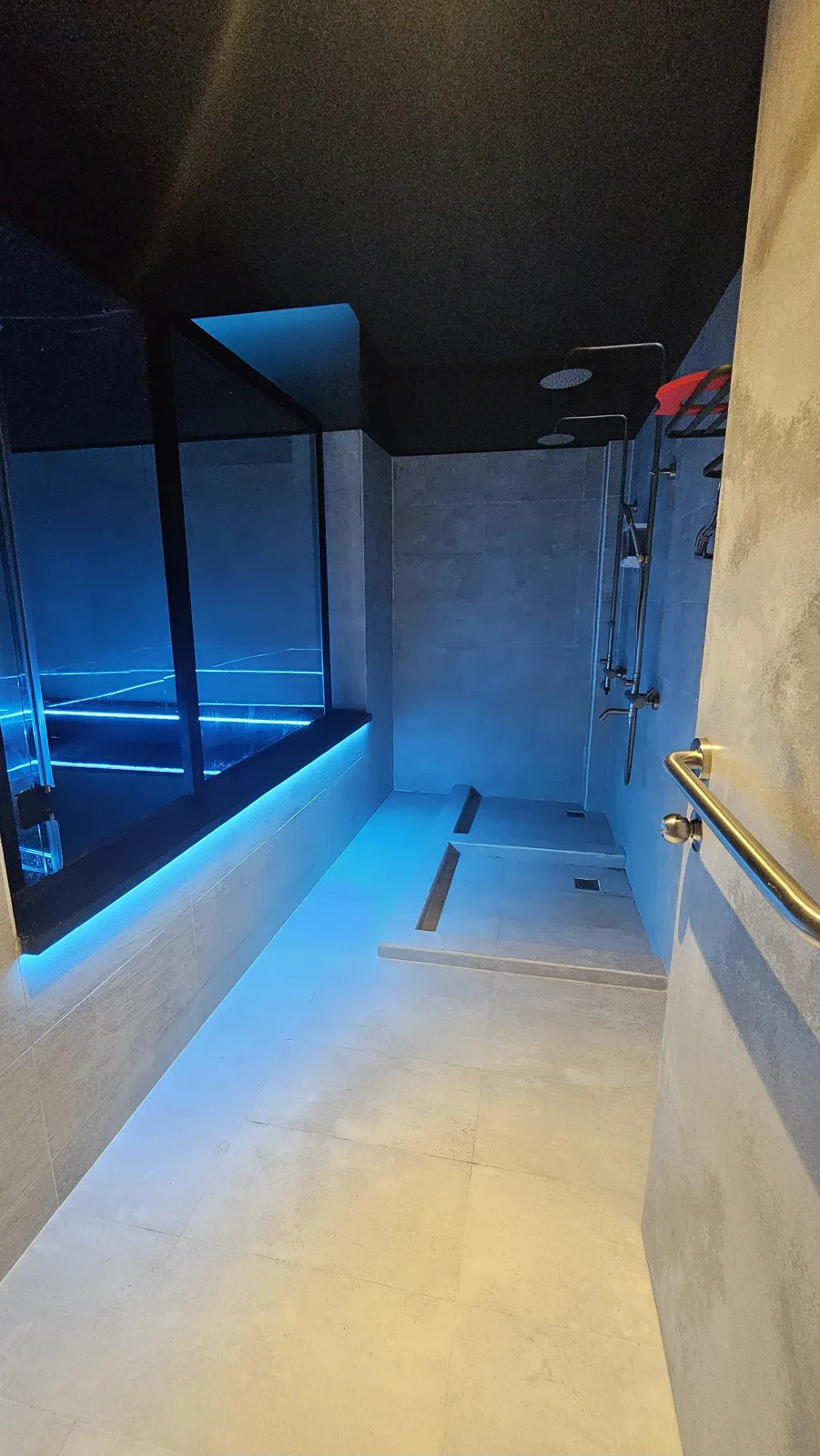
Our cold plunge is a private 30-minute session that you can take at your own pace, with the water kept at 7–12 °C. Most people choose two or three short dips rather than one long one. Step in slowly, keep your face out, and make each exhale longer than the inhale until the initial gasp settles. Bring your own swimwear for the plunge (we do not lend it); our sauna and float rooms need none. The plunge costs 450,000 VND on its own or 200,000 VND added to a float; the full sauna and cold plunge room, for up to 4 people for 60 minutes, is 900,000 VND. If you want to combine heat and cold, see our contrast therapy guide.
Cold switches you on. If what you want is almost the opposite — quiet, stillness and deep rest — that is what our float rooms are designed for. In Thiền Nổi (float therapy), you lie face up in about 25 cm of water with around 500 kg of dense, mineral-rich Epsom salt, warmed to 33–34 °C, close to skin temperature. Float has been explored across hundreds of scientific studies; in a Swedish randomised pilot trial, 65 working adults who floated 12 times over seven weeks reported less stress and anxiety and better sleep than a waiting group.
Ōmni Evidence Scale: Strong evidence, for float and stress. We rate it Strong because, alongside these trials, user experience is overwhelmingly positive: in a 2025 survey of regular floaters, 92% reported relaxation and 77% less stress, echoed by thousands of reviews, Reddit threads and forums, and by athletes and public figures who float.
Ōmni Space is a quiet float centre at 16C Quốc Hương, Thảo Điền, created by the team behind Float Vietnam, the country’s pioneer float centre since 2017. A single float costs 1,500,000 VND for 60 minutes or 2,000,000 VND for 90 minutes; the couple room adds 700,000 VND for the second person. Open 9:00–21:00 daily; last float 20:00; walk-ins until 18:00.
FAQ
Is a cold shower as good as a cold plunge?
They have not been compared head to head. A cold shower cools less of your body and depends on how cold the water from your tap actually is; a plunge holds a set temperature and covers you to the shoulders. Showers have one large trial behind them, showing fewer sick days; plunges have more trials for muscle recovery.
How long should a cold shower be?
In the largest trial, 30 seconds of cold water at the end of a warm shower worked as well as 60 or 90 seconds for the main result: fewer sick days. Longer was not better.
Does cold water reduce inflammation?
Not in the short term. The 2025 review found that inflammation markers rose immediately and one hour after cold immersion, which is a normal acute stress response. Claims that cold exposure lowers everyday inflammation have not been shown.
Will cold showers make me less stressed?
Possibly, for a while. In the review, stress was lower 12 hours after cold immersion, but not at 1, 24 or 48 hours, and mood did not change. We rate cold water as a wellbeing habit Early evidence.
Is cold water dangerous?
The first minute carries the main risk: an involuntary gasp, fast breathing and a jump in heart rate and blood pressure. Breathe out slowly, never hold your breath, keep your face out of a plunge, and get out if you feel chest pain, dizziness or an irregular heartbeat.
Written by the team at Ōmni Space – Float Saigon in Thảo Điền, which runs a cold plunge, an infrared and red-light sauna and float rooms. General information, not medical advice; sources checked on 30 October 2026.
Sources
- Cain T, Brinsley J, Bennett H, Nelson M, Maher C, Singh B (2025). Effects of cold-water immersion on health and wellbeing: a systematic review and meta-analysis. PLOS ONE 20(1): e0317615. doi:10.1371/journal.pone.0317615
- Buijze GA, Sierevelt IN, van der Heijden BC, Dijkgraaf MG, Frings-Dresen MH (2016). The effect of cold showering on health and work: a randomized controlled trial. PLOS ONE 11(9): e0161749. doi:10.1371/journal.pone.0161749
- Eglin CM, Tipton MJ (2005). Repeated cold showers as a method of habituating humans to the initial responses to cold water immersion. European Journal of Applied Physiology 93(5–6): 624–629. doi:10.1007/s00421-004-1239-6
- Butts CL, McDermott BP, Buening BJ, et al. (2016). Physiologic and perceptual responses to cold-shower cooling after exercise-induced hyperthermia. Journal of Athletic Training 51(3): 252–257. doi:10.4085/1062-6050-51.4.01
- Moore E, Fuller JT, Buckley JD, et al. (2022). Impact of cold-water immersion compared with passive recovery following a single bout of strenuous exercise on athletic performance in physically active participants: a systematic review with meta-analysis and meta-regression. Sports Medicine 52: 1667–1688. doi:10.1007/s40279-022-01644-9
- Shattock MJ, Tipton MJ (2012). “Autonomic conflict”: a different way to die during cold water immersion? The Journal of Physiology 590(14): 3219–3230. doi:10.1113/jphysiol.2012.229864
- Šrámek P, Šimečková M, Janský L, Šavlíková J, Vybíral S (2000). Human physiological responses to immersion into water of different temperatures. European Journal of Applied Physiology 81: 436–442. doi:10.1007/s004210050065
- Knechtle B, Waśkiewicz Z, Sousa CV, Hill L, Nikolaidis PT (2020). Cold water swimming: benefits and risks: a narrative review. International Journal of Environmental Research and Public Health 17(23): 8984. doi:10.3390/ijerph17238984
- Kjellgren A, Westman J (2014). Beneficial effects of treatment with sensory isolation in flotation-tank as a preventive health-care intervention: a randomized controlled pilot trial. BMC Complementary and Alternative Medicine 14: 417.
- Hilpert K, Chis Ster I (2025). Experiences and perceptions of regular floatation-REST users: results from an online survey. Journal of Clinical Images and Medical Case Reports 6(5): 3600.