
In short: Walking meditation means walking slowly and resting your attention on the sensations in your feet: lifting, moving, placing. You only need a path of 5–10 steps, walked back and forth. Whenever your mind wanders, gently come back to your feet. Ten minutes a day is enough to start. It comes from the Buddhist practice of caṅkama and is taught today in both Thich Nhat Hanh’s Plum Village tradition and Theravada meditation centres.
Read in Vietnamese: Thiền hành (thiền đi bộ) cho người mới: bài 10 phút đi chậm trong chánh niệm
You tried sitting meditation. Within five minutes your knees ached, your mind was writing emails, or you were nodding off. Maybe the problem is not you but sitting still. Here is a 10-minute walking meditation for a hallway or balcony, where it comes from, what research says, and how it pairs with a float.

What is walking meditation?
The earlier practices in our meditation hub ask you to sit or lie still: following the breath, moving through each part of the body, or sinking into deep rest. This one is different: you stand up and walk.
Walking meditation is simply walking with deliberate attention. You walk as you always do, just a little slower, slow enough to feel the body moving: the weight shifting from one foot to the other, the heel touching the ground, the sole settling onto a cool floor. In Vietnam it is called thiền hành or kinh hành; in the old Pali texts, caṅkama, walking back and forth with awareness.
Where walking meditation comes from
Caṅkama in the Pali texts
Walking meditation is one of the oldest practices in the history of meditation. In the short Caṅkamasutta (Aṅguttara Nikāya 5.29), the Buddha names five benefits of walking meditation: stamina for long journeys, stamina for practice, good health, good digestion, and concentration gained while walking that lasts a long time. On traditional retreats, students still alternate a period of sitting with a period of walking.
The Theravada way: lift, move, place
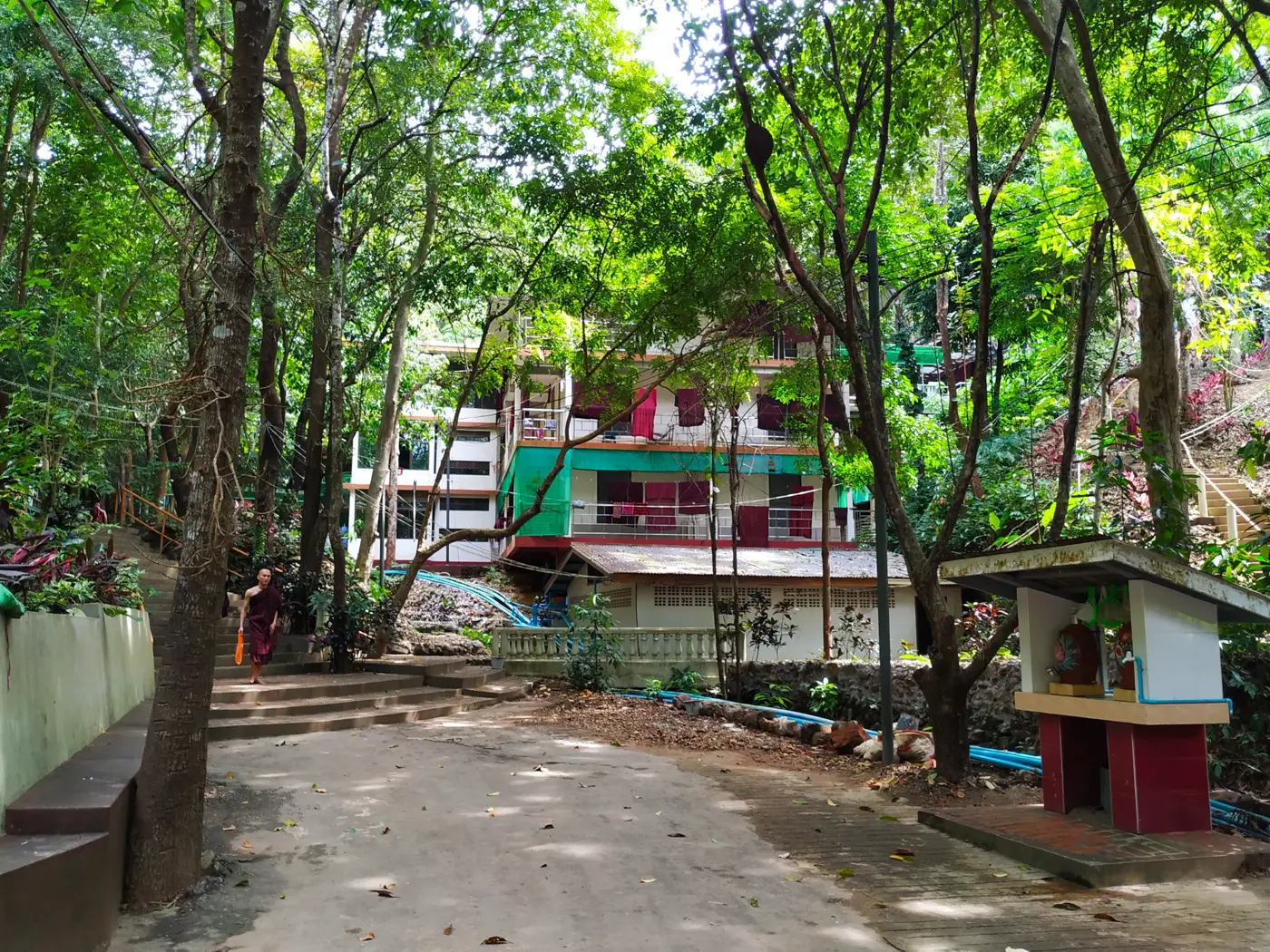
At centres that follow the Mahasi method from Myanmar, beginners start very simply by noting “left, right”. Once that feels familiar, each step is split into three clear parts: lifting, moving, placing. The teacher Sayadaw U Silananda stressed that you do not need to force yourself to walk very slowly. As attention becomes deeper and clearer, the steps tend to slow down on their own, the way a driver naturally eases off to read a sign by the road.
The Plum Village way: peace in every step
The Vietnamese Zen teacher Thich Nhat Hanh brought walking meditation to a huge number of people, in Vietnam and in the West. His well-known book Peace Is Every Step (1991) sums up the Plum Village spirit in its title: light steps, matched to the breath, each one a small return to the present moment.
Both styles keep attention with the walking body. The practice below stays neutral, so anyone can try it.
Why walking still counts as meditation
Meditation is about where you place your attention, not a fixed posture. Sitting, the breath can be your anchor; walking, the anchor is the body in motion. Every step has pressure, rhythm and balance, which for some people is more vivid than the breath.
- Restless when sitting? The body gets to move, so fidgeting settles more naturally.
- Sleepy when you meditate? Eyes open and moving, it is much harder to nod off.
- Stiff back? A few minutes of slow walking between two sits eases the body.
- Want meditation in daily life? Everyone walks somewhere. Walking meditation is a natural bridge between the cushion and a busy day.
What the research says about walking meditation
Walking meditation is studied less than sitting, and most studies are small, but early findings are fairly consistent.
| What studies found | Ōmni Evidence Scale |
|---|---|
| Regular walking reduces depressive and anxiety symptoms compared with no exercise (Xu 2024, review of 75 trials) | Promising |
| Eight mindful walking sessions over 4 weeks lowered stress in distressed adults (Teut 2013, 74 people) | Early evidence |
| 12 weeks of Buddhist walking meditation reduced depressive symptoms in older adults (Prakhinkit 2014, 45 people) | Early evidence |
| A 90-minute walk among trees reduced rumination (Bratman 2015, 38 people) | Early evidence |
| Walking produced more creative ideas than sitting (Oppezzo 2014, 176 people) | Early evidence |
Less stress. At Charité hospital in Berlin, Teut’s team split 74 distressed adults into two groups. The group that practised mindful walking reported lower stress and better quality of life than the group that had not yet started.
Low mood in older adults. In Thailand, Prakhinkit (2014) followed 45 people aged 60 to 90 with mild to moderate depressive symptoms. Only the Buddhist walking meditation group, practising three times a week for 12 weeks, saw depression scores drop clearly; both walking groups became fitter and steadier on their feet.
Less rumination. At Stanford, Bratman (2015) sent healthy young adults on a 90-minute walk either among trees or along a busy road. Those who walked in nature ruminated less, and activity in a brain area linked to dwelling on sad thoughts also went down.
A 2022 review by Davis and colleagues gathered 14 studies of meditative and mindful walking: 13 reported improvement in at least one psychological or cardiovascular measure. Most were small and loosely designed, so this is a promising direction, not a settled conclusion. Walking meditation does not replace treatment for depression or anxiety, but it can be a gentle form of support.
Ōmni Evidence Scale: Promising, for regular walking and fewer depressive and anxiety symptoms (a review of 75 trials). Early evidence, for mindful walking and stress, Buddhist walking meditation and low mood in older adults, nature walks and rumination, and walking and creative thinking (single small trials).

How to practise: a 10-minute walking meditation
Where: find a flat path of about 5–10 steps: a hallway, a balcony, a rooftop, or a corner of a park early in the morning while it is still quiet. Barefoot or in sandals, either is fine. Keep your eyes open, your gaze resting softly on the ground about two metres ahead. Read the script slowly, or record it on your phone and play it back.
Hello. Stand still at one end of your path. Feet about a hand’s width apart, knees soft, arms relaxed.
Feel the weight of your body settling into the soles of your feet. Is the floor warm or cool, hard or soft? (pause 20 seconds)
Shift your weight a little to the left, back to the centre, then to the right. Very gently, like a tree swaying in the wind. (pause 15 seconds)
Begin to walk. Lift the right heel. Move the foot forward. Place it down. Left foot. Lift. Move. Place.
From here, there is no need to name anything. Let your attention ride along with your feet, at your own pace. (pause 60 seconds)
At the end of the path, pause for a moment. Turn slowly, noticing the turn. Then walk back. (pause 60 seconds)
If you notice you are thinking about something else, simply note “thinking”, and come back to the next step. Drifting off and coming back: that is the practice. (pause 90 seconds)
If it feels natural, let your breath walk with you: in for one or two steps, out for one or two steps. (pause 90 seconds)
Notice your calves, knees and hips. Wherever something is gripping, soften a little more. (pause 60 seconds)
Widen your attention: air on your skin, birdsong, distant traffic. Keep a little attention in your feet. (pause 90 seconds)
Walk a few more lengths in silence. (pause 90 seconds)
Come to a stop at the end of your path. Stand still. Feel your body after ten slow minutes: maybe lighter, maybe warmer, or something subtle that is hard to name. Whatever you notice is fine. (pause 20 seconds)
Take one deeper breath in, and let it go. Thank you for spending ten minutes walking with yourself.
On the go: walking meditation in Saigon
You can also practise on a familiar route, from your apartment or hotel to the café or office, at normal speed. Keep your eyes open and one simple anchor, such as your heel touching the ground. Saigon’s pavements come with parked motorbikes and uneven kerbs, so keep your gaze up rather than on your feet, and when you cross the street, pause the practice, look around properly, then return to your steps.
Common slip-ups, and how to adjust
- Staring at your feet. Your neck tires and you lose balance more easily. Look gently ahead and feel your feet from the inside.
- Going so slowly it feels forced. If your legs start to shake or you wobble, speed up a little. The right pace keeps you attentive without the body straining.
- Worrying about the “right” posture. Hands behind your back, clasped in front or hanging loose are all fine. No need to look like you are meditating.
- Waiting for a special feeling. Some days feel light; some days you simply notice very clearly that you are walking. Both are practice.
Walking meditation and floating: two ends of gravity
Walking meditation trains you to feel gravity directly: your weight passing through each step into the ground. In a float, that feeling is almost reversed. About 25 cm of water with about 500 kg of dense, mineral-rich Epsom salt, at about 33–34 °C, close to skin temperature, holds the body up completely, with no posture to keep (see what weightless feels like). Going from “full weight” to “almost no weight” is a big shift for the body’s senses, and a few minutes of slow walking can help you make it more smoothly:
- Before your float: on the way in, slow down for a few minutes, notice your heels touching the ground and let your out-breath grow a little longer. The body starts to let go before the float even begins, a good fit for Floor 1, Body lets go on our map of the levels of float meditation.
- After your float: take your first steps very slowly and feel your weight return bit by bit, giving the calm after the session more time to settle. If your mind went very still, as on Floor 2, Quiet mind, carry that quiet into those first steps.
One trains attention while the body moves; the other trains letting go when movement stops. Together, they give you two ways back to your body.
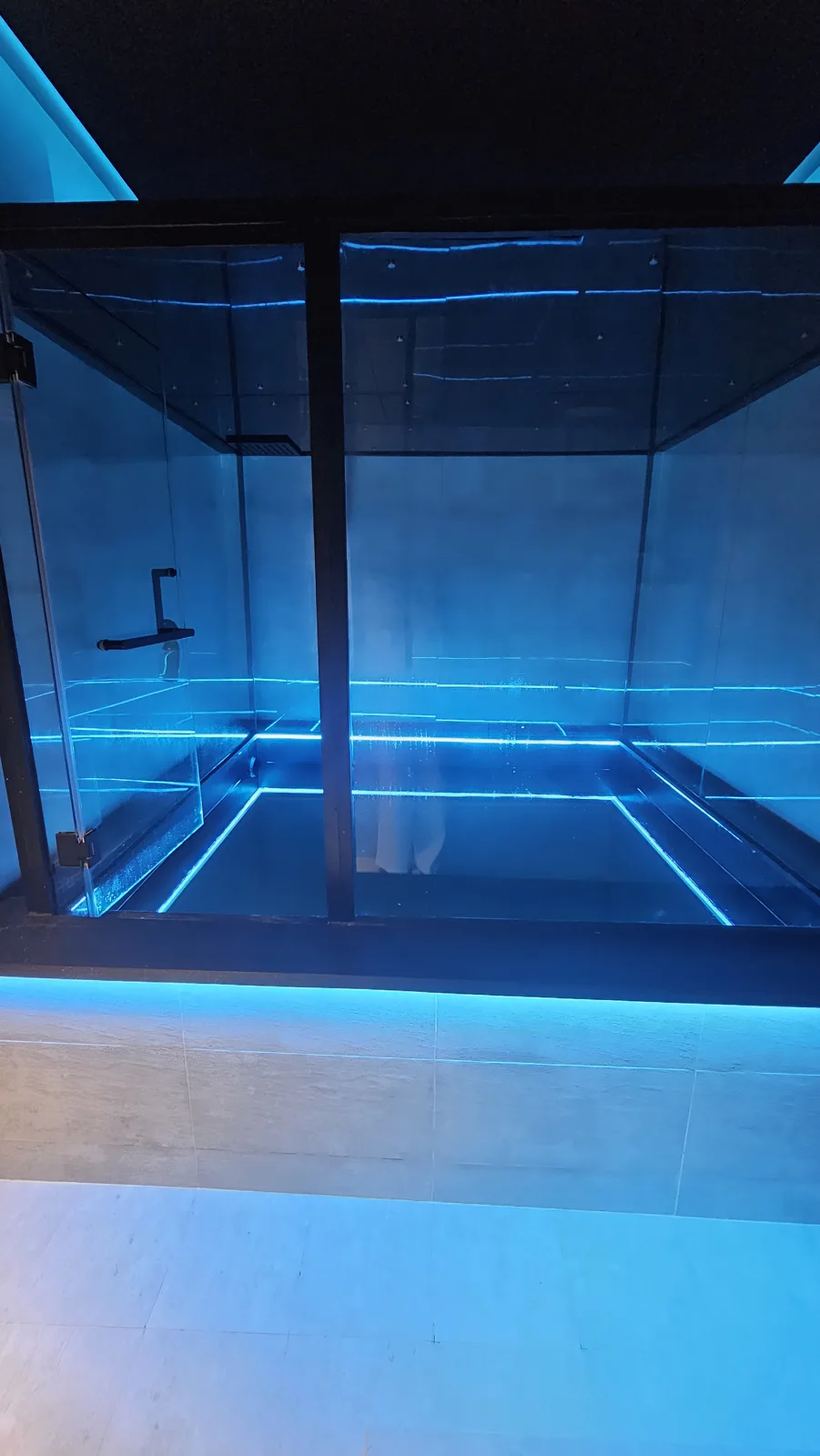
If you would like to feel the other end of gravity, try a float at Ōmni Space – Float Saigon, 16C Quốc Hương, Thảo Điền, in a private float room. We are open 9:00–21:00 every day; the last float starts at 20:00.
Float PlanRunning on empty?Take the one-minute Float Plan quiz: tell us how you feel and what you need, and get a simple plan for your first session.Make my Float PlanFrequently asked questions
How long should I do walking meditation?
Start with 10 minutes. Regularity matters more than length: a little every day helps more than one long session now and then.
Do I need to walk barefoot?
No. Walking barefoot on a wooden floor or clean grass can help you feel your feet more clearly, but sandals or soft shoes work well too. Out on the street, wear your usual shoes.
Can I do walking meditation on the street?
Yes. Walk at a normal pace with your eyes open and one simple anchor, such as your heel touching the ground. When you cross a road or enter a crowded place, pause the practice and look around first.
How is walking meditation different from a normal walk?
On a normal walk you are going somewhere while your mind is elsewhere. In walking meditation the walking itself is the point: you notice the body moving, and each time your mind wanders, you come back to the step you are taking.
Should beginners sit or walk?
If you get restless, sleepy or stiff when sitting, walking can be the easier way in. If you want to train settling deeply while the body is still, try breathing meditation. Many people combine the two: walk for a few minutes, then sit.
Written by the team at Ōmni Space – Float Saigon in Thảo Điền. General information, not medical advice; checked on 5 November 2026.
Sources
- Caṅkamasutta: Walking Meditation (Aṅguttara Nikāya 5.29), translated by Bhikkhu Sujato. SuttaCentral.
- Sayadaw U Silananda. The Benefits of Walking Meditation. Access to Insight.
- Thich Nhat Hanh (1991). Peace Is Every Step: The Path of Mindfulness in Everyday Life. Parallax Press.
- Xu Z, Zheng X, Ding H, et al. (2024). The effect of walking on depressive and anxiety symptoms: systematic review and meta-analysis. JMIR Public Health and Surveillance 10: e48355.
- Teut M, Roesner EJ, Ortiz M, et al. (2013). Mindful walking in psychologically distressed individuals: a randomized controlled trial. Evidence-Based Complementary and Alternative Medicine 2013: 489856.
- Prakhinkit S, Suppapitiporn S, Tanaka H, Suksom D (2014). Effects of Buddhism walking meditation on depression, functional fitness, and endothelium-dependent vasodilation in depressed elderly. Journal of Alternative and Complementary Medicine 20(5): 411–416.
- Bratman GN, Hamilton JP, Hahn KS, Daily GC, Gross JJ (2015). Nature experience reduces rumination and subgenual prefrontal cortex activation. PNAS 112(28): 8567–8572.
- Oppezzo M, Schwartz DL (2014). Give your ideas some legs: the positive effect of walking on creative thinking. Journal of Experimental Psychology: Learning, Memory, and Cognition 40(4): 1142–1152.
- Davis DW, Carrier B, Cruz K, et al. (2022). A systematic review of the effects of meditative and mindful walking on mental and cardiovascular health. International Journal of Exercise Science 15(2).