
In short: Yes, float therapy can help with everyday anxiety. In studies, a single float sharply lowered anxiety, and twelve sessions eased generalised anxiety for months. In Ho Chi Minh City (Saigon), start with three 90-minute floats within two weeks, then float every one to three weeks. It supports therapy and medication; it does not replace them.
Anxiety is one of the most common things people carry around, and in a fast, loud city it rarely gets a day off. Deadlines, exams, a new baby, a move to a new country, a worrying symptom you keep googling at night: the mind keeps scanning for danger. This guide was written by the team at Ōmni Space – Float Saigon in Thảo Điền for people in Saigon and Ho Chi Minh City who often feel anxious or overwhelmed and want an honest answer: can floating help, and how do you start? Float therapy means lying in warm, very salty water that holds you up without effort, in a quiet, dark room. It is general information, not a treatment plan. Details were checked on 12 October 2026.
What the research shows
Most of the anxiety research comes from two places: the Laureate Institute for Brain Research in Tulsa, USA, and Karlstad University in Sweden. Here are the studies that matter most, in plain words.
- One float, a large drop in anxiety. In 2018, Justin Feinstein and colleagues gave 50 people with anxiety and stress-related disorders (generalised anxiety, panic, social anxiety, PTSD and others; most also had depression) one float of up to an hour. State anxiety (how anxious you feel right now) fell in every participant, with a very large effect. Stress, muscle tension and pain fell too, and feelings of serenity rose. There was no control group, so this shows what happens after one float, not proof that the float caused all of it.
- Float compared with a calm alternative. In a second 2018 study, the same team took 31 people with high anxiety sensitivity (being frightened by body sensations such as a racing heart) and gave each of them, in random order, a 90-minute float and a session watching a nature documentary. The float lowered anxiety and muscle tension more, and raised relaxation and serenity more. Blood pressure fell during the float, and people became more aware of their breath and heartbeat, and found those sensations more pleasant.
- Twelve sessions for generalised anxiety. Jonsson and Kjellgren (2016) randomly assigned 50 people with generalised anxiety disorder (GAD, long-lasting worry about many things) to 12 floats over seven weeks or to a waiting list. Symptoms fell in the float group but not in the waiting group; 37% of floaters reached full remission against 14% of controls. Sleep also improved. At six months, the gains in anxiety symptoms held.
- Floating at work. Kjellgren and Westman (2014) randomised 65 healthy working adults, most of them women, to 12 floats over seven weeks or a wait-list. Stress, anxiety and depression fell, and sleep quality and optimism rose, in the float group only.
- Is it practical for anxious people? Garland and colleagues (2024) randomised 75 adults with anxiety and depression to six weekly sessions of floating (fixed one-hour sessions, or length chosen by the person) or a comfortable reclining chair. People completed 85% and 89% of their float sessions, compared with 74% in the chair. No serious problems were linked to floating. This trial tested safety and practicality, not how much anxiety fell; bigger trials are now under way.
- The bigger picture. A meta-analysis (pooling the results of many studies) by van Dierendonck and te Nijenhuis in 2005 combined 27 studies with 449 people and found relatively large positive effects on the body (such as cortisol and blood pressure), on wellbeing and on performance.
- What regular floaters say. In a 2025 survey of 83 regular floaters (Hilpert and Chis Ster), 91.6% reported relaxation, 77.1% less stress and 47% less anxiety. Most said the effects lasted one to four days.
Float therapy is a young but very active research field: randomised controlled trials have shown clear effects on anxiety, stress, muscle tension and sleep, and new clinical studies are still under way. If you want the depth behind the Laureate work, our sister site covers it in the Laureate Institute’s float research.
The honest limits. Samples are small, usually 30 to 75 people. It is hard to “blind” a float: you know you are floating, so expectation plays a part. Many studies compare floating with a waiting list rather than with another relaxing activity, and most participants are women from the US or Sweden. None of this cancels the results; it means they come with a margin of uncertainty.
Ōmni Evidence Scale: Strong evidence. For stress and anxiety, several trials point the same way. We rate it Strong because, on top of these trials, user experience is overwhelmingly positive: in a 2025 survey of regular floaters, 92% reported relaxation and 77% less stress, echoed by thousands of reviews, Reddit threads and forums, and by athletes and public figures who float. See how we rate evidence on the Ōmni Evidence Scale.
Why less input may calm an anxious nervous system
An anxious nervous system is busy. It keeps checking the outside world (noise, light, messages, other people) and the inside world (heartbeat, breath, a tight chest) for signs of trouble. A float takes away most of the outside part. The water carries your weight, the room is quiet, the light can go off, and the water is close to skin temperature, so the edge between body and water starts to blur.
Researchers think two things may happen. First, with fewer inputs, there is simply less for the alarm system to react to, and the body can shift towards its “rest and digest” mode. Second, the attention that usually goes outward turns inward. That sense of the body’s inner signals is called interoception. For many anxious people, a racing heart feels like a threat; in the 2018 crossover study, people noticed their breath and heartbeat more during the float and found them more pleasant. A 2024 study of 50 healthy adults (Hruby and colleagues) compared a float with resting on a warm waterbed in a dark room; the float loosened the sense of where the body ends more, and that loosening went together with a bigger drop in anxiety. These are early explanations, not settled facts, but they fit what floaters describe: the mind slows down once the body stops bracing.
Worried about feeling closed in?
This is the most common worry from anxious first-timers, and a fair one. Here is exactly what a room in Thảo Điền looks like:
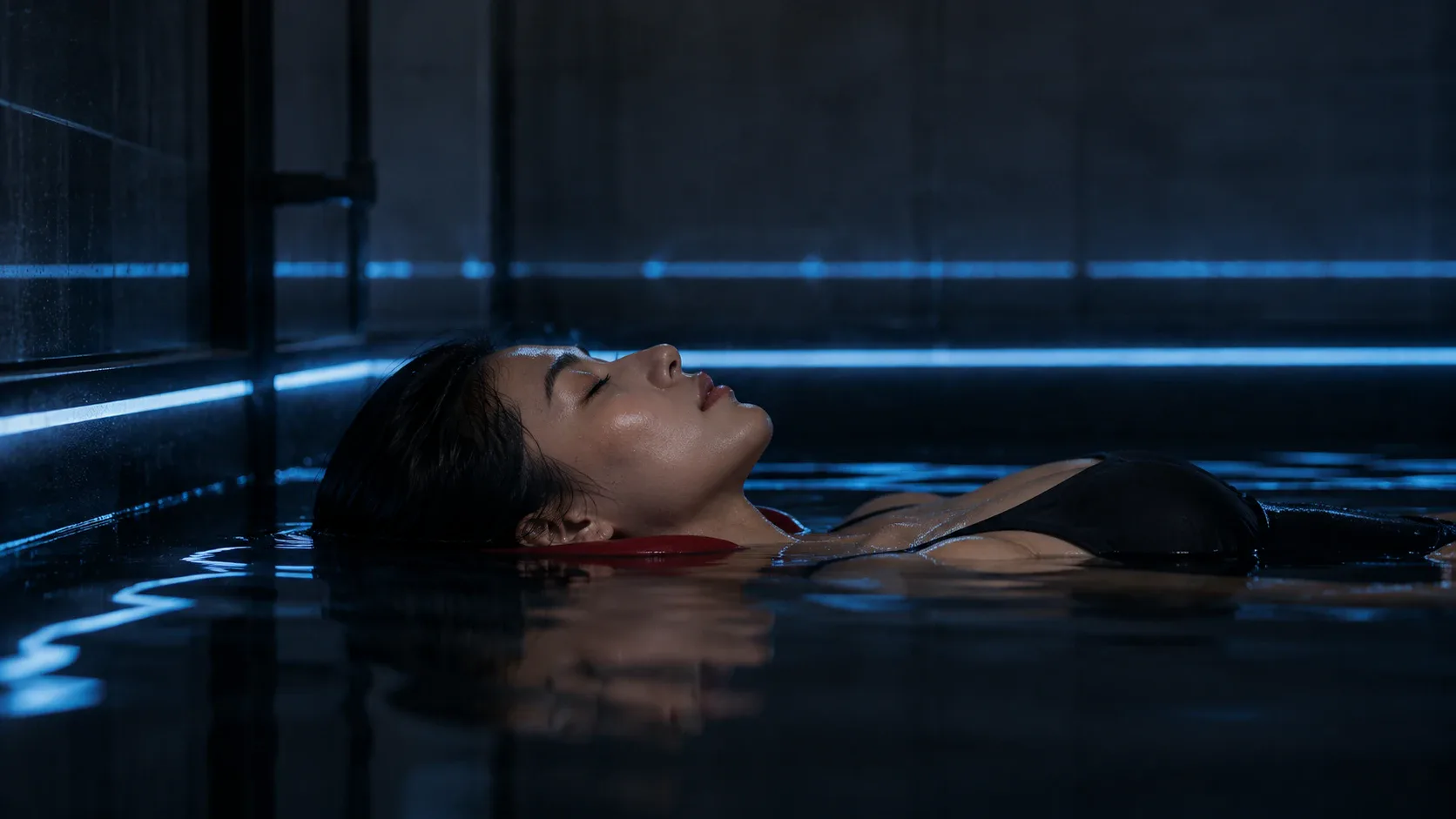
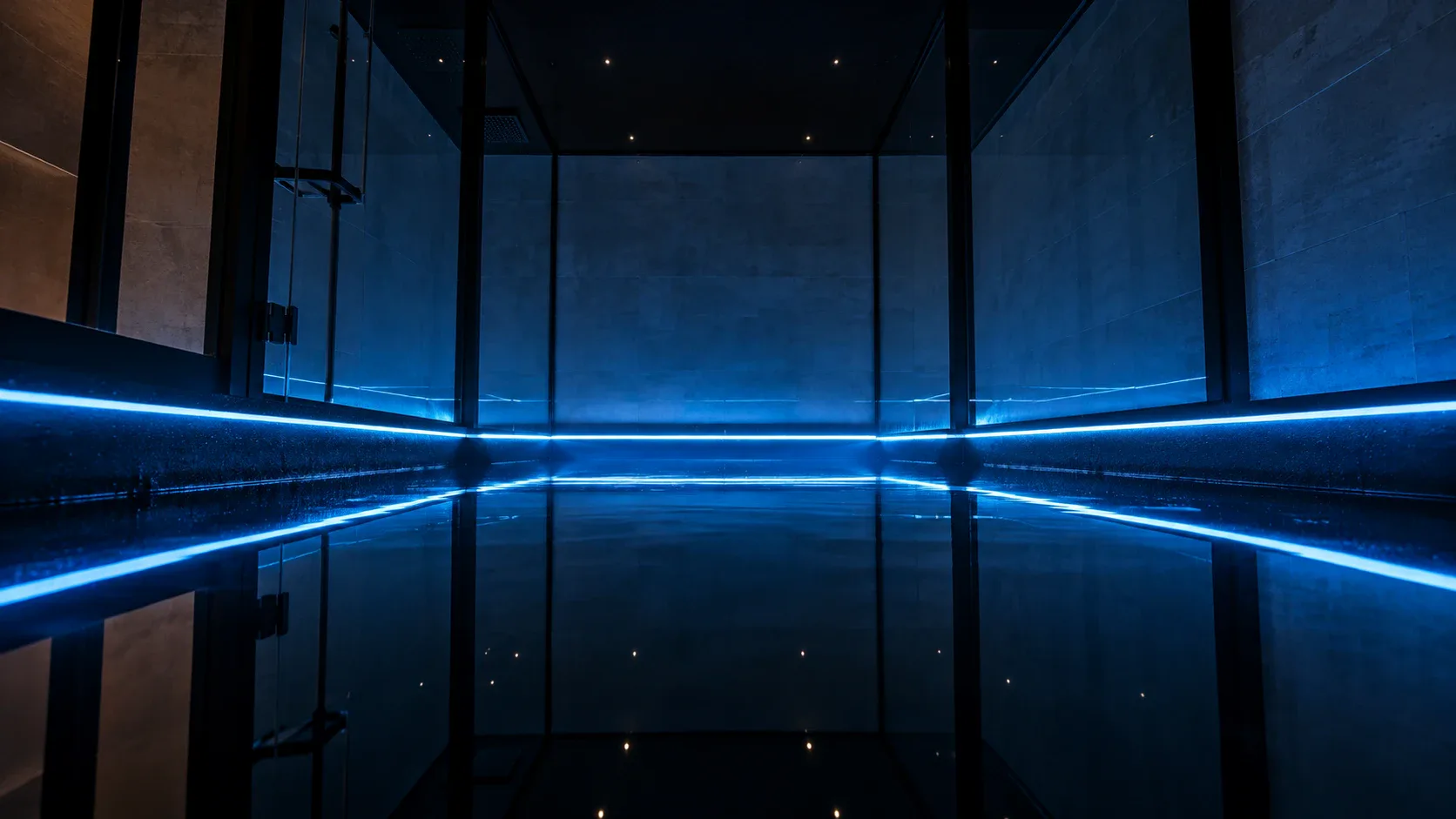
- An open pool, not a pod. Each room has an open rectangular pool, 1.2 × 2.4 m, with about 25 cm of water and 500 kg of Epsom salt. There is no lid to close over you. The room sits behind soundproof, light-blocking glass doors, so it feels like a room, not a capsule.
- You control the light. You can float with the light on for the whole session, dim it, or switch it off when you feel ready.
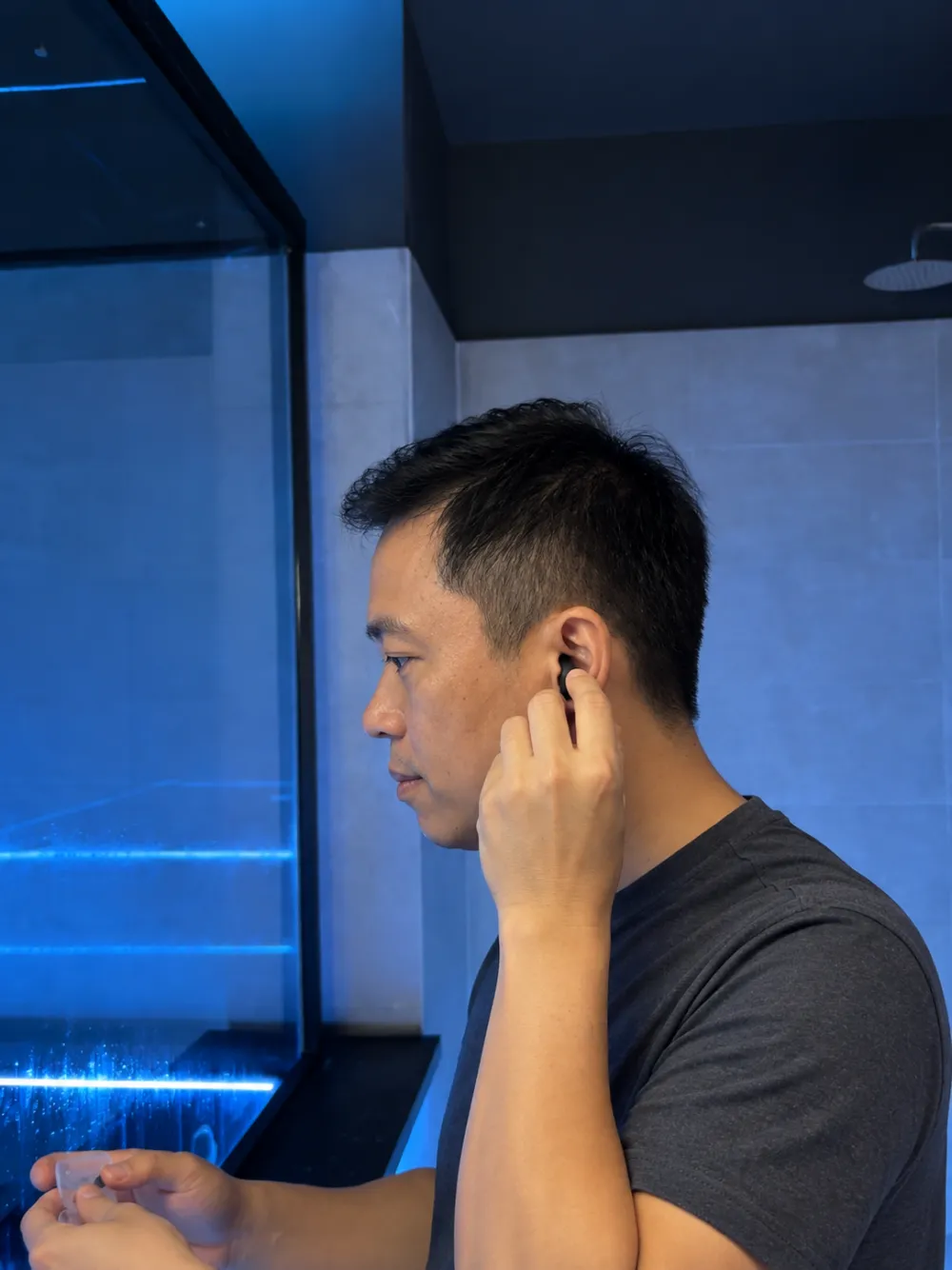
- Support for your neck and ears. A Halo neck pillow is available, and every guest is given earplugs.
- No phone, but not cut off. Your phone can stay at reception or in a locker. In an urgent case, reception knocks on your door.
- A health check first. You fill in a short health questionnaire before every visit.
If you are choosing between centres, our guide to float pods versus float rooms explains the difference. For practical tips, read before your first float.
A gentle first-month plan in Saigon (Ho Chi Minh City)
The first float is often the strangest. Many people spend part of it learning to let go: of their neck, of their thoughts, of the urge to check the time. That is why we suggest a short series rather than one try. Our article on why three float sessions matter explains the reasoning.
- Weeks 1–2: three floats of 90 minutes. Space them a few days apart. The Introduction Package covers exactly this: 3 × 90 minutes for 3,000,000 VND, valid for 3 months, with sauna included.
- After that: every one to three weeks. In the 2025 survey, most regular floaters floated one to three times a month, and felt the effects for one to four days. Find the rhythm that keeps you steady.
- Breathe between floats. A few minutes of slow breathing each day keeps the calm going. Our breathwork guide has simple techniques.
- Protect your sleep. Anxiety and poor sleep feed each other. If nights are hard, see our insomnia plan for Saigon.
- Notice, do not judge. After each float, write one line: how you feel, and how you slept that night. Patterns show up after a few weeks.
Safety, and when to get more help
- Float is not a replacement for therapy or medication. It can sit alongside them. Keep taking any medicine you have been prescribed, and do not change it without your doctor.
- Panic disorder, PTSD or serious symptoms: talk to a doctor or licensed psychologist before you start, and tell them you plan to float. Studies have included people with these conditions, but in a research setting with medical screening.
- If anxiety stops you working, sleeping or leaving the house, or if you have thoughts of harming yourself, please see a doctor or licensed psychologist soon. In an emergency in Vietnam, call 115.
- Pregnancy: ask your doctor first, and tell us when you book.
- During the float: if you feel uneasy, sit up, turn on the light or open the door. You can end the session at any time.
Where to try it in Saigon
Our centre is at 16C Quốc Hương, Thảo Điền, open 9:00–21:00 every day; the last session starts at 20:00. Single Room prices:
| Session | Single Room |
|---|---|
| 60 minutes | 1,500,000 VND |
| 90 minutes | 2,000,000 VND |
| 120 minutes | 2,500,000 VND |
| Introduction Package: 3 × 90 minutes (valid 3 months, sauna included) | 3,000,000 VND |
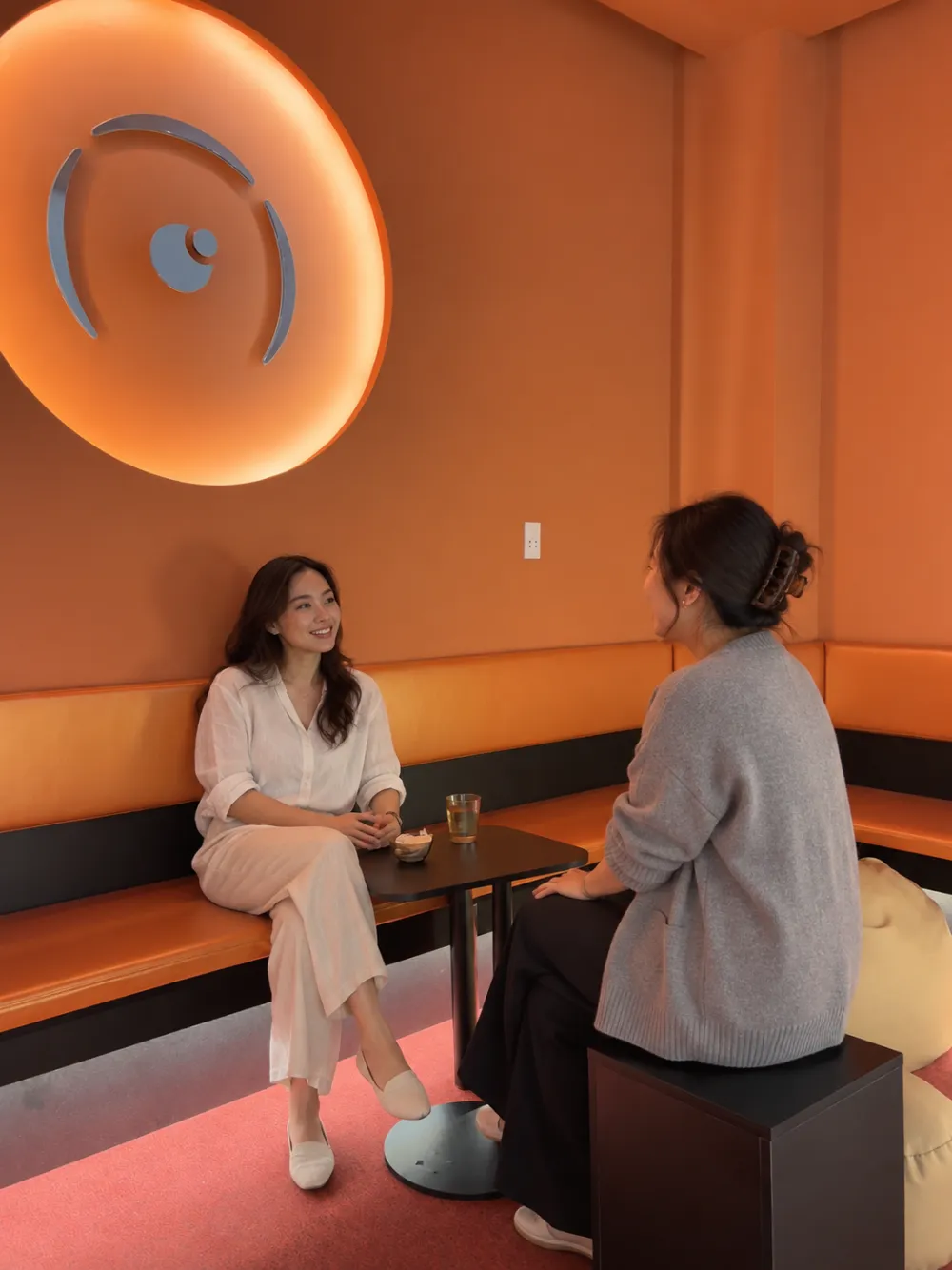
See all options on our services page. After a float, many people like to sit a while before going back into the traffic: a cup of tea and a quiet chat help the calm settle.
FAQ
Does float therapy really help anxiety?
Research says it can. One float sharply lowered state anxiety in 50 people with anxiety disorders, and 12 sessions eased generalised anxiety, with gains still there after six months. Studies are small, so think of it as a helpful tool, not a cure.
How many sessions do I need?
Many people feel calmer after the first float. For a fair test, try three 90-minute floats within two weeks, then float every one to three weeks. The trials that tracked lasting change used 12 sessions over seven weeks.
I get claustrophobic. Can I still float?
Usually, yes. Our pools are open, with no lid, behind glass doors. You can keep the light on all session and get out whenever you want.
Can floating trigger a panic attack?
Some people feel uneasy at first, especially in the dark. You can end the session at any moment. If you have panic disorder, talk to your doctor or psychologist first, and start with the light on and the session short.
Can I float if I take anxiety medication?
Floating does not replace your medication, so keep taking it as prescribed. Mention it on the health questionnaire, and if you are unsure whether floating suits you, ask your doctor first.
How much does float therapy cost in Ho Chi Minh City?
In Thảo Điền, a Single Room costs 1,500,000 VND for 60 minutes, 2,000,000 VND for 90 minutes and 2,500,000 VND for 120 minutes. The Introduction Package is 3 × 90 minutes for 3,000,000 VND.
Sources
- Feinstein JS et al. (2018). Examining the short-term anxiolytic and antidepressant effect of Floatation-REST. PLOS ONE 13(2): e0190292.
- Feinstein JS et al. (2018). The elicitation of relaxation and interoceptive awareness using floatation therapy in individuals with high anxiety sensitivity. Biological Psychiatry: Cognitive Neuroscience and Neuroimaging 3(6): 555–562.
- Jonsson K, Kjellgren A (2016). Promising effects of treatment with flotation-REST as an intervention for generalized anxiety disorder: a randomized controlled pilot trial. BMC Complementary and Alternative Medicine 16: 108.
- Kjellgren A, Westman J (2014). Beneficial effects of treatment with sensory isolation in flotation-tank as a preventive health-care intervention: a randomized controlled pilot trial. BMC Complementary and Alternative Medicine 14: 417.
- Garland MM et al. (2024). A randomized controlled safety and feasibility trial of floatation-REST in anxious and depressed individuals. PLOS ONE 19(6): e0286899.
- Garland MM et al. (2023). Same trial, preprint version (medRxiv), with adherence data.
- van Dierendonck D, te Nijenhuis J (2005). Flotation restricted environmental stimulation therapy (REST) as a stress-management tool: a meta-analysis. Psychology & Health 20(3): 405–412.
- Hilpert K, Chis Ster I (2025). Experiences and perceptions of regular floatation-REST users: results from an online survey. Journal of Clinical Images and Medical Case Reports 6(5): 3600.
- Hruby H, Schmidt S, Feinstein JS, Wittmann M (2024). Induction of altered states of consciousness during Floatation-REST is associated with the dissolution of body boundaries and the distortion of subjective time. Scientific Reports 14: 9316.
Leave a Reply