Author: Duc Nguyen Trung

  • The Art of Doing Nothing

    The Art of Doing Nothing

    Person resting peacefully and daydreaming, embracing the art of doing nothing

    Daydreaming is a perfectly natural and normal part of childhood; it allows children to cultivate a rich imagination, explore exciting new worlds, and envision a bright future. In contrast, adults rarely allow themselves to let their minds wander, often feeling that doing so is a waste of time.

    However, as author Leo Babauta once wrote in an article of the same name, “doing nothing” might appear to be a waste of time, but it can also be an art form. It is a way to improve your life, melt away stress, and boost your productivity.

    1. What Does “Doing Nothing” Really Mean?

    You might say you are “doing nothing” this weekend, yet if your hands are constantly scrolling through social media and your eyes are glued to notifications, you are actually doing quite a lot. Your mind remains active, consuming information and reacting to it.

    “Doing nothing,” in this context, is an act of defiance. It means declining a non-urgent call, ignoring message alerts, or quietly stepping away from a boisterous gathering you didn’t really want to attend in the first place. Within that fiercely guarded personal space, you might spend the entire day catching up on sleep, taking a leisurely stroll with no particular destination, or casually engaging in an activity you haven’t done in ages.

    2. Why Is “Doing Nothing” Beneficial?

    We often feel that every action must be driven by a valid motive or a goal for self-improvement, and that rest is only justified when we are on the verge of exhaustion.

    Yet, the only reason needed to do nothing is simply: because you want to.

    Such spontaneity requires no explanation or permission from anyone else. Sometimes, shedding the armor of the “responsible adult” to embrace unadulterated, unconditional laziness serves as the most potent natural restorative. When you stop trying to control everything around you, your body and mind naturally rediscover their innate rhythm of balance.

    Body and mind finding natural balance through stillness and letting go

    3. How Do You Practice This Art?

    To master this “art,” you need a bit of courage to step outside the box:

    Go “tech-free”: Turn off your phone or switch on “Do Not Disturb” mode for the morning.

    Flip your routine: Put on your most glamorous outfit, spritz on your most expensive perfume, and sit alone in your living room eating a bowl of instant noodles. Try breaking familiar conventions to find something fresh.

    Redefine joy: Joy doesn’t have to mean exotic trips or grand milestones. It can be as simple as curling up in a warm blanket all day and indulging in “unproductive” activities to your heart’s content.

    (And hey, if you’re reading this right now while your to-do list is piling up… perhaps this is the universe’s way of telling you: It’s time to pause and simply “do nothing”!)

    4. Where Can You “Do Nothing”?

    There are no limits to where you can practice doing nothing, provided the space allows you to completely withdraw from the hustle and bustle:

    Right in your bedroom: A place where you can sleep until you wake up naturally, wrap yourself in a warm blanket, put on an old movie, or slowly turn the pages of a book. In a quiet corner of the garden: A place to sow a new flower seedling, leisurely water the plants, or simply lie on the porch watching wisps of cloud drift slowly across the sky.

    In the cozy kitchen: A space to take your time preparing ingredients and cooking a dish that might be a bit unusual or spontaneous, yet serves as the ultimate act of self-indulgence.

    5. “Doing Nothing” at the highest level.

    But have you ever considered experiencing a state of “doing nothing” on a completely different level?

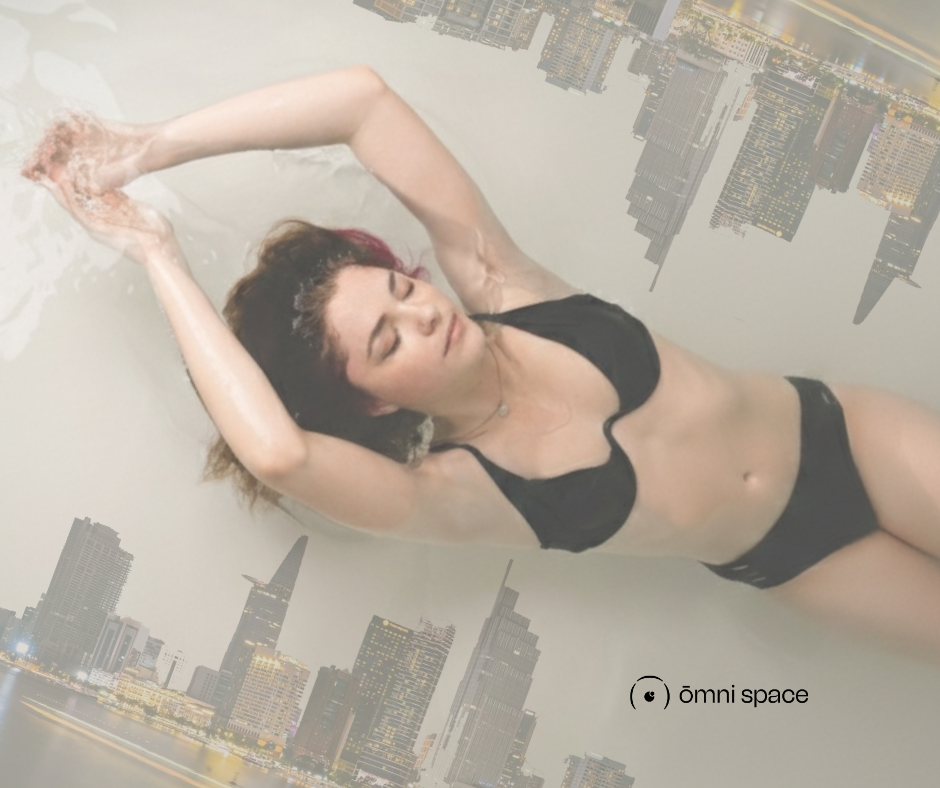
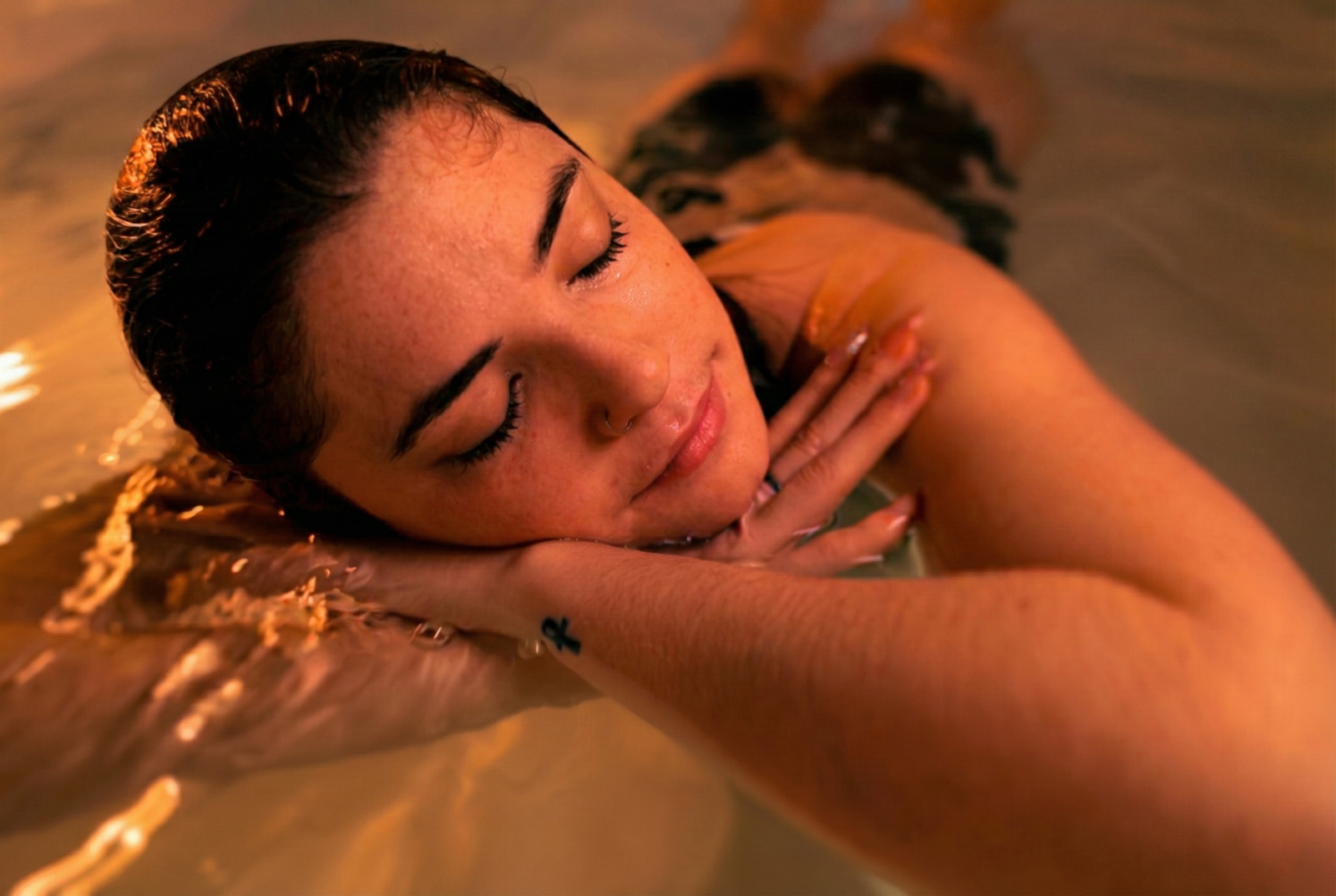
    Picture a space entirely set apart: no light, no noise, no other people, and (believe it or not) no gravity. Floating Meditation at Omni Space offers a fascinating way to experience such a moment of absolute respite. As your body drifts freely on the surface of warm saltwater, your senses are liberated from external stimuli. Here, “doing nothing” reaches its purest form: there is no need to balance or think; nothing remains but the simple existence of your breath and your own self.

    Conclusion

    Ultimately, the art of “doing nothing” is the highest form of self-love.

  • Ultimate BioHacker: The Muscle Grow faster outside the Gym

    Ultimate BioHacker: The Muscle Grow faster outside the Gym

    Athlete recovering muscles with float therapy after an intense gym workout

    For the intellectually driven fitness enthusiast, training is rarely a matter of mere physical exertion; it is an equation of biological optimization. We meticulously calculate our calories ratios, track our progressive overload, and measure our training volume. Yet, a critical blind spot persistently compromises the effectiveness of our physical efforts: the fundamental misunderstanding of where muscular adaptation actually transpires.

    Contrary to conventional belief, muscle hypertrophy does not occur during your high intensity resistance training sessions. Within the gym walls, you are not constructing a physiological fortress; you are actively pushing it toward systemic exhaustion.

    The Physiology of Micro Trauma and Central Nervous System Fatigue

    From a physiological standpoint, resistance training acts as a profound stressor. When lifting near maximal loads, muscle fibers undergo structural micro tears , a process known as exercise induced muscle damage (EIMD). Concurrently, your acute endocrine response triggers a surge in cortisol (the primary catabolic hormone) while your sympathetic nervous system operates at its absolute peak to sustain the “fight or flight” response.

    Furthermore, high intensity training places an immense burden on the Central Nervous System (CNS). The continuous, rapid fire firing of motor units depletes neurotransmitters, leading to neuromuscular fatigue. If this catabolic state is prolonged without a strategically engineered countermeasure, your body enters a phase of diminishing returns. The result? Stagnation, hormonal imbalance, and the counterproductive degradation of lean muscle tissue.

    Reconceptualizing the Recovery Equation

    To truly biohack your physiology, you must embrace a fundamental paradigm shift: Training is merely the catalyst; recovery is the actual execution.

    True muscular growth, scientific progression, and cognitive restoration occur exclusively during states of deep parasympathetic dominance. This is where the body shifts from a state of breakdown (catabolism) to a state of systemic repair and synthesis (anabolism). For the high achieving individual navigating a demanding career alongside a rigorous fitness regimen, standard sleep and nutrition are often insufficient to counteract the compounding cognitive and physiological stressors.

    To unlock the next frontier of human performance, we must look beyond the conventional recovery paradigm. It requires a deliberate, hyper efficient intervention that can systematically down regulate the nervous system, neutralize cortisol production, and accelerate cellular repair.

    Optimization is not achieved by simply adding more stress to the equation; it is mastered by mastering the art of the profound pause and this is precisely where Float Therapy (Restricted Environmental Stimulation Therapy, or R.E.S.T.) serves as the ultimate physiological override.

    The Perfect Intervention: How Float Therapy Weaponizes Recovery

    Float Therapy is not a passive “spa day” luxury; it is a hyper-efficient, non-invasive biohacking tool engineered to systematically down-regulate the nervous system, neutralize cortisol, and accelerate cellular repair. By isolating the body from all external stimuli, it forcefully shifts your biology into an optimal anabolic state through three distinct mechanisms:

    1. Zero-Gravity Decompression and Enhanced Blood Flow

    Floating in a super-saturated solution of 500kg of Epsom salt (magnesium sulfate) creates an environment of total weightlessness.

    • By eliminating hydrostatic pressure and the effects of gravity, the physical burden on your joints, spine, and recovering muscle groups drops to zero.

    • This absolute offloading causes peripheral blood vessels to dilate (vasodilation), dramatically increasing the delivery of oxygen, amino acids, and vital nutrients directly to the micro-tears in your muscle tissues.

    • Concurrently, it accelerates the removal of metabolic waste products, such as blood lactate, cutting down recovery downtime significantly.

    2. The Transdermal Magnesium Infusion

    The high concentration of magnesium sulfate acts as a direct biochemical treatment for exhausted muscles.

    • As your skin absorbs magnesium transdermally during a float, it replenishes the intracellular magnesium levels severely depleted during intense muscular contractions.

    • Magnesium is the key element responsible for down-regulating muscle spindles, preventing nocturnal cramping, regulating protein synthesis, and reducing systemic inflammation.

    3. Neurological Reset: The Theta State Cascade

    The most profound impact of Float Therapy happens between your ears. By blocking out 90% of sensory input (light, sound, and tactile variance), the brain is liberated from its heavy cognitive load.

    • Within 20 to 30 minutes of a float, your brain waves drop from high-alert Beta frequencies down to the elusive Theta State, a state typically reserved for deep REM sleep or hours of advanced meditation.

    • This neurological shift signals the endocrine system to forcefully suppress cortisol production while unleashing a cascade of endorphins and dopamine.

    By systematically silencing the sympathetic nervous system and forcing immediate parasympathetic dominance, Float Therapy provides the pristine biological landscape required for rapid tissue synthesis. It is the ultimate system reboot, allowing high performers to train harder, adapt faster, and return to peak physical execution without the compounding tax of systemic fatigue.and this is precisely where Float Therapy (Restricted Environmental Stimulation Therapy, or R.E.S.T.) serves as the ultimate physiological override.

    The Perfect Intervention: How Float Therapy Weaponizes Recovery

    Float Therapy is not a passive “spa day” luxury; it is a hyper-efficient, non-invasive biohacking tool engineered to systematically down-regulate the nervous system, neutralize cortisol, and accelerate cellular repair. By isolating the body from all external stimuli, it forcefully shifts your biology into an optimal anabolic state through three distinct mechanisms:

    1. Zero-Gravity Decompression and Enhanced Blood Flow

    Floating in a super-saturated solution of 500kg of Epsom salt (magnesium sulfate) creates an environment of total weightlessness.

    • By eliminating hydrostatic pressure and the effects of gravity, the physical burden on your joints, spine, and recovering muscle groups drops to zero.

    • This absolute offloading causes peripheral blood vessels to dilate (vasodilation), dramatically increasing the delivery of oxygen, amino acids, and vital nutrients directly to the micro-tears in your muscle tissues.

    • Concurrently, it accelerates the removal of metabolic waste products, such as blood lactate, cutting down recovery downtime significantly.

    2. The Transdermal Magnesium Infusion

    The high concentration of magnesium sulfate acts as a direct biochemical treatment for exhausted muscles.

    • As your skin absorbs magnesium transdermally during a float, it replenishes the intracellular magnesium levels severely depleted during intense muscular contractions.

    • Magnesium is the key element responsible for down-regulating muscle spindles, preventing nocturnal cramping, regulating protein synthesis, and reducing systemic inflammation.

    3. Neurological Reset: The Theta State Cascade

    The most profound impact of Float Therapy happens between your ears. By blocking out 90% of sensory input (light, sound, and tactile variance), the brain is liberated from its heavy cognitive load.

    • Within 20 to 30 minutes of a float, your brain waves drop from high-alert Beta frequencies down to the elusive Theta State, a state typically reserved for deep REM sleep or hours of advanced meditation.

    • This neurological shift signals the endocrine system to forcefully suppress cortisol production while unleashing a cascade of endorphins and dopamine.

    By systematically silencing the sympathetic nervous system and forcing immediate parasympathetic dominance, Float Therapy provides the pristine biological landscape required for rapid tissue synthesis. It is the ultimate system reboot, allowing high performers to train harder, adapt faster, and return to peak physical execution without the compounding tax of systemic fatigue.

  • How to Fix Revenge Bed Time

    How to Fix Revenge Bed Time

    Tired person scrolling a phone in bed late at night, revenge bedtime procrastination

    Does this sound familiar? After a long, frantic day of deadlines, meetings, chores, and endless responsibilities, you finally hit the sheets. But instead of turning off the lights, you reach for your phone. You scroll through Facebook, lose yourself in TikTok, catch up on news, or binge episode after episode on Netflix.

    This is your “me time”: a small act of “revenge” for a day sacrificed to everyone else. This phenomenon has a name: “Revenge Bedtime Procrastination.”

    But how do you feel the next morning when the alarm blares? Exhausted, sluggish, your head feeling like lead as you struggle to crawl out of bed. The cycle repeats day after day. Why does an act you consider a “self-reward” leave you feeling more depleted? The truth is: When you are “scrolling,” your brain isn’t actually resting. It’s being tricked into working harder than you realize.

    The “Revenge” is Real, but You are the Victim

    Psychologically, Revenge Bedtime Procrastination is completely understandable. It stems from a very legitimate need: the desire for control and autonomy. All day long, your time is dominated by work, family, and social obligations. The late-night hours, when the world is quiet and everyone else is asleep, are when you reclaim that control. You want to enjoy a freedom that no one can interrupt.

    However, therein lies a painful paradox: You are taking “revenge” on your own opportunity to recover and regenerate. You are stealing the most precious resource needed to prepare for a new day: deep, high-quality sleep. Instead of avenging a day gone by, you are essentially shooting your “tomorrow self” in the foot.

    The Scrolling Trap: Your Brain is Being Stimulated, Not Rested

    Let’s look deeper into what happens to your brain and nervous system when you lie in bed with a glowing screen:

    1. Blue Light: The Sleep Thief

    Screens emit significant amounts of blue light. This short-wavelength, high-energy light has a powerful impact on your circadian rhythm. It severely suppresses the production of melatonin, the hormone that signals your body it’s time to sleep. Essentially, you are shining a flashlight directly at your pineal gland and commanding it to “STAY AWAKE!” Your brain is fooled into thinking it’s still daytime, throwing your biological clock into total chaos.

    2. Dopamine & The Infinite Loop

    Every time you swipe for a new post, every time a short video starts, every time you see a “like” or comment, your brain is “rewarded” with a hit of dopamine. This is the hormone of excitement and pleasure. Sounds good? Not quite. You are pushing your brain into a state of “stressful arousal.” It remains in “anticipation mode,” processing new information, images, and emotions. This state is functionally identical to high-stress work, not rest.

    In contrast, true rest (lights off, silence) allows the brain to shift from Beta waves (alert/active) to Alpha waves (light relaxation) and Theta waves (deep relaxation/creativity), the states where actual repair happens.

    3. The “Fragmented Attention” Effect

    When scrolling, you aren’t fully relaxed, nor are you fully focused. You exist in a “half-way” state of fragmented attention: your mind is stretched between trying to relax your body and constantly processing screen stimuli. This state is incredibly draining on mental energy. It’s like trying to run a marathon while attempting to nap; neither is successful, and you end up utterly exhausted.

    The Double Blow: Physical Decay and Mental Fog

    The consequences of this habit hit your health from two sides:

    • On Sleep: You might still get 7–8 hours, but it’s shallow, low-quality sleep. You struggle to reach Deep Sleep and REM stages, the two most critical phases for cellular repair, memory consolidation, emotional processing, and “flushing out” neuro-waste from the brain. You wake up feeling like you haven’t slept at all.

    • On the Next Day: Fatigue accumulates. You struggle to focus, your memory falters, and you become irritable and impatient. This adds more pressure to your day, which makes you crave “revenge” even more that night. A toxic cycle is formed.

    In short, you think you’re gifting yourself 1–2 hours of freedom, but you’re actually taking out a high-interest loan, paying for it with the energy, clarity, and long-term health of your entire next day.

    The Alternative: Give Your Brain a Real Vacation

    How do you break the trap? The answer lies in clearly separating “stimulation space” from “rest space.”

    • Create a “Digital Sunset”: Set a fixed time (at least 60 minutes) before bed to turn off all electronic screens.

    • Switch to Low-Stimulation Activities:

      • Read a physical paper book (not a backlit tablet).

      • Listen to instrumental music, calm podcasts, or nature sounds.

      • Journal or write down small things you’re grateful for.

      • Do gentle stretching or deep breathing (4-7-8 technique).

      • Meditate for 5–10 minutes to quiet the mind.

    • Optimize Your Environment: Ensure your bedroom is completely dark, quiet, and cool.

    For many people, especially founders, creatives, and high-level professionals, self-triggering that “off switch” is incredibly difficult. The mind keeps racing with work, anxieties, and plans. That’s when you need a more radical “reset.”

    Float Therapy: The “Power Off” Switch for Your Nervous System

    This is exactly why Float Therapy is such a powerful tool to break the “Revenge Bedtime” cycle.

    • An Environment with No Choice But Rest: In a float pod, you enter a space designed to eliminate all external stimuli: no light, no sound, no gravity, no temperature fluctuations. Your brain, after a few minutes of “searching” for something to process, is forced to realize: “Oh, there’s nothing to do. I guess I’ll rest.”

    • Forced Relaxation: In zero-gravity and sensory isolation, the Sympathetic Nervous System (fight or flight) “shuts off,” and the Parasympathetic Nervous System (rest and digest) is fully activated. The brain quickly shifts into the Theta wave state, a deep, creative relaxation usually found only in light sleep or very deep meditation.

    After 60–90 minutes of floating, you emerge with a body relieved of spinal pressure and a mind that has been “decluttered.” The internal noise subsides. You feel a sense of true peace, rather than the “wired” fatigue of a dopamine binge. That night, you will fall into a natural, high-quality sleep without the urge to reach for your phone.

    From “Revenge” to “Kindness”

    Revenge Bedtime Procrastination is a false solution. It gives you the feeling of freedom but imprisons you in a cycle of exhaustion. The kindest thing you can do for yourself is not staying up late to scroll, but gifting your nervous system the luxury of undisturbed rest.

    Deep relaxation and good sleep are not luxuries; they are the foundations of health, creativity, and a fulfilling life. Sometimes, the most effective way to move forward is to know how to stop and completely power down.

    Are you ready to flip that switch?

    Float Saigon – Omni Space Giving your mind the stillness it deserves.

    #RevengeBedtimeProcrastination #SleepHygiene #MentalHealth #FloatTherapy #DigitalDetox #StressRelief #SleepQuality #Wellness #SelfCare #Neuroscience #FloatSaigon #OmniSpace

  • Float Therapy: Why Epsom Salt is the Secret to Weightlessness

    Float Therapy: Why Epsom Salt is the Secret to Weightlessness

    white concrete building during daytime

    Have you ever wondered how people stay afloat in a sensory deprivation tank without even trying? It’s not magic. It’s a massive amount of Epsom salt.

    Some people might ask: “Can I just do this in my bathtub at home?”, understanding the science of the salt is key to unlocking the full benefits of float therapy.

    What is Epsom Salt? (Hint: It’s Not Actually Salt)

    While it looks like the sea salt in your kitchen, Epsom salt is a naturally occurring mineral compound known as Magnesium Sulfate (MgSO4).

    First discovered in the 1600s in the English town of Epsom, this “bitter saline” was quickly prized for its healing properties. Unlike table salt (Sodium Chloride), which can be drying and abrasive, Epsom salt feels silky to the touch and acts as a powerful muscle relaxant.

    Epsom Salt vs. Sea Salt: Which is Better for Floating?

    If you’ve ever tried to float in the ocean, you know you still have to “tread” slightly to stay up. In a float tank, the goal is zero-effort buoyancy.

    • Sea Salt / Table Salt: Highly irritating to the skin and eyes. If used at the concentrations needed for floating, it would be incredibly harsh and could cause stinging or “salt itch.”

    • Epsom Salt: Known for being “skin-friendly.” It softens the skin, helps with inflammation, and creates a “thick,” oily water texture that feels like a protective cocoon.

    Why 1,000 Pounds? The Science of Buoyancy

    To achieve the “anti-gravity” effect, float tanks aren’t just “salty”. They are saturated.

    A typical float pod contains roughly 800 to 1,500 pounds (360–680kg) of medical-grade Epsom salt dissolved in just 10–12 inches of water. This creates a solution with a Specific Gravity of approximately 1.25 to 1.30.

    The Result: Your body becomes lighter than the water. You float on the surface like a cork, allowing every muscle and joint to decompress completely. This is the only environment on Earth where your body can experience near-total relief from the constant pull of gravity.

    The Magnesium Connection: Mind and Body

    The “float glow” isn’t just a myth. When you soak in a tank, your body is immersed in a high-concentration magnesium solution. Magnesium is essential for over 300 biochemical reactions in the body, including:

    1. Lowering Cortisol: Magnesium helps regulate the nervous system, signaling the brain to move out of “fight or flight” mode.

    2. Muscle Recovery: It helps flush lactic acid and reduces inflammation, which is why athletes use floating for rapid recovery.

    3. Sleep Quality: Magnesium helps the brain produce GABA, a neurotransmitter that encourages relaxation and deep sleep.

    Can I Float at Home in My Bathtub?

    This is the #1 question for wellness enthusiasts. The short answer? You can soak, but you can’t “float.”

    The Challenges of a Home “Float”

    • The Salt Volume: To get the same buoyancy as a commercial tank (which holds 200 gallons), you would need about 400–600 pounds of Epsom salt for a standard bathtub. Not only is this expensive, but your plumbing likely isn’t designed to handle that much mineral concentration.

    • Temperature Control: Float tanks are kept at exactly 93.5°F (34.2°C), the same as skin temperature. In a bathtub, the water cools down quickly, breaking the sensory deprivation “infinity” effect where you can’t tell where your skin ends and the water begins.

    • Sensory Input: True float therapy (REST) requires total darkness and silence. Bathtubs are usually too short to let you fully stretch out without touching the sides, which alerts your brain to your position in space.

    The Verdict: While a home bath with 2–4 cups of Epsom salt is fantastic for muscle soreness, it won’t provide the neurological “reset” of a true sensory deprivation tank.

    Safety and Hygiene: Is it Clean?

    Many people worry about sharing water with others. However, the high salt concentration in a float tank is naturally antimicrobial. Most bacteria simply cannot survive in a 30-40% salt solution.

    Furthermore, professional float centers use:

    • High-End Filtration: The water is typically filtered 3–5 times between every single client.

    • UV and Ozone: These advanced sanitation systems kill any remaining microorganisms.

    • Hydrogen Peroxide: A safe, non-toxic disinfectant often used to keep the water pristine.

    Ready to Experience the Weightlessness?

    Floating is a practice. The more you do it, the better your brain becomes at entering the Theta state, that “half-awake, half-dreaming” zone where true healing happens.

  • Couple Float – Prelude to Harmony Love

    Couple Float – Prelude to Harmony Love

    Illustration of a couple floating side by side in calm, harmonious water

    Why Do Loving Souls Turn to Float as a Prelude to Harmony?

    At its deepest level, love is not made of elaborate declarations or fiery, noisy moments.
    Love is a sacred nakedness when masks fall away, defenses dissolve, and we no longer need to appear “strong” or “composed.”
    What remains is simply who we are: fragile, honest, and open.

    Perhaps that is why more and more couples are drawn to float as a gentle passage, a way of being together that feels unfamiliar, yet strangely intimate.

    When Loving Means Daring to Enter Silence Together

    In everyday life, we love amid constant noise:
    messages calling for attention, work piling up, unnamed expectations, misunderstandings not yet resolved.
    Even when sitting side by side, breath close to breath, the mind can still wander far away.A float tank opens a rare space where time seems to pause.Light fades. Sound dissolves into nothingness. Roles fall away.There, each person quietly returns to their own inner worldand within that return, an invisible thread begins to gently bind two souls together.No need to hold hands.
    No need for exchanged glances.
    Yet one can still feel the warmth of the other’s presence subtle, profound, and deeply resonant.

    A Communion Beyond Words

    Float is not simply “doing something together.”It is meeting within a shared, pure state of being.As the body drifts in warm water, tension melts away, the nervous system softens like an autumn lake without ripples.Layers of armor like control, vigilance, anxiety slowly dissolve.In that moment, many couples sense something difficult to name:
    as if a fine, delicate thread were linking their inner worlds,
    even while each remains peacefully at home within their own universe.This is not a hurried merging.It is two individuals standing fully themselves, yet wholeheartedly open to one another.

    After Float: Softer, Truer Resonance

    The quiet magic does not end in the salt water.

    After floating, the inner world often feels lighter, clearer, unexpectedly open.Conversations that follow take on a different tone:

    • Voices carry less defense

    • Eyes no longer seek to win

    • What was once difficult to say finds gentle passage

    • Listening happens with the whole heart, without haste or judgment

    Not because answers have been found but because the body and mind have been bathed in calm.

    When the inner space is still enough, sharing becomes natural and unforced.

    Float as A Prelude to a Mature Love

    Float is not a grand romantic date filled with spectacle and intensity.It does not provoke dramatic emotion.
    It does not stimulate.
    It does not climax.Yet perhaps this very simplicity is what suits those who wish to move beyond the surface to understand one another more deeply,to be together without the need to perform or embellish.It is a gentle ritual reminding us that:Love is not only about doing things together, it is about being present together.And sometimes, simply passing through a shared stillness of the universe is enoughfor love to be touched again, like a rose blooming in the night, silent, yet profoundly fragrant.Let float become the prelude to harmony between two souls, where silence is not absence,but the place where love finds its most original sound.

  • What to Do After a Float – Journaling Prompts for a Guided Reflection

    What to Do After a Float – Journaling Prompts for a Guided Reflection

    Writing in a journal after a float session to reflect with a clear mind

    After a float, the mind may feel unusually clear.
    Or unusually empty.
    Sometimes both.There is nothing you need to hold on to.Nothing you need to understand right now.This reflection is not about interpreting the experience.It is about giving it a quiet place to land.You don’t need to write well.
    You don’t need to write long.
    Let the words come as they are, or not at all.

    1. Start with the Body

    What the body remembers

    Before the mind begins to explain, the body already knows.

    Take a moment to notice how it feels to be back in gravity.

    • How does your body feel right now, as a whole?

    • Is there any area that feels lighter, heavier, warmer, or unusually clear?

    • How is your breathing without trying to change it?

    • Is there a sensation that remains from the float, even faintly?

    Write in simple language.There is no need to describe everything, only what stands out.

    2. Notice the Inner Climate

    What the mind is doing now

    After deep quiet, the mind behaves differently.

    Sometimes it rushes back.Sometimes it stays suspended, as if unsure what to do next.

    • Is your mind calm, drifting, alert, or very still?

    • Are thoughts moving slowly, or barely at all?

    • Do you feel closer to silence, or to language?

    • Is there something present that you cannot quite name?

    There is no correct state.The noticing itself is enough.

    3. Sense the Emotional Tone

    What moved, without a story

    You may feel nothing in particular.Or you may sense something subtle, without a reason attached.

    Both are valid.

    • Is there an emotional tone present right now?

    • If this feeling had a texture or temperature, what would it be?

    • Are you allowing it to be there, or trying to move past it?

    • What happens if you stay with it for a few breaths?

    Do not ask where it came from.Just let it exist.

    4. Let Insight Appear (If It Does)

    What became simpler

    Not every float brings insight.And insight is not a requirement.

    Sometimes clarity shows up as fewer questions, not better answers.

    • Did anything feel less urgent after the float?

    • Is there a thought that lost its grip?

    • Did a concern become quieter, or more distant?

    • If nothing changed, how does that feel to notice?

    There is nothing missing if nothing appeared.

    5. Bring It Back Gently

    Integrating without effort

    You do not need to act on this experience.You do not need to improve yourself.

    Integration can be very small.

    • Is there something you don’t need to carry as tightly today?

    • Is there a pace that feels more natural right now?

    • How might you treat your body and mind a little more gently for the rest of the day?

    Let the answers remain open-ended.

    Closing

    A float does not ask you to become someone else.It invites you to return to a state that was already there.This reflection is not meant to preserve the experience.It is meant to allow it to pass through, without resistance.When you are ready, close the journal.
    Drink some water.
    Move slowly back into the day.

    Nothing more is required.

  • What Happens to Your Brainwaves in a Float Tank?

    What Happens to Your Brainwaves in a Float Tank?

    Restless mind at rest as brainwaves slow down in a float tank

    You lie down to rest, but your mind keeps going.The body is still, yet thoughts replay conversations, plan tomorrow, or drift into worry.If this feels familiar, you’re not alone.And the reason has less to do with discipline or willpower and more to do with how your brain has learned to operate.

    Why Rest Often Doesn’t Feel Restful

    Modern life trains the brain to stay alert.Notifications, noise, artificial light, constant decision-making. These keep us mentally “on,” even when we’re exhausted.

    So when we try to rest, something strange happens:

    • The body slows down

    • But the mind stays active

    This is why lying on a bed doesn’t always lead to recovery.True rest doesn’t start in the body. It starts in the brain.

    The Missing Piece: Mental Speed

    Your brain is always producing electrical activity.This activity moves at different speeds depending on how alert or relaxed you are.

    These speeds are called brainwaves.

    You don’t need to understand the science in detail to feel the effect. You already experience it every day:

    • When your mind races, your brain is operating fast

    • When you feel calm and clear, your brain slows down

    The problem is that most of us spend too much time in the fast state and very little time in the slower ones.

    A Brain Stuck in Overdrive

    In daily life, the brain often stays in what’s known as beta state:

    • Problem-solving

    • Planning

    • Reacting

    • Monitoring

    Beta isn’t bad. It’s necessary.But when the brain never leaves beta, the nervous system never fully recovers.

    This is why chronic stress feels exhausting even when nothing “big” is happening.

    Slower Brainwaves, Deeper Rest

    Below beta are slower brainwave states:

    • Alpha – calm awareness, clarity, light meditation

    • Theta – deep meditation, dreamlike states, emotional processing

    These states are where:

    • Stress begins to dissolve

    • The nervous system repairs itself

    • Creativity and insight emerge

    In normal life, reaching these states can be difficult. They often appear only just before sleep, or after years of meditation practice.

    What Changes Inside a Float Tank

    A float tank quietly removes the conditions that keep the brain alert.

    Inside the tank:

    • There is no light to process

    • No sound to monitor

    • No gravity pulling on the body

    Nothing demands attention.

    When the brain no longer needs to scan the environment for input, it does something natural:it slows down.

    Without effort, without technique.

    The Brainwave Shift During Floating

    Many people experience a gentle progression:

    • First, mental chatter softens

    • Breathing slows

    • The body feels heavier, yet supported

    This is the brain moving from beta into alpha.

    As the session continues, thoughts become more abstract. Time feels less defined. Images or sensations may appear and fade.

    This is often theta, a state many describe as:

    “Not asleep, not awake, but deeply rested.”

    Why This State Feels So Powerful

    Theta is where the brain:

    • Processes emotions without judgment

    • Integrates experiences

    • Releases mental tension

    It’s also why people often leave a float feeling:

    • Clear-headed

    • Emotionally lighter

    • As if they’ve rested far longer than the clock suggests

    This isn’t imagination.It’s the nervous system finally accessing a slower, restorative rhythm.

    Not Sleep, but Something Different

    Floating isn’t about sleeping.

    Sleep disconnects awareness.Floating allows awareness to remain while the brain rests.

    That combination of deep rest with gentle awareness is rare in modern life. And profoundly restorative.

    Why This Matters Today

    In a world that rarely slows down, the ability to access slower brain states is no longer a luxury. It’s a form of maintenance.

    Without it:

    • Stress accumulates

    • Sleep quality declines

    • Mental clarity fades

    With it:

    • Recovery accelerates

    • Focus improves

    • The nervous system becomes more resilient

    A Space That Allows the Brain to Rest

    At Omni Space, float rooms are designed to support this shift. Not through stimulation, but through removal.

    When the brain feels safe enough, it doesn’t need to be forced into rest.It returns there naturally.🌊Experience what happens when your brain finally slows down.👉 Book your float at https://omnispacevn.com

  • The Luxury of a Quiet Space: Why Silence Is the New Necessity of Modern Life

    The Luxury of a Quiet Space: Why Silence Is the New Necessity of Modern Life

    Quiet, calm space offering a peaceful escape from constant noise and connection

    We live in an age of unprecedented connection.Messages arrive instantly. Cities pulse without pause. Information flows faster than thought itself.

    Somewhere along the way, we began to mistake frenzy for modernity, and noise for luxury.

    But when sound becomes the default, silence becomes rare.And what is rare, intentional, and difficult to access has always defined true luxury

    When Noise Became Normal

    Modern cities are designed for stimulation. Traffic hums. Notifications vibrate. Conversations overlap. Even moments meant for rest are filled with background sound, music in elevators, voices in cafés, screens everywhere.This constant stimulation has quietly reshaped our nervous systems. We are alert even when we don’t need to be. Restless even when we stop moving.The result? We may be physically present, but mentally fragmented.

    The Shift in What Luxury Means

    Luxury used to mean more: More space. More objects. More experiences.

    Today, that definition is changing.

    The most refined luxury is no longer excess, it is discernment. Not accumulation, but subtraction.

    In a world that offers everything, the ability to remove what overwhelms becomes a mark of sophistication.

    Silence is no longer empty. It is curated. Designed. Protected.

    Silence as a Designed Experience

    True silence doesn’t happen by accident especially in a city. It requires intention, architecture, and care.A quiet space is not just a room without sound. It is an environment where the mind no longer needs to defend itself.

    When silence is paired with stillness, warmth, and safety, something shifts:

    • Breathing slows.

    • Muscles release.

    • Thoughts soften rather than disappear.

    This is not escapism. It is regulation.

    Why the Mind Needs Quiet to Function Well

    Our brains are not built for constant input. Without pauses, the nervous system stays in a low-grade state of alert.

    Silence allows the mind to:

    • Integrate experiences rather than react to them

    • Recover from decision fatigue

    • Return to clarity and perspective

    This is why moments of quiet often feel unfamiliar at first, almost uncomfortable. They reveal how rarely we allow ourselves to truly stop.

    But once the nervous system adapts, silence becomes nourishing.

    Curated Peace as a Modern Essential

    In the past, silence was associated with retreat; something you had to leave the city to find. Today, silence must be created within it.Curated peace is not passive. It is a conscious choice to design spaces that support:

    • Mental clarity

    • Emotional balance

    • Deep rest

    This is why quiet spaces are emerging as the new cultural landmarks of modern life; not loud statements, but subtle sanctuaries.

    Redefining Sophistication

    Sophistication today is not about being constantly available. It’s about knowing when to disconnect.It’s the ability to step out of noise without losing relevance. To pause without falling behind.Silence signals confidence. Stillness signals control.

    Those who can rest deeply can think clearly and those who think clearly move through the world with intention.

    The Future Is Quieter Than We Think

    As cities grow louder, the desire for quiet will only intensify. Not as an escape, but as a counterbalance.

    Silence will become:

    • A marker of wellness

    • A tool for creativity

    • A foundation for sustainable performance

    And the most valued spaces will not be the most stimulating ones but the ones that allow us to hear ourselves again.

    A Space Designed for Silence

    At Omni Space, we believe silence is not the absence of life it is the condition that allows life to reorganize itself.

    In a city that never stops, we’ve created a place where stillness is intentional, protected, and deeply restorative.

    Because in modern life, silence is no longer optional. It is necessary.🌊Discover the luxury of quiet at Omni Space 👉https://omnispacevn.com

  • Floating for Sleep Optimization: The Science Behind Deep Rest

    Floating for Sleep Optimization: The Science Behind Deep Rest

    Person sleeping deeply and peacefully, illustrating floating for better sleep

    In today’s overstimulated world, good sleep has become a luxury. We scroll before bed, think about work even while lying down, and wake up tired the next morning. For many people, the body is resting, but the mind never truly stops.

    That’s where Float Therapy comes in.

    What Happens When You Float

    During a float session, your body drifts effortlessly in warm water filled with 500 kg of Epsom salt. The temperature matches your skin, and there’s no light, sound, or gravity pulling on you.

    This is not just relaxation. It’s a neurological reset.

    When sensory input drops close to zero, your brain no longer needs to process sight, sound, or physical tension. This shift triggers the parasympathetic nervous system, also known as the “rest and digest” mode, the biological opposite of stress.

    Inside this environment, your brain waves naturally slow down from busy beta states to alpha and theta, the same stages you experience just before deep sleep or meditation.

    How Floating Improves Sleep Quality

    Scientific research shows that floating can significantly reduce cortisol, the hormone that keeps your body in stress mode. Lower cortisol = easier transition into restful sleep.

    Float therapy also increases dopamine and serotonin, the neurotransmitters that stabilize mood and regulate your sleep cycle. Many first-time floaters report feeling deeply rested and sleeping longer than usual that night, even if they usually struggle with insomnia.

    Over time, regular floating helps your nervous system “learn” what calm feels like, making it easier to fall asleep and stay asleep.

    The Hidden Benefit: Resetting Your Default Mode Network

    When you lie in stillness, your brain’s Default Mode Network (DMN), the region active during mind-wandering and overthinking, starts to quiet down. This mental silence is what allows deep rest to happen.

    In float therapy, this happens naturally. The constant background chatter fades, and the body’s natural repair mechanisms take over.

    What to Expect After a Float

    After your first float, you might notice:

    • Falling asleep faster than usual

    • Fewer middle-of-the-night awakenings

    • Waking up refreshed, without the usual “mental fog”

    Some people describe it as “the best nap I never had.”

    A New Kind of Rest

    Float therapy doesn’t replace sleep. It enhances it. It gives your body and mind the space to fully disconnect, so your natural rhythms can restore themselves.

    At Omni Space, our float rooms are designed as sanctuaries of silence: a place to escape stimulation, recover from burnout, and experience what true rest feels like.

    🌙 Ready to experience it yourself? 👉Book your float at Omni Space

  • Float vs. Meditation: Different Paths to the Same State of Mind

    Float vs. Meditation: Different Paths to the Same State of Mind

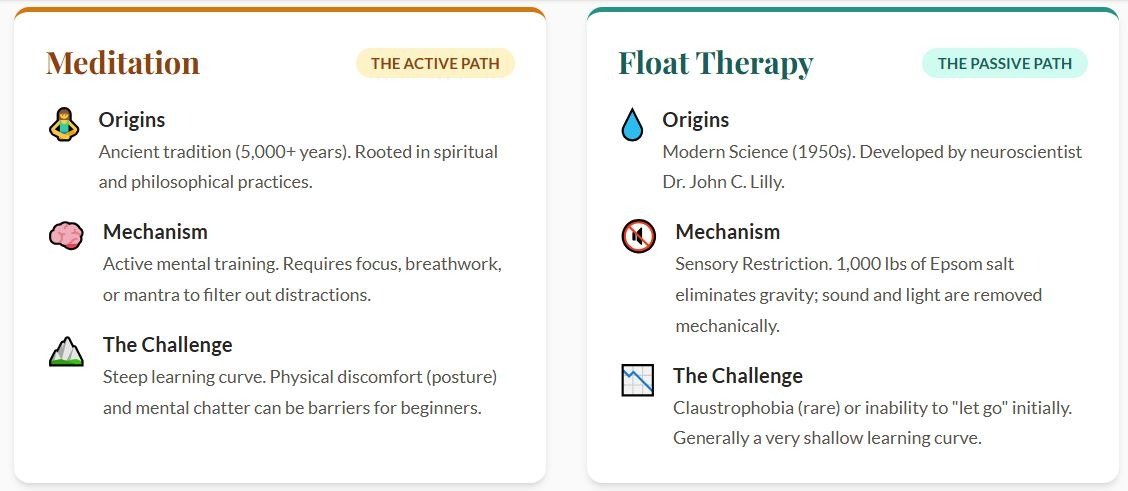
    Comparison of the history of meditation and float therapy

    Meditation has been practiced for thousands of years to calm the mind and cultivate awareness. Float therapy, on the other hand, is a modern innovation that uses science and technology to create a similar inner state.

    At first glance, they look different. But when we look deeper, float therapy and meditation often lead to the same state of mind: calm, clarity, and presence.

    The Goal: Quieting the Mind

    Both meditation and floating share one intention: to quiet the endless mental chatter and help you reconnect with yourself.

      Meditation: You use something as an object of attention like breath, bodily feeling, mantra, or awareness of thoughts as an anchor. Over time, this trains your brain to reduce distractions and maintain focus.

    • Float Therapy: The environment itself (silence, darkness, and weightlessness) removes distractions for you. The tank does the “heavy lifting,” so your mind naturally shifts inward.

    • How the Brain Responds

      Scientific research shows that both meditation and floating affect the Default Mode Network (DMN), the part of the brain responsible for daydreaming, self-talk, and rumination.

      In Meditation: Long-term practice reduces DMN activity, which is why experienced meditators often feel peaceful and centered.

    • In Floating: Studies using fMRI scans suggest floating can quiet the DMN after just a single session, even for beginners.

    • (Sources: Taking the body off the mind: Decreased functional connectivity between somatomotor and default‐mode networks following Floatation‐REST – PMC, Raichle, 2015 – Annual Review of Neuroscience)

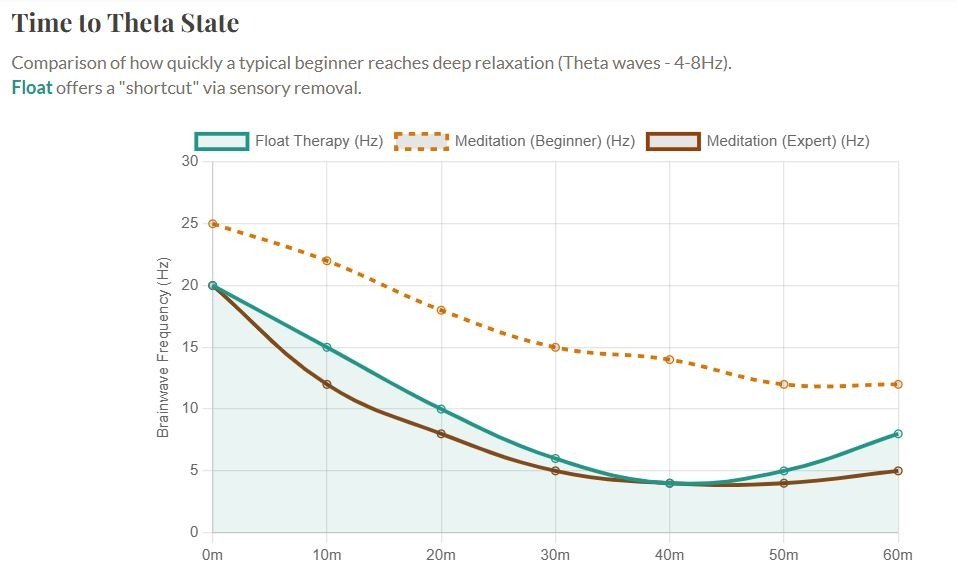
      Both practices are also analyzed for their ability to promote lower-frequency brainwave states, which are intrinsically linked to deep relaxation and altered states of consciousness. The general progression involves moving from the high-frequency Beta waves of normal cognitive engagement toward Alpha waves, associated with calm, wakeful relaxation.

    Chart comparing how quickly meditation and floating reach the theta brainwave state

    The key convergent state is the increase in Theta wave activity, which is strongly associated with deep relaxation, dreaming, and profound meditative states. EEG studies have confirmed that flotation therapy significantly increases theta brain wave activity. A notable difference is the speed of induction: studies have shown that a rapid, profound Theta activity can be produced in as little as 15 to 20 minutes during a single 60 minute float session. This rapid induction mirrors the deep meditative states that might typically require years of practice for an experienced meditator to reliably access. While long-term meditators consistently exhibit increased Alpha and Theta coherence, the induction is necessarily gradual, requiring continuous, effortful focus.

    The Experience

    • Meditation: Often practiced seated, in stillness or with gentle focus. It requires discipline, patience, and repetition. Some people struggle with restlessness or find it hard to sit quietly.

    • Floating: You lie effortlessly in warm, salty water. No gravity, no external noise, no effort required. The stillness is built into the environment.

    For many people, floating feels like “cheating at meditation” you reach a deep state without the years of practice.

    Unique Benefits of Each

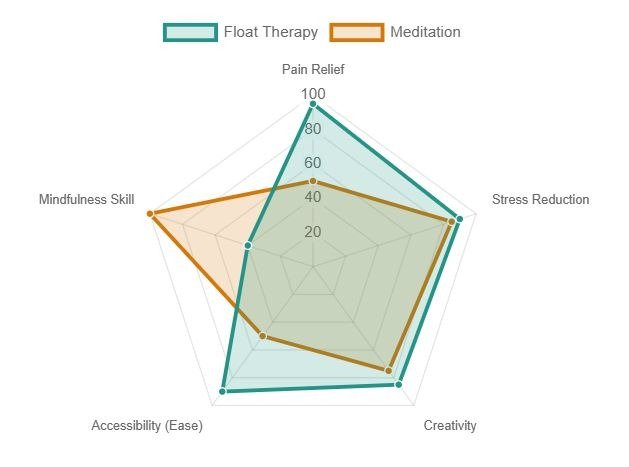
    Side-by-side comparison of the effects of meditation and float therapy

    Meditation:

    • Can be done anywhere, anytime

    • Builds long-term mindfulness

    • Enhances emotional regulation and compassion

    Floating:

    • Provides immediate deep relaxation

    • Supports physical recovery (muscle repair, joint release)

    • Delivers consistent, distraction free environment

    Together, they form a powerful duo: floating can accelerate meditation, and meditation can help seasoned floaters deepen their inner journey.

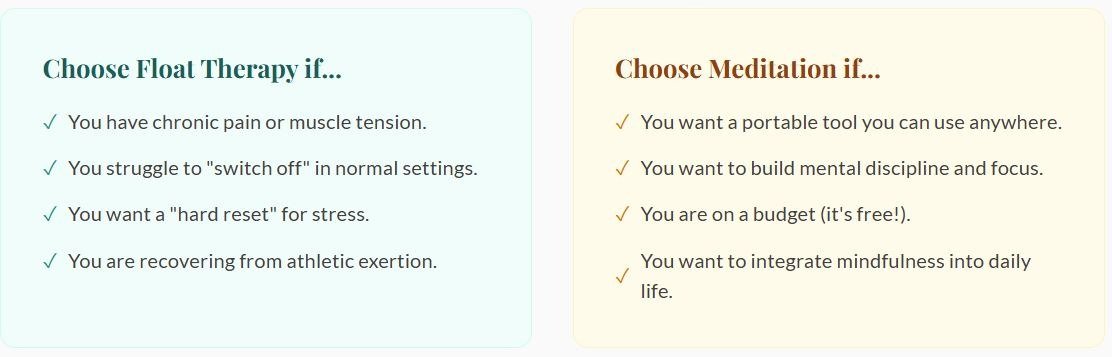
    Which One Is Right for You?

    If you:

    • Want a daily practice → Start with meditation.

    • Struggle to “switch off” your mind → Try floating for a jumpstart.

    • Are seeking physical recovery + mental clarity → Floating may be your best first step.

    • Value a lifelong tool for awareness → Meditation is essential.

    The truth is, you don’t have to choose. Many people use both: float therapy as the reset button, and meditation as the daily practice.

    Float therapy as a reset and meditation as a daily practice

    Float Your Way Into Meditation

    At Omni Space in Thảo Điền, we see floating as the bridge between modern life and timeless meditation. For beginners, it’s the easiest way to taste silence. For seasoned meditators, it’s a chance to go even deeper.

    👉 Book your float session today and experience how effortlessly your mind can arrive at stillness.