
In short: Binaural beats are a sound illusion: two slightly different tones, one in each ear through headphones, create a “beat” your brain makes up. They may ease anxiety a little, especially before stressful moments, but the claim that they tune your brainwaves is not proven. There is no good evidence that 432 Hz or “healing frequencies” are special.
This guide was written by the team at Ōmni Space in Thảo Điền, Ho Chi Minh City. We opened Vietnam’s first float centre (Float Vietnam, Hanoi, 2017), and we ask the same question of every wellness trend: what does it do for the nervous system, and how strong is the evidence? Here is what binaural beats and 432 Hz music are, what the studies found, and how to try them safely. This is general information, not medical advice.
What are binaural beats?
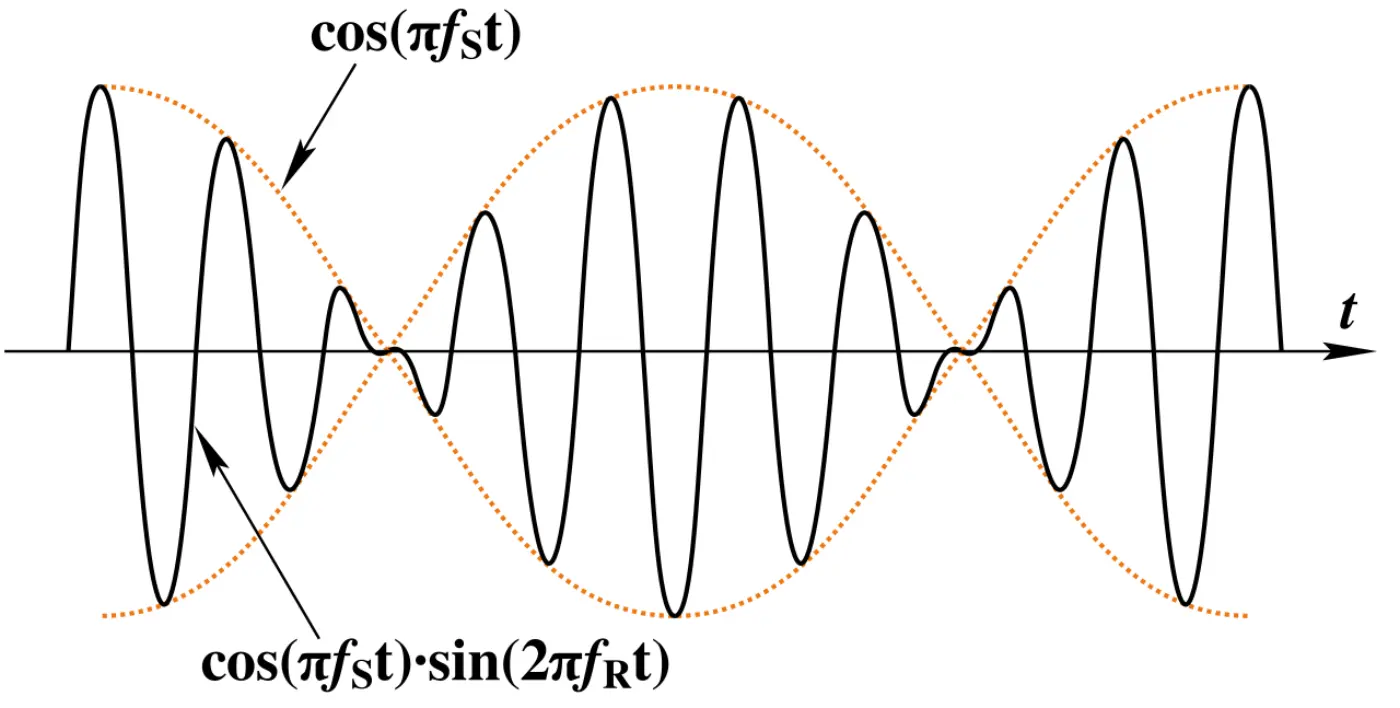
Play 200 Hz into your left ear and 210 Hz into your right, and you perceive a soft pulse ten times a second: the 10 Hz difference. That pulse does not exist in the air. Your brainstem creates it while comparing the signals from both ears.
Key facts:
- You need headphones. Each tone must reach only one ear.
- The tones must be fairly low. They appear only below about 1,000 Hz and are heard best around 400 Hz.
- The beat itself is slow. Binaural beats can be perceived at differences of about 1 to 30 Hz, the same range as the brainwave bands measured by EEG (recording the brain’s electrical rhythms through the scalp).
- It is an old discovery. H. W. Dove first described the effect in 1839. Gerald Oster’s 1973 article in Scientific American revived interest, and a wave of commercial products followed.
The big claim: do binaural beats “entrain” your brainwaves?
Apps promise that a 10 Hz beat pushes your brain into “alpha”, or 4 Hz into “theta”, rhythms linked with deep relaxation. This is the brainwave entrainment hypothesis: brain activity starts to oscillate at the frequency it is fed.
It is a neat story, but the evidence is messy. A 2023 systematic review in PLOS ONE (Ingendoh, Posny and Heine) gathered 14 EEG studies. Five found results in line with entrainment, eight found results that contradicted it, and one was mixed. The studies differed so much in method that the authors called for standardised research first. A small 2024 nap study (12 people) found that very slow binaural beats shortened the time to deep sleep, but the researchers did not see the brain lock onto the beat frequency.
If binaural beats help, it may not be by “tuning” your brain. Calm sound, sitting still and expecting to relax may do much of the work.
Ōmni Evidence Scale: No good evidence yet. A 2023 systematic review found more EEG studies against brainwave entrainment than for it.
Anxiety, sleep and focus: what the studies found
Does listening help anyway? The best-known meta-analysis (a study that pools the results of many studies) is Garcia-Argibay and colleagues, 2019, in Psychological Research. Across 22 studies and 35 results on memory, attention, anxiety and pain, binaural beats had a medium-sized overall effect (g = 0.45). Listening before a task worked better than only during it, longer listening helped, and results depended on the beat frequency.
| Goal | What the research shows | Ōmni Evidence Scale |
|---|---|---|
| Anxiety before a procedure | A 2025 meta-analysis: 14 randomised trials, 1,047 surgery patients; less anxiety than with blank audio, but results varied a lot | Promising |
| Sleep | Small studies of 10–20 people; some found faster sleep onset or more deep sleep, others did not | Early evidence |
| Focus and memory | Part of the 2019 meta-analysis; newer reviews could not pool cognitive results because studies were too different | Early evidence |
| “Tuning” brainwaves | 2023 review: 5 of 14 EEG studies supportive, 8 contradictory | No good evidence yet |
Anxiety
The strongest signal is for short-term anxiety around medical procedures. A 2025 meta-analysis in Complementary Therapies in Medicine (Xiong and colleagues) pooled 14 trials with 1,047 surgical patients and found binaural beats lowered anxiety compared with blank audio. But the trials disagreed a great deal (heterogeneity of 91.6%), and blank audio is not calm music, so we cannot tell how much comes from the beats themselves.
Ōmni Evidence Scale: Promising. Several randomised trials point the same way for anxiety before procedures, but they vary widely and rarely compare with ordinary relaxing music.
Sleep
Sleep studies are tiny. In 2024, a study of 10 people found a slowly changing beat shortened the time to fall asleep, and the 12-person nap study found a faster drop into deep sleep. A 2026 study of 20 students found no faster sleep onset, but fewer awakenings. Not yet a reason to replace good sleep habits. If you struggle with sleep, our insomnia and float plan covers the basics first.
Ōmni Evidence Scale: Early evidence. A handful of small studies in healthy volunteers, with mixed results.
Focus and memory
“Focus” playlists lean on the 2019 meta-analysis. But a 2026 meta-analysis of 13 trials on theta beats could not combine the cognitive results at all, because the studies measured such different things.
Ōmni Evidence Scale: Early evidence. Some positive lab results, but tasks and frequencies differ too much to know what works for whom.
432 Hz vs 440 Hz: the history and the myths
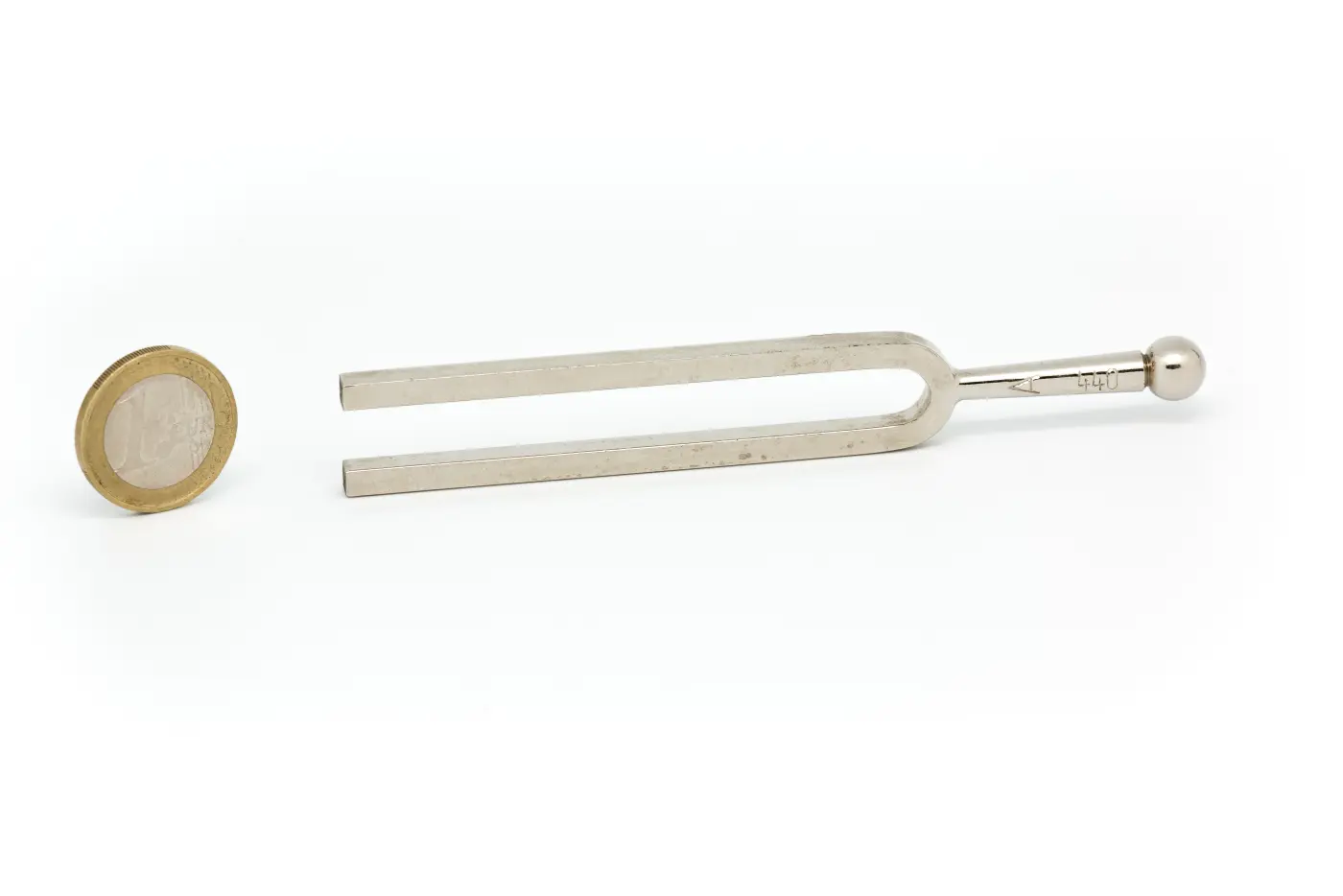
“432 Hz music” is about tuning, not beats: the pitch of the note A above middle C. Most modern music uses 440 Hz. Fans say 432 Hz is more “natural” and in harmony with the body.
History shows there has never been one “natural” pitch. Surviving tuning forks range from about 409 Hz (1780) to 455.4 Hz (Beethoven’s, around 1800). France fixed A at 435 Hz by law in 1859. An international conference recommended 440 Hz in 1939, and the ISO adopted it as a standard, reaffirmed as ISO 16 in 1975. The so-called “Verdi tuning” of 432 Hz is promoted mainly by the Schiller Institute. Online claims that 440 Hz was imposed for sinister reasons are conspiracy theories with no historical support.
What the small trials found
- Calamassi and Pomponi, 2019 (Explore): 33 healthy volunteers heard the same film soundtracks at 440 Hz and 432 Hz. Heart rate was 4.79 beats per minute lower with 432 Hz, right at the edge of statistical significance (p = 0.05).
- Calamassi and colleagues, 2022: 54 emergency nurses. Anxiety fell in all three groups, including the group that just took a normal break with no music.
- Hohneck and colleagues, 2025 (BMC Complementary Medicine and Therapies): a randomised cross-over trial in 43 cancer patients, using a 15-minute body monochord session at 432 Hz or 443 Hz. Heart rate fell after both, slightly more with 432 Hz (median 3 vs 1 beat per minute). Several other vessel measures did not differ significantly between tunings, and both improved mood. The authors note that the 432 Hz theory rests on historical and philosophical interpretations, not empirical data. (Some summaries call this paper a “2025 review”; it is a trial.)
- Jebabli and colleagues, 2025: in 28 kickboxers, 440 Hz warm-up music beat 432 Hz.
The pattern: calm music lowers heart rate a little, whatever the tuning. Any extra effect of 432 Hz is small and inconsistent.
Ōmni Evidence Scale: No good evidence yet. A few small trials show tiny, inconsistent differences, and the theory itself is not based on experimental data.
Solfeggio and “healing frequencies”
Next to 432 Hz you will meet “solfeggio frequencies”: 174, 396, 528 Hz and more, each sold for a purpose, such as “528 Hz DNA repair”. They are presented as an ancient sacred scale. We found no independent historical source for that, and no controlled study showing a sound frequency repairs DNA or heals organs.
Real research is thin. A 2026 trial in 162 students during exams compared 528 Hz music, 432 Hz music and no music. Some saliva markers differed between groups, but performance on an attention test did not. One study of lab markers is not evidence of healing.
Ōmni Evidence Scale: No good evidence yet. The healing claims for specific frequencies rest on numerology and marketing, not on controlled trials.
Safe listening: protect your ears first
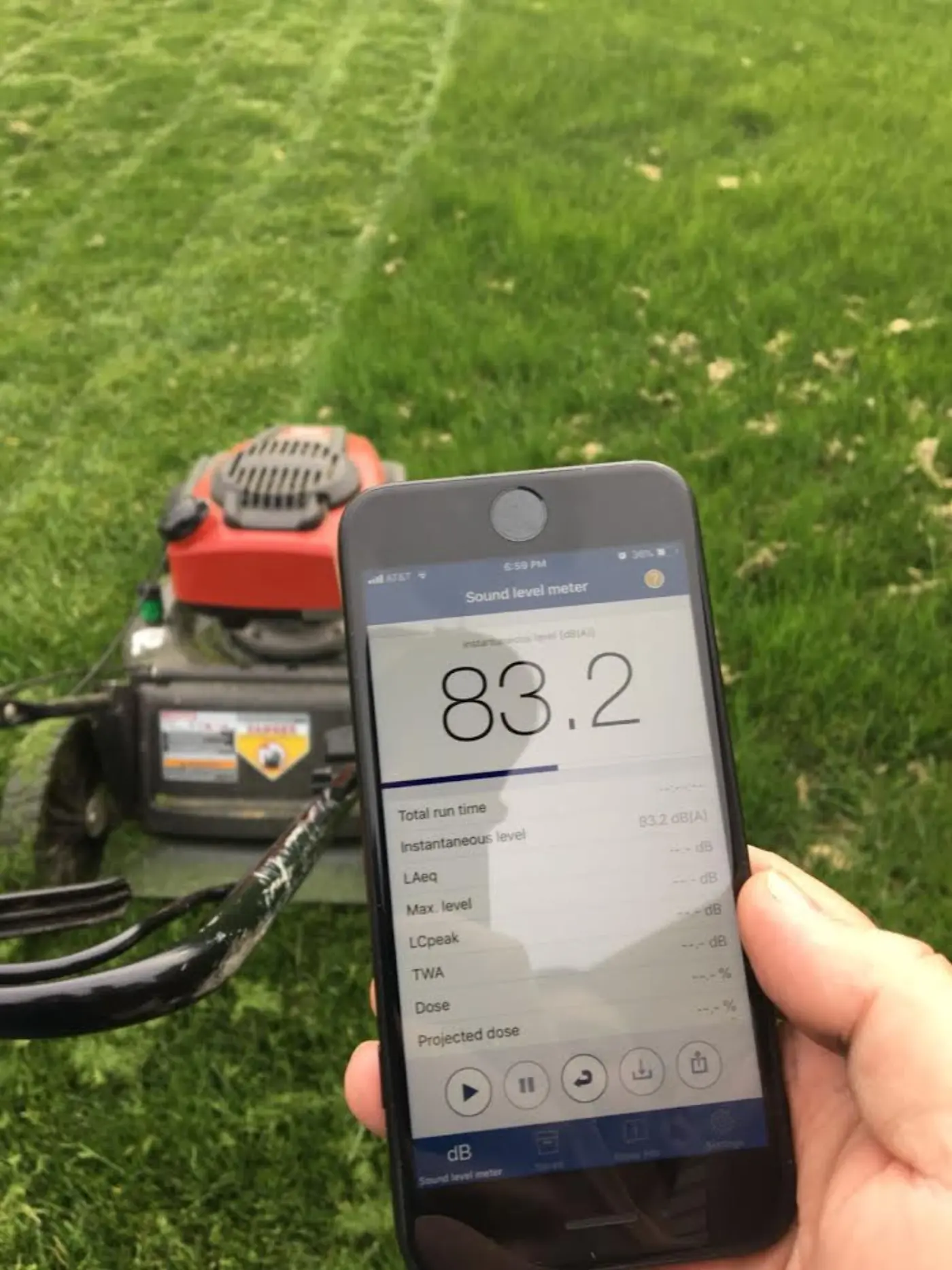
The one sure risk is hearing damage. The World Health Organization (WHO) says over 1 billion people aged 12 to 35 risk losing their hearing from loud listening. Its guidance:
- You can safely listen at 80 dB for up to 40 hours a week. At 90 dB, the safe time drops to about 4 hours a week.
- Keep your device volume at no more than 60% of maximum.
- Use well-fitted, noise-cancelling headphones so you need less volume in a Grab ride or a busy café.
- Give your ears frequent breaks from loud sound.
Binaural beats work at a soft volume. Never listen while driving or riding a motorbike: they are meant to make you drowsy.
How this relates to sound healing and Neuro Align
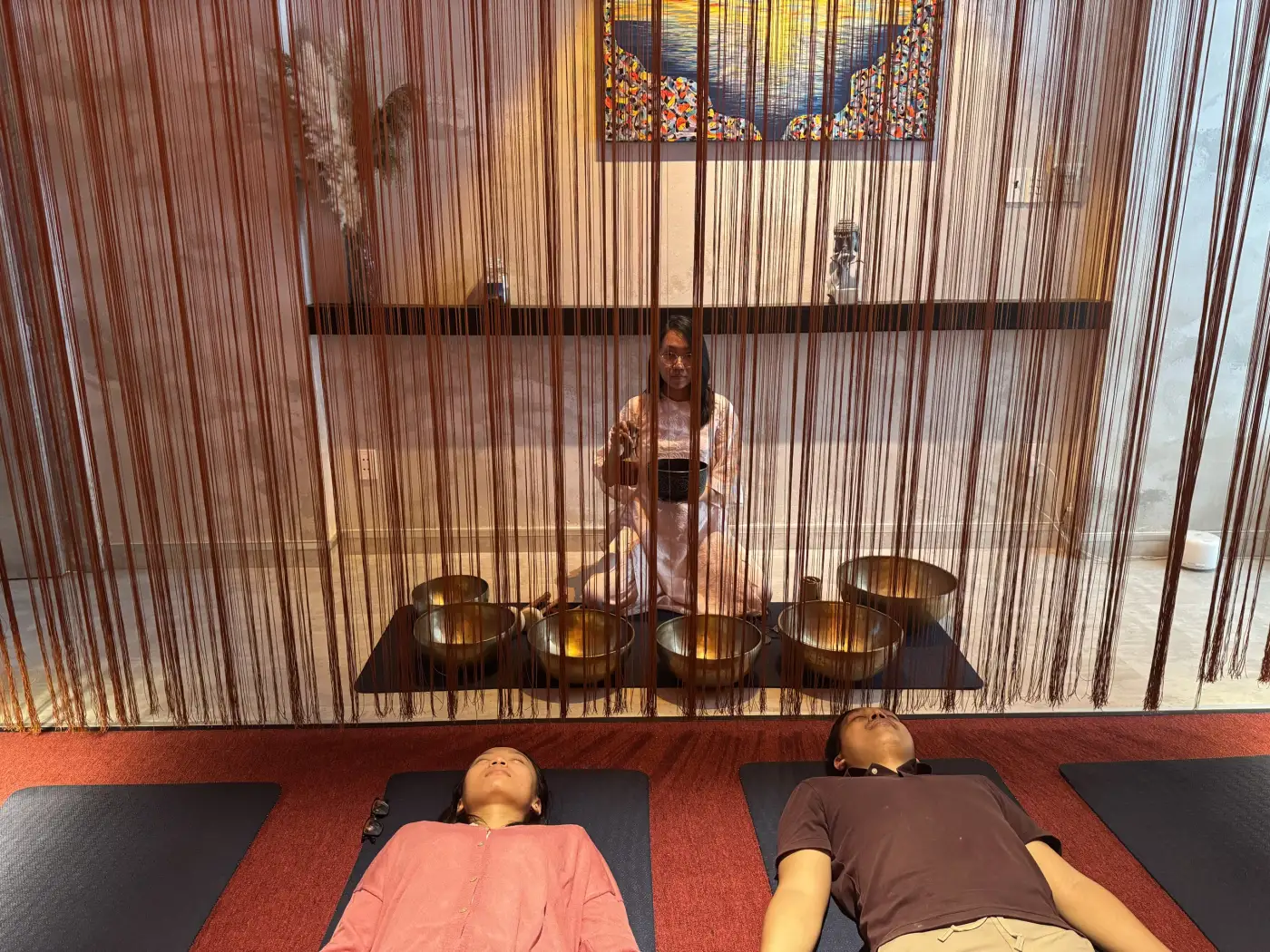
A sound bath with singing bowls, gongs or a handpan is live sound in a room, with no headphones, so no binaural beats in the strict sense. Its evidence is also early. Our guide to sound healing in Saigon covers the instruments, the studies and where to go.
At Ōmni, Brainwaves Neuro Align is a 30-minute light-and-sound session: you lie back, eyes closed, with light glasses showing gentle rhythmic patterns and headphones playing matching sound (audio-visual entrainment). We offer it as a relaxation experience only, not a treatment. It costs 450,000 VND on its own or +200,000 VND with a float. Every guest fills in a health questionnaire, by email before the visit and again on site. Because the session uses flickering light, it is not for anyone with epilepsy, a history of seizures or migraines triggered by flashing light. If you are pregnant or have a neurological or psychiatric condition, check with your doctor first. For how it compares with EEG headbands and other devices, see meditation devices compared.
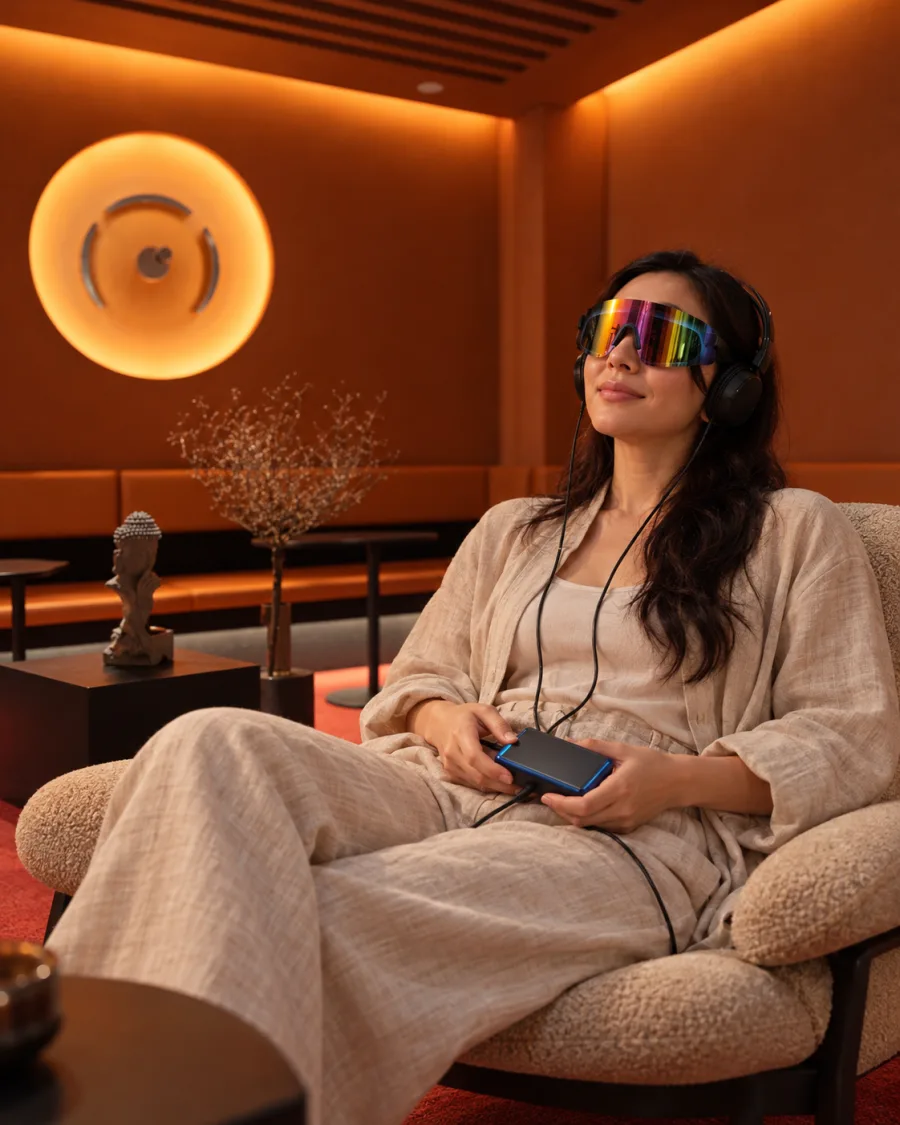
Ōmni Evidence Scale: Early evidence. A 2025 review of audio-visual entrainment found mixed results, including null effects, and warned against premature claims.
Try it yourself: a simple two-week test
Binaural beats are free to try. Judge them with a small personal experiment.
- Set up. Use stereo headphones, not a speaker. Pick a track that states its beat frequency (for example 6–10 Hz) and uses tones under 1,000 Hz.
- Volume. Raise it from zero until the pulse is just clear, and stay at or below 60% of maximum.
- Timing. Sit or lie down somewhere safe and listen for 15–20 minutes before the moment you want help with: a stressful meeting, study, or bedtime. Never while driving.
- Score it. Before and after, rate your stress from 1 to 10 and note it down.
- Compare. On alternate days, do the same with calm music without beats, or with silence and slow breathing (see our breathwork guide).
- Decide. After two weeks, compare your scores and keep what helps most.
Stop if you get a headache, dizziness, ringing in the ears or feel more anxious.
Where to try it in Saigon
Binaural beats need only headphones and a quiet corner. For live sound, these Ho Chi Minh City sound healing studios were open when we checked in October 2026. We have not tried them all; please contact them directly.
- OM Himalayas (OM Healing), 256 Pasteur, District 3: singing bowl sessions and courses.
- YATA Wellness & Sound Healing, 590/13 Cách Mạng Tháng Tám, District 3.
- Sound Healing by Healiverse, 104/20 Mai Thị Lựu, Tân Định, District 1.
- Awakening’s Well-being Centre, 215B1 Nguyễn Văn Hưởng, Thảo Điền.
- Anahata Handpan, 37 Cầm Bá Thước, Phú Nhuận: handpan classes.
For more places, see our Saigon wellness map. If you want to compare sound with near-total silence, a float at Ōmni Space, 16C Quốc Hương, Thảo Điền, starts from 1,500,000 VND for 60 minutes, and Neuro Align can be added for +200,000 VND. We are open 9:00–21:00 daily; see all services and prices. To understand how we rate the research, read the Ōmni Evidence Scale.
For the theta state that binaural tracks often aim for, see Float Vietnam’s explainer on theta waves and float therapy.
FAQ
Do binaural beats work without headphones?
No. Each ear must hear only one of the two tones. Through speakers, the tones mix in the air and you hear an ordinary acoustic beat, which is a different thing.
Can binaural beats help with anxiety?
Possibly, a little. Trials in surgery patients found less anxiety than with blank audio, but results varied widely and few studies compared them with ordinary calm music. They are not a treatment for an anxiety disorder.
Is 432 Hz music better than 440 Hz?
There is no good evidence that it is. A few small trials found heart rate a beat or a few beats lower, but results are inconsistent, and the theory behind 432 Hz rests on historical and philosophical ideas rather than experiments.
Are binaural beats safe?
For most people, yes, at a low volume. The main risk is hearing damage from loud headphones: WHO suggests keeping volume at no more than 60% of maximum. Never listen while driving or riding.
Do solfeggio frequencies like 528 Hz heal DNA?
No controlled study shows that any sound frequency repairs DNA or heals the body. Enjoy the music if it relaxes you, but treat healing claims as marketing.
Sources
- Ingendoh RM, Posny ES, Heine A. Binaural beats to entrain the brain? A systematic review of the effects of binaural beat stimulation on brain oscillatory activity. PLOS ONE, 2023.
- Garcia-Argibay M, Santed MA, Reales JM. Efficacy of binaural auditory beats in cognition, anxiety, and pain perception: a meta-analysis. Psychological Research, 2019.
- Xiong J et al. Binaural beats for perioperative anxiety and pain: a systematic review and meta-analysis. Complementary Therapies in Medicine, 2025.
- Fatima I et al. Efficacy of theta binaural beat therapy on pain, cognition and anxiety in adults: a systematic review and meta-analysis of randomized controlled trials. Explore, 2026.
- Lee HA et al. Effect of dynamic binaural beats on sleep quality: a proof-of-concept study with questionnaire and biosignals. Sleep, 2024.
- Fan Z et al. Binaural beats at 0.25 Hz shorten the latency to slow-wave sleep during daytime naps. Scientific Reports, 2024.
- Dabiri R et al. The effect of delta binaural beat on sleep onset and maintenance based on EEG signal analysis. Acta Psychologica, 2026.
- Calamassi D, Pomponi GP. Music tuned to 440 Hz versus 432 Hz and the health effects: a double-blind cross-over pilot study. Explore, 2019.
- Calamassi D et al. Listening to music tuned to 440 Hz versus 432 Hz to reduce anxiety and stress in emergency nurses during the COVID-19 pandemic: a double-blind, randomized controlled pilot study. Acta Biomedica, 2022.
- Hohneck A et al. Differential effects of sound interventions tuned to 432 Hz or 443 Hz on cardiovascular parameters in cancer patients: a randomized cross-over trial. BMC Complementary Medicine and Therapies, 2025.
- Jebabli N et al. Effects of 440-Hz vs. 432-Hz preferred music frequencies, during warm-up, on intermittent anaerobic speed test performance in kickboxers: a double-blind crossover study. PeerJ, 2025.
- Bozok ÜG et al. Acute music-frequency exposure modulates salivary stress and neurotrophic markers in young adults: a randomized controlled trial. Brain and Behavior, 2026.
- Rahmani M, Romero Lauro LJ, Pisoni A. Audio-visual entrainment neuromodulation: a review of technical and functional aspects. Brain Sciences, 2025.
- World Health Organization. Deafness and hearing loss: safe listening.
- World Health Organization. WHO releases new standard to tackle rising threat of hearing loss, 2022.
- Wikipedia. Concert pitch (history of A440 and 432 Hz tuning).
Leave a Reply