
In short: Partly. Reviews of digital detox studies find mixed results: quitting your phone completely does not reliably make people happier. But cutting back, by about an hour a day or to 30 minutes of social media, has improved mood and well-being in several trials. Fewer notifications and real phone-free time look like the useful parts.
This guide was written by the team at Ōmni Space in Thảo Điền. Our team opened Vietnam’s first float centre (Float Vietnam, Hanoi, 2017), and we ask of every wellness trend: what does it do for the nervous system, and how strong is the evidence? Many of our guests are office workers, expats and digital nomads whose work lives inside a phone. Here is what the research shows, and how to try a detox in Saigon without losing your job or your Grab ride home. This is general information, not medical advice.
What people mean by “digital detox”
Researchers define digital detox as time out from digital devices, either completely or for one part of their use, such as social media or messaging apps. In daily life it covers a wide range: a phone-free dinner, a week without Instagram, a weekend retreat where you hand your phone in at the door.
“Detox” is a misleading word: your phone leaves no toxins in your body. What people really want to change is how often their attention gets pulled away, how much of the day goes into scrolling, and whether they ever have a quiet, empty moment. The evidence differs for each.
Attention, notifications and stress, explained simply
Attention works like a spotlight. Every buzz, banner or red badge swings it away, and swinging it back takes effort.
A notification costs attention even if you ignore it. In a 2015 lab study at Florida State University (Stothart and colleagues), people doing a demanding attention task performed worse when their phone received a call or text alert, even though they did not touch the phone. The drop was similar in size to actually using a phone. The alert starts a train of thought (“who was that?”) that competes with the task.
Checking less often can lower stress. In a 2015 study (Kushlev and Dunn), 124 adults spent one week checking email only three times a day and another week checking as often as they liked. Their daily stress was lower in the limited week. In a 2019 field experiment (Fitz and colleagues, 237 people), those who received phone notifications in three batches a day felt more attentive, more in control, in a better mood and less stressed than those who got them as usual. People who got no notifications at all gained little and felt more anxious and afraid of missing out.
Ōmni Evidence Scale: Early evidence. For batching notifications or checking messages a few times a day to lower stress: two well-designed field experiments point the same way, but they are few, short and based on self-reports.
What about the “brain drain” idea? A widely shared 2017 paper (Ward and colleagues) reported that students did worse on memory and reasoning tests with their phone on the desk, even switched off, than with it in another room. A 2022 direct replication (Ruiz Pardo and Minda) found no difference. A 2023 meta-analysis (a study pooling many studies; Parry, 56 effects, about 7,000 people) found a small negative effect on working memory only, and warned that many studies were too small to be reliable.
Ōmni Evidence Scale: Early evidence. For “a phone nearby drains your brainpower”: the original finding did not replicate directly, and pooled data suggest a small effect on working memory at most.
Our reading: the interruption matters more than the object. A silent phone in a drawer is kinder to your attention than a buzzing one in your hand.
What the trials show: quitting vs cutting back
The big picture is mixed. A systematic review (Radtke and colleagues, Mobile Media & Communication, 2022) gathered 21 studies with 3,625 participants, 12 of them randomised controlled trials. Effects on well-being, relationships, self-control and performance varied: some studies found benefits, some nothing, and some found that the break made people feel worse. Which kinds of detox work, and for whom, is still unclear.
Cutting back may beat quitting. In a German experiment (Brailovskaia and colleagues, published 2022), 619 smartphone users either gave up their phone for 7 days, used it one hour less per day for a week, or carried on as usual. Both changes eased depressive and anxiety symptoms and raised life satisfaction and physical activity, but the one-hour-less group did better, and its gains held more steadily four months later. Total abstinence, the authors concluded, is not necessary.
Limiting social media to about 30 minutes a day helped. At the University of Pennsylvania (Hunt and colleagues, 2018), 143 students were randomly assigned to limit Facebook, Instagram and Snapchat to 10 minutes each per day, or to use them as usual, for three weeks. The limited group became less lonely and less depressed than the control group.
Blocking mobile internet for two weeks. In a 2025 trial (Castelo and colleagues, PNAS Nexus), 467 iPhone users installed an app that blocked mobile internet but still allowed calls and texts. After two weeks, mental health, well-being and a test of sustained attention improved, and people spent more time with others, exercising and outdoors. Caveats: the volunteers wanted to cut back, only about one in four kept the block on for at least 10 of 14 days, and everyone knew what the study was about.
Ōmni Evidence Scale: Promising. For cutting back (rather than quitting) to improve mood and well-being: several randomised trials point the same way, but people knew they were cutting back and results rely mostly on self-reports.
Ōmni Evidence Scale: Early evidence. For a complete phone “detox” as a reliable way to feel better: a 2022 systematic review found mixed results, including some negative effects.
Boredom, the default mode network and why rest is not idle
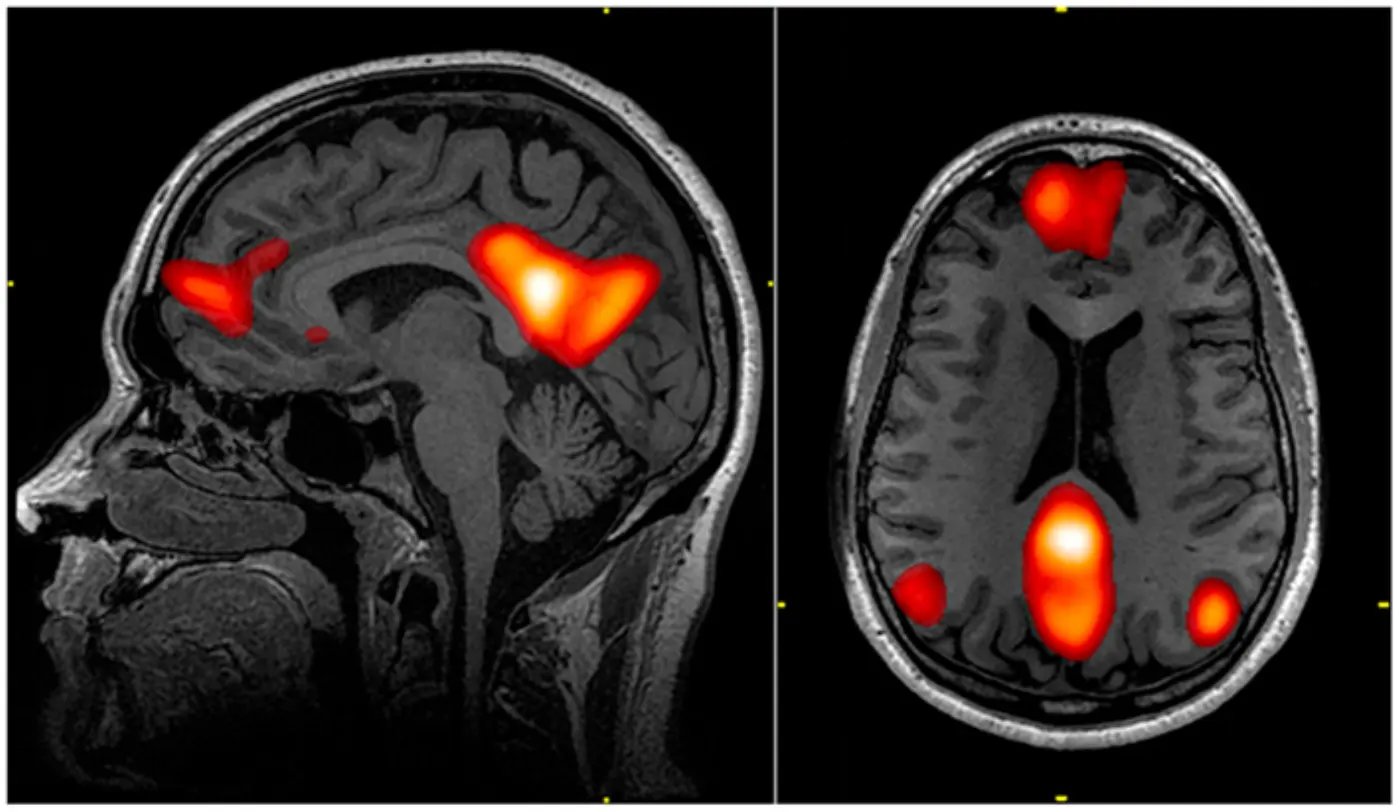
In 2001, neurologist Marcus Raichle and colleagues described brain regions that are more active at rest than during a focused task: the default mode network (DMN). It switches on when your mind wanders, remembers, imagines the future or thinks about people. A 2012 review (Immordino-Yang and colleagues) argued that this inward time supports reflection, and that constant outward attention may crowd it out.
A phone fills every gap: the Grab ride, the lift, the coffee queue. And empty time feels uncomfortable. In 11 studies (Wilson and colleagues, Science, 2014), people generally disliked spending 6 to 15 minutes alone with their thoughts, and many chose a mild electric shock over doing nothing. That restlessness is normal.
Ōmni Evidence Scale: Early evidence. For “phone-free downtime rests the brain” through the default mode network: the network itself is well established, but direct proof that unplugged time restores it is still limited.
We go deeper in float therapy and your default mode network, and in the art of doing nothing.
Practical plans for Saigon life: 1 hour, 1 day, a weekend
In Saigon, work rarely stops at the office door. Teams coordinate in Zalo or WhatsApp groups, clients message late, and you need your phone to book a Grab, pay by QR code and find your way. A total detox is unrealistic for most people, and the research says it is not needed. Aim for less interruption, not zero phone.
The 1-hour reset (any day)
- Tell your team: “Offline 12:00–13:00, call if urgent.”
- Switch on Do Not Disturb or a Focus mode, and allow calls from a short list of people.
- Put the phone in a bag or another room, not face down on the table.
- Eat lunch without a screen, or walk under trees, and let your mind wander.
The 1-day plan (a workday with fewer interruptions)
- Batch your messages. Check Zalo, WhatsApp, Slack and email at set times, for example 9:00, 13:00 and 17:00, as in the batching studies above. Mute busy group chats; on iPhone, Scheduled Summary groups notifications.
- Keep your phone for tools, not feeds. Book the Grab, pay, then put it away.
- One-hour cut. Use your screen-time report to find one hour to drop, as in the German study.
- A screen-free evening. Charge your phone outside the bedroom and use an ordinary alarm clock. For sleep, see our guide to revenge bedtime procrastination.
The weekend plan (for real recovery)
- Set an auto-reply; tell family how to reach you in an emergency.
- Choose one morning or afternoon with no social media at all.
- Plan offline anchors: a park, a bookshop, a class, a long lunch with friends. A detox works better filled with something good.
- Notice the itch to check, and let it pass.

Where to try it in Saigon: offline places
Places our team likes, named neutrally; check hours on each place’s own page.
- Parks: Tao Đàn Park in District 1, with tall old trees and shaded paths, and Gia Định Park in Gò Vấp. Go early in the morning or late in the afternoon, when it is cooler.
- Bookshops: Book Street (Đường sách Nguyễn Văn Bình) beside the Central Post Office, a short car-free street of bookshops and cafés, and Tea Time Books in Thảo Điền, a small shop with English-language books.
- Art: the Ho Chi Minh City Museum of Fine Arts in District 1, and Quang San Art Museum in Thảo Điền (closed Mondays).
- The riverside: the public riverside path at the end of Làng Báo Chí in Thảo Điền, beautiful at sunset.
- Meditation: Thiền Viện Vạn Hạnh in Phú Nhuận holds public guided meditation on Sunday mornings from 7:00.
Nature may add something: in a Stanford study (Bratman and colleagues, 2015), a 90-minute nature walk, but not an urban one, reduced brooding.
Ōmni Evidence Scale: Early evidence. For short nature walks as a way to quiet a busy mind: well-run but small, short-term experiments.

Our Saigon Wellness Map lists more than 90 yoga studios, meditation centres, sound baths and saunas, many of them good places to spend a screen-free hour. For more quiet corners, see our guide to quiet places in Saigon and things to do in Thảo Điền.
A float: 60 to 90 minutes with no phone
This is where we come in. A float may be the simplest detox in the city, because phones and salt water do not mix: your phone stays outside the pool (in the room, in a locker or at reception, as you prefer), and for 60 to 90 minutes nobody can reach you. If something truly urgent comes up, our reception knocks on your door. You lie in skin-warm water holding 500 kg of Epsom salt, in a private room behind soundproof glass doors (we measured close to 0 dB inside), with the lights under your control. No feed, no pings. More on the value of quiet: why silence is the new luxury of modern life.

The evidence is encouraging but not final. In a Swedish randomised pilot trial (Kjellgren and Westman, 2014), 65 healthy employees who did 12 floats over seven weeks reported less stress, anxiety and depression and better sleep than a waiting-list group. In a US study (Feinstein and colleagues, 2018), one float clearly lowered anxiety in 50 people with anxiety disorders, but without a control group. A 2005 meta-analysis (van Dierendonck and te Nijenhuis) also found benefits for stress.
Ōmni Evidence Scale: Strong evidence. For float therapy and stress: a meta-analysis and several trials point the same way, but samples are small and it is hard to blind people to floating. We rate it Strong because, on top of these trials, user experience is overwhelmingly positive: in a 2025 survey of regular floaters, 92% reported relaxation and 77% less stress, echoed by thousands of reviews, Reddit threads and forums, and by athletes and public figures who float.
Floats start from 1,500,000 VND for 60 minutes (2,000,000 VND for 90), open 9:00–21:00 daily; every guest fills in a short health questionnaire first. New to it? Read what float therapy is and before your first float, or see all services.
When to ask for help
A detox is a lifestyle experiment, not treatment. If you feel low for weeks, cannot control your phone use despite trying, or your sleep, work or relationships suffer, talk to a doctor or mental health professional. Keep your phone close when you need it for safety, such as travelling alone at night.
Heard of “dopamine detox”? Float Vietnam explains why the name is misleading and what actually happens to dopamine when you cut back on screens.
FAQ
Does a digital detox really work?
It depends. A 2022 review of 21 studies found mixed results for full detoxes, but cutting back (one hour less a day, or 30 minutes of social media) improved well-being in several trials.
How long should a digital detox last?
Trials that found benefits ran from one to three weeks. A lasting habit, like one hour less per day, seems to matter more than one long break.
Is it bad to keep my phone on my desk?
The “brain drain” result did not replicate directly; pooled data show a small effect on working memory at most. Notifications are the bigger distraction.
Should I turn off all notifications?
Not necessarily. In one trial, getting notifications in three batches a day lowered stress, while getting none at all raised anxiety and fear of missing out.
Can a float count as a digital detox?
Yes, in a practical sense: your phone stays outside the pool for 60 to 90 minutes, in the room, a locker or at reception. If there is an emergency, reception knocks on your door. Float therapy itself is rated Strong evidence for stress on our evidence scale.
How we grade studies: the Ōmni Evidence Scale.
Sources
- Radtke T, Apel T, Schenkel K, Keller J, von Lindern E. Digital detox: an effective solution in the smartphone era? A systematic literature review. Mobile Media & Communication 10(2):190–215, 2022.
- Brailovskaia J et al. Finding the “sweet spot” of smartphone use: reduction or abstinence to increase well-being and healthy lifestyle?! Journal of Experimental Psychology: Applied, 2022 (online), 29(1):149–161, 2023.
- Hunt MG, Marx R, Lipson C, Young J. No more FOMO: limiting social media decreases loneliness and depression. Journal of Social and Clinical Psychology 37(10):751–768, 2018.
- Castelo N et al. Blocking mobile internet on smartphones improves sustained attention, mental health, and subjective well-being. PNAS Nexus 4(2):pgaf017, 2025.
- Stothart C, Mitchum A, Yehnert C. The attentional cost of receiving a cell phone notification. Journal of Experimental Psychology: Human Perception and Performance 41(4):893–897, 2015.
- Kushlev K, Dunn EW. Checking email less frequently reduces stress. Computers in Human Behavior 43:220–228, 2015.
- Fitz N et al. Batching smartphone notifications can improve well-being. Computers in Human Behavior 101:84–94, 2019.
- Ward AF, Duke K, Gneezy A, Bos MW. Brain drain: the mere presence of one’s own smartphone reduces available cognitive capacity. Journal of the Association for Consumer Research 2(2):140–154, 2017.
- Ruiz Pardo AC, Minda JP. Reexamining the “brain drain” effect: a replication of Ward et al. (2017). Acta Psychologica 230:103717, 2022.
- Parry DA. Does the mere presence of a smartphone impact cognitive performance? A meta-analysis of the “brain drain effect”. Media Psychology 27(5):737–762, 2024 (online 2023).
- Raichle ME et al. A default mode of brain function. PNAS 98(2):676–682, 2001.
- Immordino-Yang MH, Christodoulou JA, Singh V. Rest is not idleness: implications of the brain’s default mode for human development and education. Perspectives on Psychological Science 7(4):352–364, 2012.
- Wilson TD et al. Just think: the challenges of the disengaged mind. Science 345(6192):75–77, 2014.
- Bratman GN et al. Nature experience reduces rumination and subgenual prefrontal cortex activation. PNAS 112(28):8567–8572, 2015.
- Kjellgren A, Westman J. Beneficial effects of treatment with sensory isolation in flotation-tank as a preventive health-care intervention: a randomized controlled pilot trial. BMC Complementary and Alternative Medicine 14:417, 2014.
- Feinstein JS et al. Examining the short-term anxiolytic and antidepressant effect of Floatation-REST. PLoS ONE 13(2):e0190292, 2018.
- van Dierendonck D, te Nijenhuis J. Flotation restricted environmental stimulation therapy (REST) as a stress-management tool: a meta-analysis. Psychology & Health, 2005.
Leave a Reply