
In short: Yes, most women with a healthy pregnancy can float, and many find it one of the kindest hours of the week. The salt water carries the weight of the bump off your back, pelvis and legs. In Ho Chi Minh City (Saigon), the second trimester is the most comfortable time to start. Tell the team you are pregnant when you book, and talk to your doctor if you have any concerns.
By the afternoon your lower back aches, your ankles have quietly doubled in size, and at night you turn from one side to the other, looking for a position that does not exist. Pregnancy asks your body to carry more every single week. This guide shows how an hour in warm, buoyant water can hand some of that weight back, when in pregnancy to float, how to stay safe and comfortable, and what to expect on the day, so you can book with a calm mind.
Why pregnancy is so hard on your body
- Back and pelvis. Backache is one of the most common pregnancy complaints, especially in the later months, says the American College of Obstetricians and Gynecologists (ACOG). The growing womb shifts your centre of gravity and stretches the tummy muscles, and pregnancy hormones soften the ligaments around the pelvis. A large review found that about 45% of pregnant women have pelvic girdle pain, low back pain or both.
- Swollen feet and ankles. Your body holds more water than usual, and the growing womb slows blood flow from the legs, so fluid gathers in the ankles and feet, especially in hot weather or after standing, explains the NHS. Saigon’s heat does not help: our Saigon heat guide has tips for staying cool.
- Restless nights. A meta-analysis of 24 studies and more than 11,000 women found that almost half (45.7%) sleep poorly during pregnancy, and sleep tends to get worse from the second to the third trimester.
- A busy mind. In a review of 102 studies and almost 222,000 women, about one in five reported anxiety symptoms in the first and second trimesters, rising to about one in four in the third.
None of this means something is wrong; it is simply what growing a baby asks. It explains why so many mums-to-be long for an hour where nothing presses or needs them.
What the research says about floating in pregnancy
A float means lying on your back in about 25 cm of water with around 500 kg of dense, mineral-rich Epsom salt, warmed to 33–34 °C, close to skin temperature. You float without effort, in a private room that can be fully dark and quiet.
Floating itself. We searched the medical databases carefully, and no study has yet tested floating in pregnant women. What we can show is research on very similar things, and what floating does for everyone else.
Warm water in pregnancy. In a US study of healthy women in the third trimester, sitting in shoulder-deep water at 32 °C moved fluid out of swollen tissue faster than bed rest, and blood pressure eased during every session. A follow-up study had women from 26 to 38 weeks sit in 34 °C water for four or five days in a row: the effect held each day, with no sign that their bodies got used to it. In a Swedish randomised trial of 390 pregnant women, weekly water aerobics eased pregnancy-related low back pain more than exercise on land. And in a small Swiss study, women from 34 weeks who were gently moved through 35 °C water felt less stress and pain, with no side effects.
Floating in everyone else. The largest pain trial, from Germany in 2021 with 99 people living with chronic pain (not pregnant), found that pain and stiffness dropped clearly right after each float session. You walk out lighter the same day; that relief did not last to week 12 or 24, so regular floats are how you keep it. In a Swedish randomised trial, 65 working adults who floated 12 times in seven weeks felt less stress, anxiety and pain, and slept better, than a waiting group.
So, can floating help you through pregnancy? Yes, it can likely support you. The salt water carries you and your bump evenly, taking pressure off the spine, the pelvis and the legs that work so hard all day. Lying fully supported, the muscles that brace your back can finally let go. The warm, dark quiet calms a nervous system that rarely switches off. Many pregnant guests tell us it is the first time in weeks they have felt light.
Float therapy is a young but very active research field: randomised controlled trials have shown clear effects on anxiety, stress and muscle tension, many people also sleep better, and new clinical studies are still under way.
Ōmni Evidence Scale: Strong evidence, for float and stress. We rate it Strong because, on top of these trials, user experience is overwhelmingly positive: in a 2025 survey of regular floaters, 92% reported relaxation and 77% less stress, echoed by thousands of reviews, Reddit threads and forums, and by athletes and public figures who float. See how we rate evidence on the Ōmni Evidence Scale.
Ōmni Evidence Scale: Early evidence, for floating during pregnancy. No float trial in pregnant women exists yet; small studies of warm-water immersion in pregnancy (swelling, back pain, stress) and the experience of pregnant floaters all point the same gentle way.

When in pregnancy to float
We welcome pregnant guests. This table is Ōmni’s suggestion from our house rules, public health advice and guests’ experience, not a medical prescription. Whatever the week, talk to your doctor if you have any concerns.
| Stage | Floating | Good to know |
|---|---|---|
| First trimester (to week 13) | Fine for many women | Many float centres prefer to wait until week 14. If you feel queasy or very tired, a later start may feel nicer |
| Second trimester (weeks 14–27) | The sweet spot we encourage | The bump is big enough to feel the relief, and lying on your back is usually comfortable |
| Third trimester (week 28 to 35) | Yes, with your doctor’s OK | Start with 60 minutes rather than 90; if lying on your back makes you dizzy, sit up slowly |
| From 36 weeks | Please wait until after the birth | Our house rules ask guests not to float from 36 weeks |
About lying on your back. In later pregnancy, the NHS and ACOG advise not to lie flat on your back for long, because the womb can press on a large vein, lower your blood pressure for a while and make you feel dizzy. In the water you are carried evenly, which many women find far easier than a bed, but listen to your body: if you feel dizzy, sick or short of breath, sit up slowly and rest.
Safety: when to ask your doctor first
A float is deep rest, not medical treatment. Check with your doctor before you book if you have:
- a high-risk pregnancy, or you have been told to rest;
- any bleeding from the vagina, or a history of bleeding in this pregnancy;
- high blood pressure or pre-eclampsia;
- a placenta problem, such as a low-lying placenta;
- dizziness or faintness when lying on your back, or a history of fainting.
Do not float, and call your doctor or the hospital, if your waters break or leak, or if you have regular painful contractions. The NHS also asks you to get urgent advice for sudden swelling of the face, hands or feet, a very bad headache or blurred vision, which can be signs of pre-eclampsia.
- Drink and eat. Arrive well hydrated and have a light snack beforehand; floating on an empty stomach can leave you light-headed.
- Move slowly. Get in and out of the water slowly and hold on as you stand. Ask the team to show you the easiest way in.
- Skin. Avoid shaving or waxing in the 24 hours before; fresh cuts and scratches sting in the salt.
- Sauna and cold plunge: skip them during pregnancy unless your doctor agrees. The float water, at 33–34 °C, does not heat you up like a hot tub; ACOG advises avoiding overheating, especially in the first trimester.
- Health questionnaire: every guest fills one in, fully and honestly, at every visit. Mention your due date.
Your float day: booking, what to bring, what to expect
- Booking: book on the booking site, by Zalo or by Messenger, and tell the team you are pregnant and how many weeks. No doctor’s note is needed.
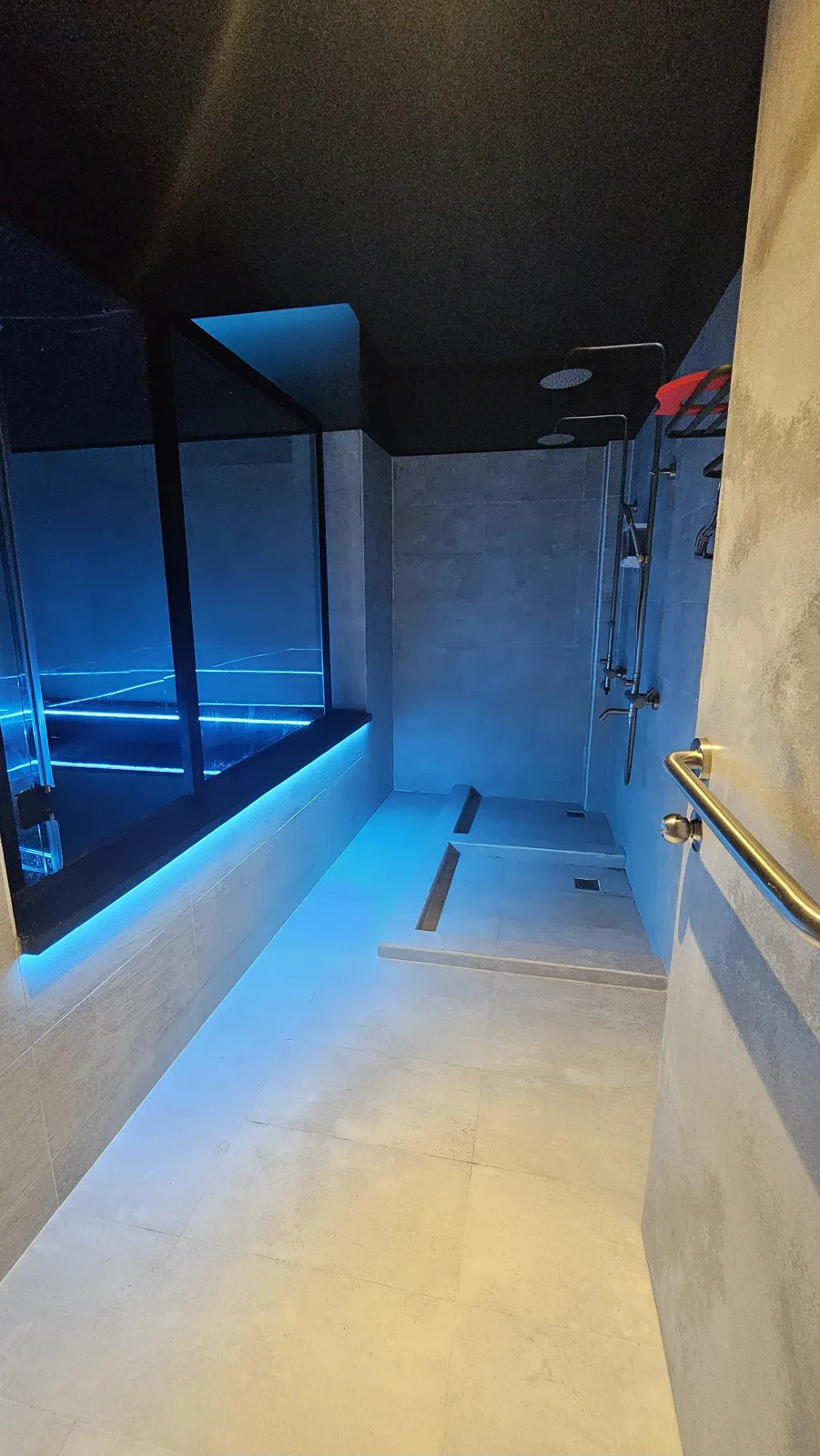
- What to bring: very little. The float room is private, so no swimsuit is needed. Towels, earplugs, shampoo, shower gel and a hairdryer are there, and a Halo neck pillow if you want extra support.
- Privacy: you lock the door from the inside and set the lights yourself, from soft glow to full darkness.
- Timing: allow about 30 extra minutes for a short guide and showers before and after.
- Afterwards: stand up slowly, drink some water and take a quiet half hour before the traffic.
New to floating? Read what float therapy is and before your first float. Our sister site Float Vietnam also has a short page on floating for pregnancy.
Bring your partner (or your mum)
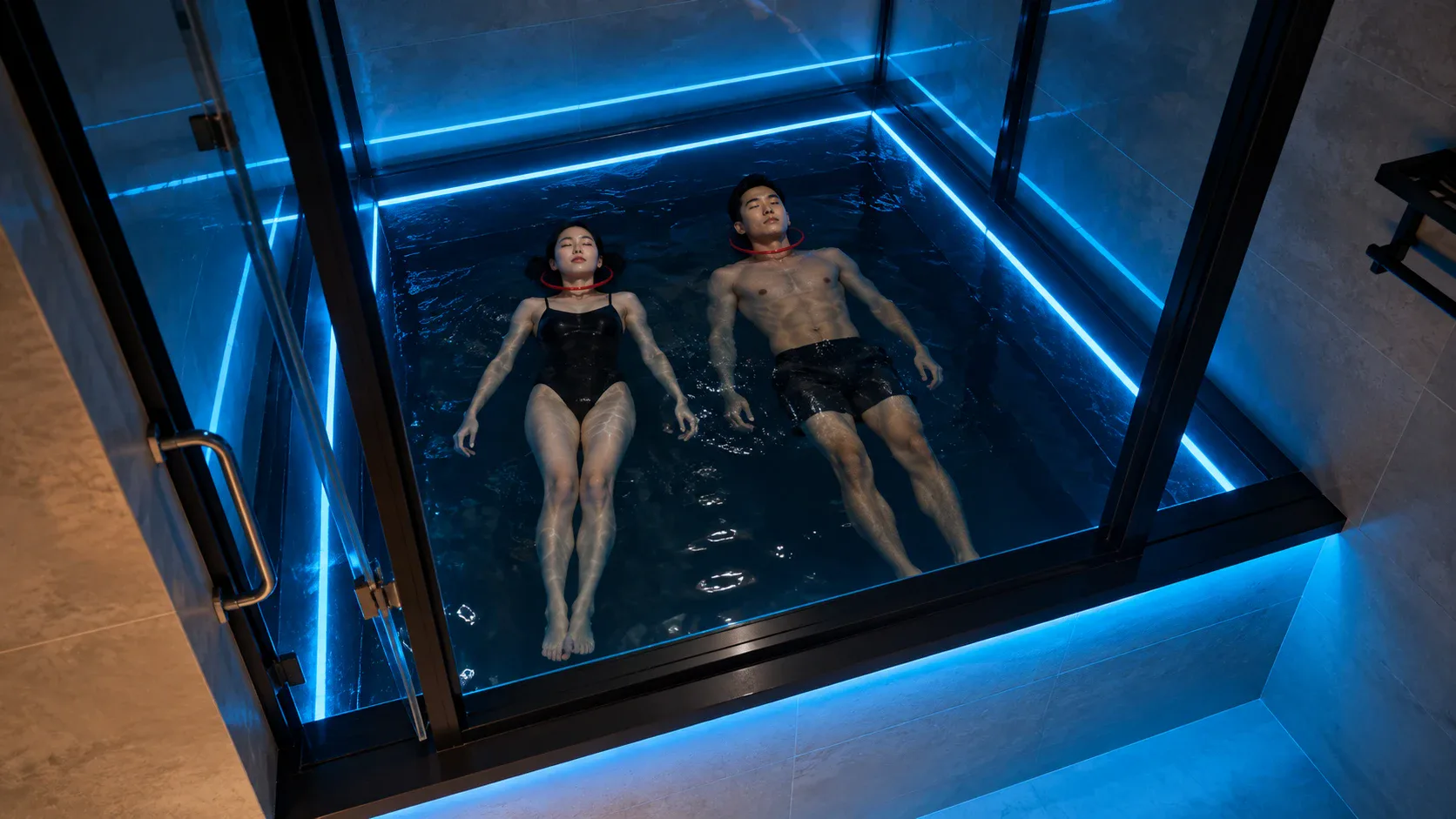
Our couple room has a square float pool for two and its own shower, for any two people: your partner, your mum or your best friend. It is 2,200,000 VND per room for 60 minutes. Floating side by side is a gentle way to share some calm before the baby arrives.
After the birth, and a gift for a mum-to-be
Floating after the birth. No study has tested floating after childbirth, but the stress and sleep findings above apply to new mums as much as anyone. For the timing, follow the advice for swimming: the NHS suggests waiting until 7 days after your postnatal bleeding has stopped. After a caesarean or a complicated birth, recovery takes longer, and the wound must be fully healed before salt water touches it. Get your doctor’s or midwife’s OK first. Then an hour where nobody needs feeding or rocking can feel like a small miracle. See how often to float.
A gift for an expecting friend. Baby gifts are lovely, but a mum-to-be rarely gets a gift that is just for her. A gift card can be used for any of our services and can be passed on to someone else, so she can float now, or save it for after the birth.

Where to float in Saigon while pregnant
Ōmni Space – Float Saigon is at 16C Quốc Hương, Thảo Điền, in Ho Chi Minh City. We are open 9:00–21:00 every day, and the last float starts at 20:00. A single 60-minute float is 1,500,000 VND; the couple room is 2,200,000 VND per room for 60 minutes. Everything else is on the price page. Payment is by card, bank transfer or cash. If stress is keeping you up at night, our guides to float therapy for anxiety and back and neck pain go deeper.
Float PlanBody tight from sitting or training?Take the one-minute Float Plan quiz: tell us how you feel and what you need, and get a simple plan for your first session.Make my Float PlanFAQ
Is float therapy safe during pregnancy?
For most women with a healthy pregnancy, yes. The water is about 33–34 °C, close to skin temperature, and it carries your weight evenly. Tell the team you are pregnant when you book, and talk to your doctor if you have any concerns or a high-risk pregnancy.
Can I float in the first trimester?
Yes, the first trimester is fine for many women, though many float centres prefer to wait until week 14. The second trimester is the time we encourage most. If you feel unsure, ask your doctor first.
Is it OK to lie on my back in the float pool late in pregnancy?
The water supports you evenly, which many women find easier than lying on a bed. Later in pregnancy, start with 60 minutes, get your doctor’s OK, and sit up slowly if you feel dizzy. Our house rules ask guests not to float from 36 weeks.
Does floating help pregnancy back pain and swollen feet?
It can likely help. No float study in pregnancy exists yet, but warm-water studies in pregnant women eased swelling and back pain, and in float trials pain and stiffness dropped right after each session.
Can my partner float with me?
Yes. The couple room has a square float pool for two and its own shower, for any two people. It is 2,200,000 VND per room for 60 minutes.
Written by the team at Ōmni Space – Float Saigon in Thảo Điền. General information, not medical advice; checked on 21 October 2026.
Sources
- American College of Obstetricians and Gynecologists (ACOG). Back pain during pregnancy (patient FAQ).
- American College of Obstetricians and Gynecologists (ACOG). Exercise during pregnancy (patient FAQ FAQ119).
- Wu WH et al. (2004). Pregnancy-related pelvic girdle pain (PPP), I: terminology, clinical presentation, and prevalence. European Spine Journal 13(7): 575–589.
- NHS. Swollen ankles, feet and fingers in pregnancy.
- NHS. Back pain in pregnancy.
- Sedov ID, Cameron EE, Madigan S, Tomfohr-Madsen LM (2018). Sleep quality during pregnancy: a meta-analysis. Sleep Medicine Reviews 38: 168–176.
- Dennis CL, Falah-Hassani K, Shiri R (2017). Prevalence of antenatal and postnatal anxiety: systematic review and meta-analysis. British Journal of Psychiatry 210(5): 315–323.
- Katz VL, Ryder RM, Cefalo RC, Carmichael SC, Goolsby R (1990). A comparison of bed rest and immersion for treating the edema of pregnancy. Obstetrics & Gynecology 75(2): 147–151.
- Katz VL, Rozas L, Ryder R, Cefalo RC (1992). Effect of daily immersion on the edema of pregnancy. American Journal of Perinatology 9(4): 225–227.
- Granath AB, Hellgren MS, Gunnarsson RK (2006). Water aerobics reduces sick leave due to low back pain during pregnancy. Journal of Obstetric, Gynecologic & Neonatal Nursing 35(4): 465–471.
- Schitter AM et al. (2015). Effects of passive hydrotherapy WATSU (WaterShiatsu) in the third trimester of pregnancy: results of a controlled pilot study. Evidence-Based Complementary and Alternative Medicine 2015: 437650.
- Loose LF, Manuel J, Karst M, Schmidt LK, Beissner F (2021). Flotation restricted environmental stimulation therapy for chronic pain: a randomized clinical trial. JAMA Network Open 4(5): e219627.
- Kjellgren A, Westman J (2014). Beneficial effects of treatment with sensory isolation in flotation-tank as a preventive health-care intervention: a randomized controlled pilot trial. BMC Complementary and Alternative Medicine 14: 417.
- Hilpert K, Chis Ster I (2025). Experiences and perceptions of regular floatation-REST users: results from an online survey. Journal of Clinical Images and Medical Case Reports 6(5): 3600.
- NHS. Exercise in pregnancy.
- NHS. Keeping fit and healthy with a baby.
- Ōmni Space. Health, safety and waiver (house rules).
Leave a Reply