
In short: Audio-visual entrainment (AVE) pulses light through closed eyelids, usually with matching sound, at a steady rate. The brain’s visual system really does respond at that rate, as EEG shows. Whether this improves relaxation, sleep, mood or thinking is less clear: the research is small and mixed. Never use it with epilepsy or a seizure history.
This guide was written by the team at Ōmni Space in Thảo Điền. We opened Vietnam’s first float centre (Float Vietnam, Hanoi, 2017), and we offer a light-and-sound session ourselves, so we wanted to explain the method honestly: where it came from, what it does in the brain, what the studies show, and who should not try it. If you want a side-by-side look at Muse, Lucia, DAVID and other gadgets, read our meditation devices comparison. This article is about the method behind them. It is general information, not medical advice.
What is audio-visual entrainment?
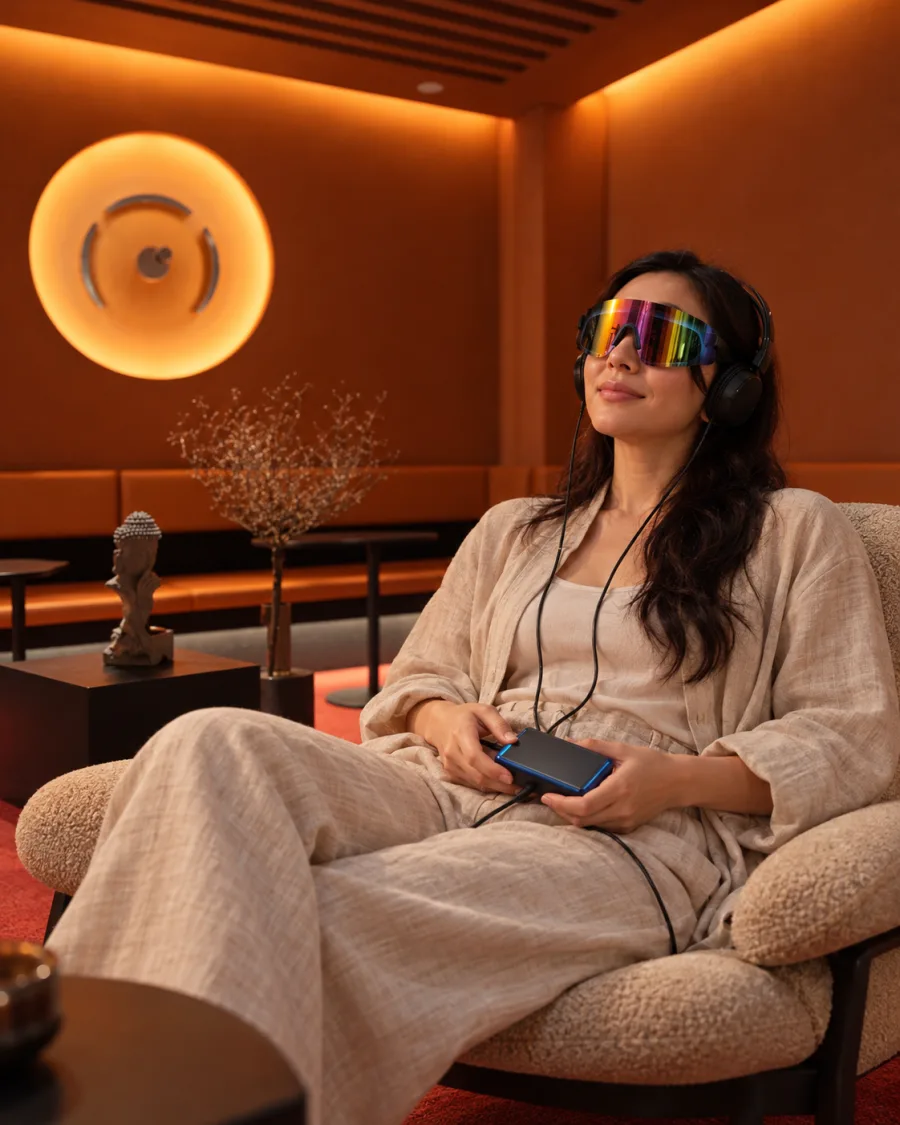
You lie back and close your eyes. A pair of glasses with small lights inside flickers at a steady rate, for example ten times a second. Headphones pulse clicks or tones at the same rate. That is audio-visual entrainment (AVE), also called “brainwave entrainment”, “light and sound therapy” or “mind machines”.
“Entrainment” means one rhythm being pulled into step with another, the way people walking together slowly fall into the same pace. The idea behind AVE is that the brain’s own electrical rhythms will lean toward the beat of the light and sound. Makers then pick slower or faster rates for sessions labelled calm, sleep, focus or energy.
With your eyes closed you usually see shifting colours and patterns. Nothing is drawn on the glasses: your own visual system makes them. Some people drift into a dreamy, half-asleep state; others find it busy.
A short history: from flicker experiments to the Dreamachine
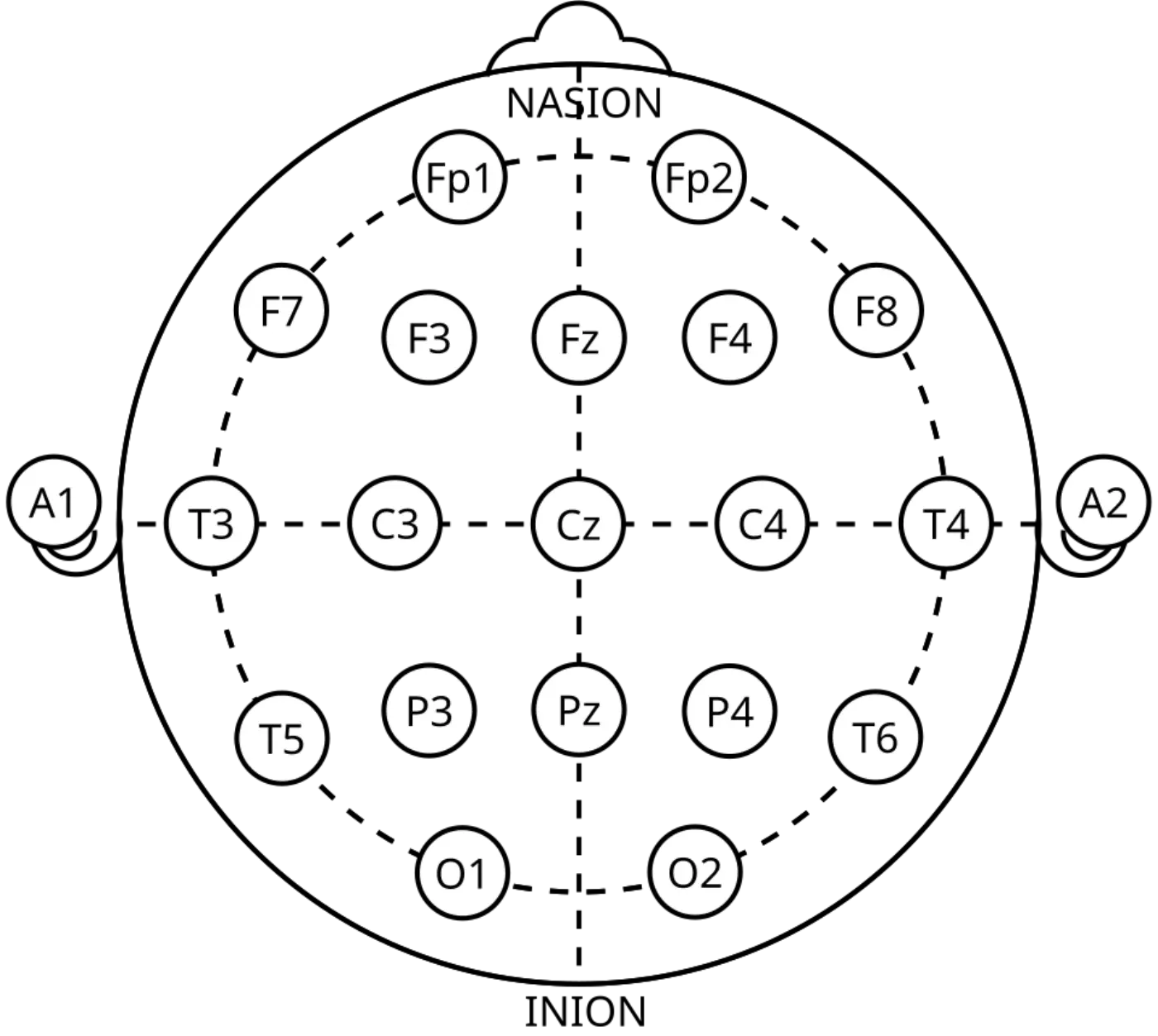
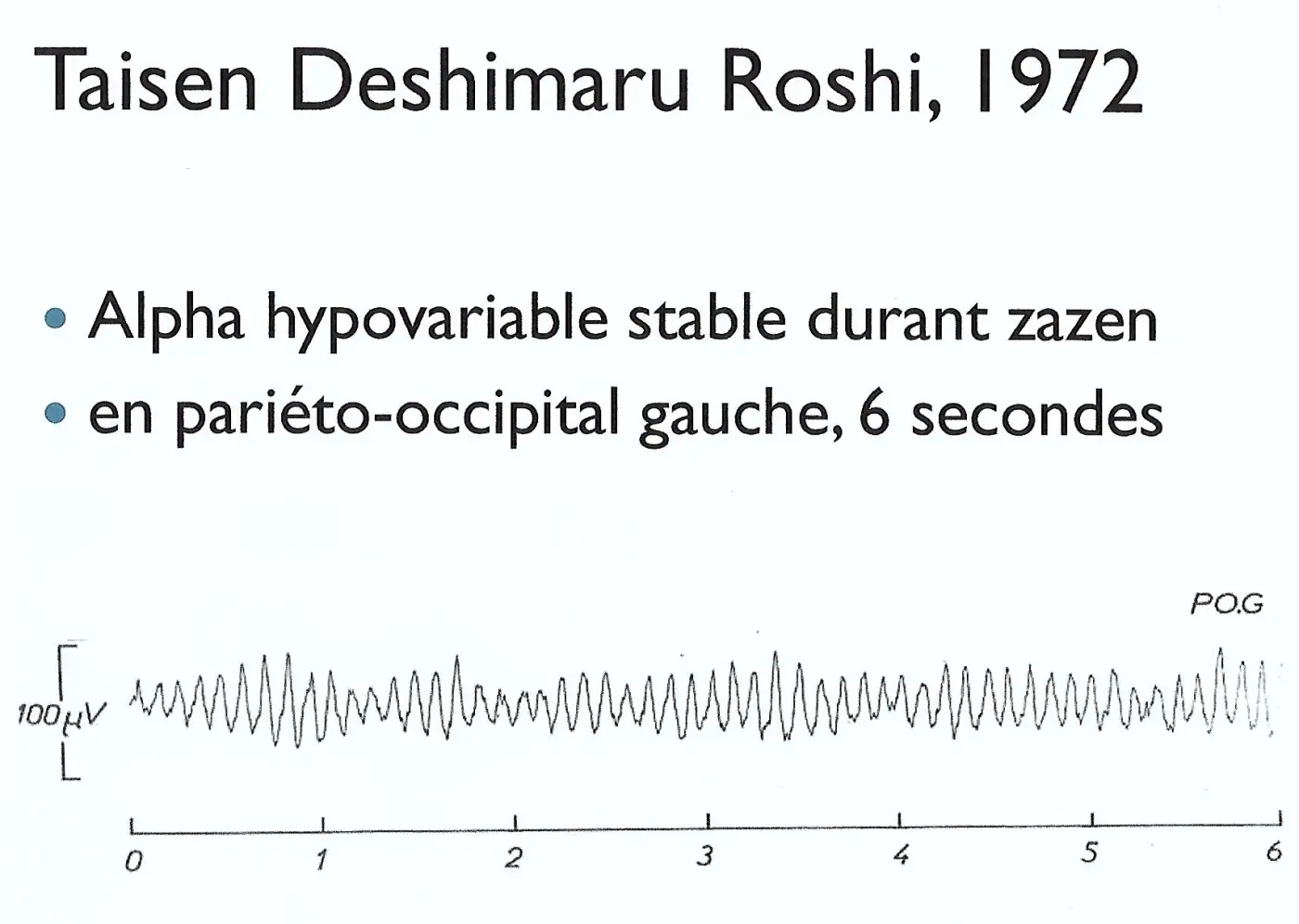
The story starts with the EEG (electroencephalogram), which records the brain’s electrical activity through sensors on the scalp. In 1934, the Cambridge physiologists E. D. Adrian and B. H. C. Matthews confirmed the “Berger rhythm”, now called the alpha rhythm: a wave of about ten cycles a second that appears at the back of the head when you rest with your eyes closed. They also showed that a flickering light could pull this rhythm along with it. Scientists call that effect photic driving (“photic” simply means “to do with light”).
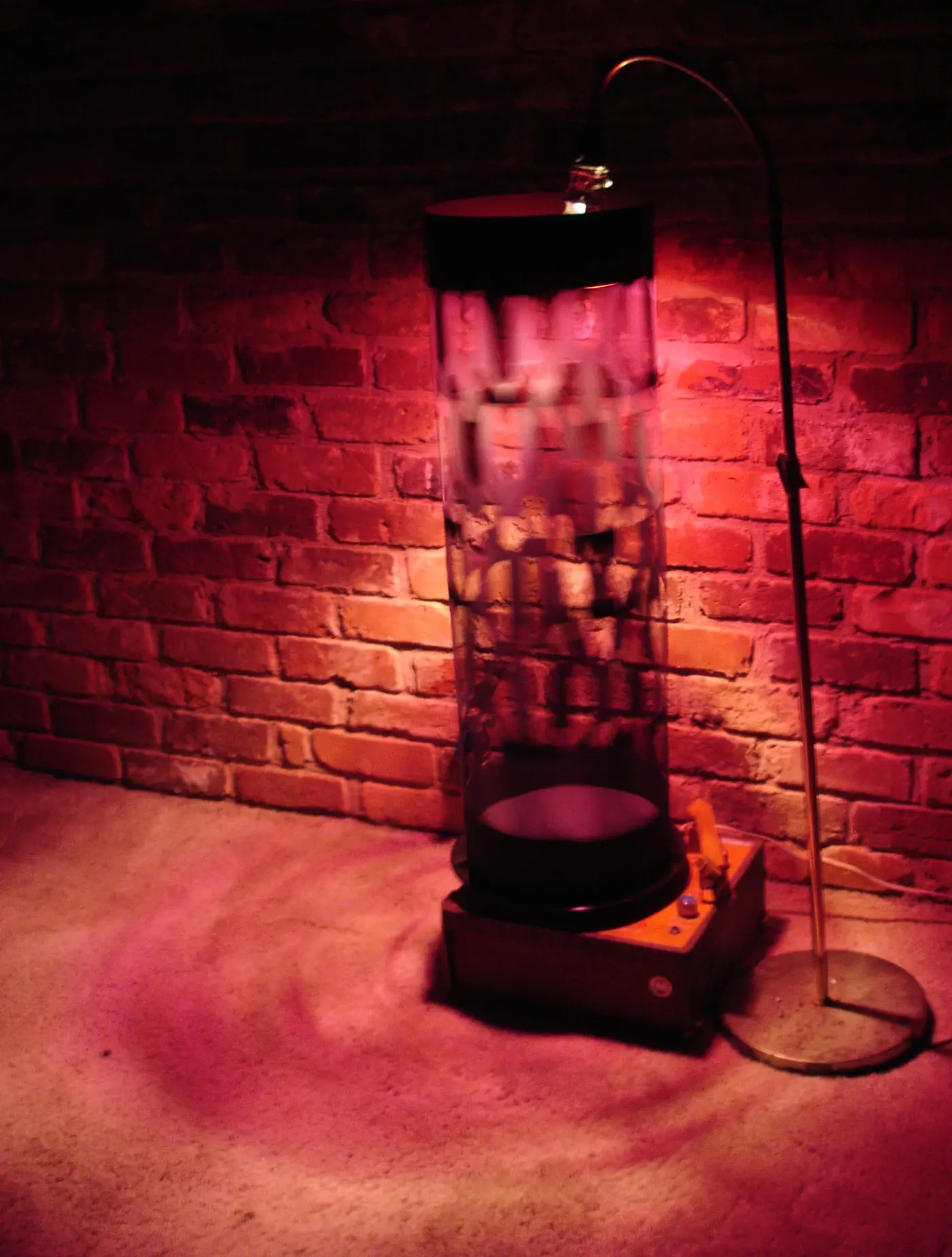
In the 1940s and 1950s the British neuroscientist W. Grey Walter studied flicker closely. In a 1956 paper in Nature he described the colour illusions people see in front of a flickering light, and his 1953 book The Living Brain brought the topic to a wide audience. That book reached the artist Brion Gysin and the technician Ian Sommerville. Around 1959 to 1961 they built the Dreamachine: a slotted cylinder spinning on a record turntable around a light bulb, viewed with closed eyes. It flickered at roughly 8 to 13 times a second, in the alpha range.
Electronic “mind machines” with LED glasses and headphones later replaced the spinning cylinder, and the Dreamachine itself returned in 2022 as a group experience linked to a large perception study at the University of Sussex. Today’s light-and-sound devices, including the one we use, belong to this family.
How flicker and sound pulses affect the brain, explained simply
This part is solid science. When your eyes receive light that flickers at a steady rate, the visual areas at the back of your brain fire in time with it. On an EEG you can see a clear signal at the flicker rate, and often at double that rate too. Researchers call it the steady-state visually evoked potential, or SSVEP. In plain words: a steady visual beat produces a steady echo in the brain. Vision scientists rely on it as a research tool. Rhythmic sound produces a similar, usually weaker, echo in the hearing areas.
The harder question is what that echo means. An echo in the visual cortex is not the same as the whole brain shifting into a calmer or more focused state, and it does not prove a lasting benefit. Researchers still debate whether AVE truly “entrains” the brain’s own rhythms or mostly records the brain responding to each flash. A 2025 review in Brain Sciences by Rahmani and colleagues describes how the mechanisms are still not well understood, and notes that many studies do not even report key settings such as brightness or exact frequency.
Device sessions usually aim at familiar EEG bands. These names describe rhythms, not guaranteed effects:
- Delta and theta (slow, under about 8 per second): linked with sleep and drowsiness. Used in “sleep” sessions.
- Alpha (about 8 to 12 per second): the relaxed, eyes-closed rhythm. Used in “relax” and “meditate” sessions.
- Beta (faster): linked with alert, busy thinking. Used in “focus” or “energize” sessions.
- Gamma (40 per second): studied for Alzheimer’s disease in research labs. More on that below.
What the research says
Two reviews, 17 years apart, give the clearest overview.
- Huang and Charyton, 2008. This review in Alternative Therapies in Health and Medicine gathered 20 studies that used rhythmic light or sound. It reported benefits for thinking problems, stress, pain, headaches, premenstrual symptoms and behaviour, and called brainwave entrainment an effective tool. The authors also said more controlled trials were needed, and many of the studies were small.
- Rahmani, Romero Lauro and Pisoni, 2025. This newer review in Brain Sciences is more cautious. It found results that differ from study to study, small samples, inconsistent methods and some null results, and it concludes that firm claims of benefit are premature.
A note on who did the research. Much of the clinical AVE literature was written or co-written by Dave Siever of Mind Alive, the Canadian company that makes DAVID devices (he is named as inventor on one of its AVE patents), sometimes with Thomas Collura, founder of the EEG equipment maker BrainMaster Technologies. Their chapters are useful overviews, but they are industry-linked. We have a stake too, since we use a Mind Alive device at Ōmni, which is why we give the independent reviews more weight.
| Goal | What studies report | Ōmni Evidence Scale |
|---|---|---|
| Relaxation, calmer feeling | People often report feeling relaxed; some small studies show lower anxiety; formal proof is limited | Early evidence |
| Sleep | Small studies over about four weeks report fewer insomnia symptoms | Early evidence |
| Mood | Small studies (around 15 people each) report fewer low-mood symptoms; one controlled study on seasonal low mood is industry-linked | Early evidence |
| Memory and attention | Mixed: some theta-rate studies helped memory, beta and 40 Hz did not; small school studies on attention | Early evidence |
| 40 Hz for Alzheimer’s disease | Promising in some mouse studies, disputed in others; a small human pilot was inconclusive; large trial results not yet published | Early evidence (research setting only) |
Ōmni Evidence Scale: Early evidence. For relaxation, sleep and mood, the studies point in a hopeful direction, but they are small, varied in method, and partly industry-linked, with no large independent trials yet.
Ōmni Evidence Scale: Early evidence. For memory and attention, results are mixed and depend heavily on the frequency used, so we would not choose AVE to sharpen thinking.
40 Hz gamma stimulation: a separate research story
You may have read headlines about flickering light and Alzheimer’s disease. This research is real, but it is not the same thing as a relaxation session.
In 2016, a team at MIT (Iaccarino and colleagues, Nature) reported that light flickering 40 times a second reduced amyloid, a protein linked to Alzheimer’s, in the visual cortex of mice. In 2023, another team (Soula and colleagues, Nature Neuroscience) tested 40 Hz light in two Alzheimer’s mouse models and found it did not drive the brain’s own gamma rhythms or reduce amyloid. The debate is still open. In people, a small pilot study was inconclusive. A large sham-controlled trial of a 40 Hz light-and-sound headset in Alzheimer’s (the HOPE study, run by Cognito Therapeutics, about 670 people) was completed in 2026. When we checked in October 2026, we could not find published results.
So a “gamma” or 40 Hz session on a wellness device is not a treatment for memory loss. Anyone worried about memory should see a doctor.
Ōmni Evidence Scale: Early evidence. 40 Hz stimulation is being tested as a medical approach in controlled trials; it is not proven, and consumer relaxation sessions are not part of that research.
Safety: who should not use flashing light
This is the most important section. Flashing light can trigger a seizure in people with photosensitive epilepsy. Closing your eyes does not remove the risk, because light passes through the eyelids.
- The Epilepsy Society (UK) says flashing between 3 and 30 times a second is the usual trigger range, with the highest risk around 16 to 25 flashes a second. That overlaps with the rates AVE devices use.
- A 2005 review for the Epilepsy Foundation of America put photosensitive epilepsy at up to about 1 in 4,000 people.
- Mind Alive’s own quick-start guide for the DAVID Delight says not to use it with a history of epilepsy, photic epilepsy or any seizure disorder.
- The 2025 review says repetitive light may trigger migraine in people who are prone to it.
- Mind Alive also mentions that some people get a headache or feel groggy in their first several sessions, and suggests drinking water beforehand.
Please do not use light-and-sound sessions if any of these apply:
- You have epilepsy, or have ever had a seizure.
- Bright or flickering light triggers migraines or makes you feel unwell.
- You are pregnant, take medication that affects the brain, or have a mental health condition, unless your doctor has said it is fine.
If you feel unwell during a session, open your eyes, take off the glasses and tell someone. At Ōmni, every guest fills in a short health questionnaire before any service, by email before the visit and again on site, and if you report epilepsy, a seizure history or light sensitivity, the team will steer you away from Neuro Align toward another service, such as a float.
What a session at Ōmni is like
Our Brainwaves Neuro Align session runs on a DAVID Delight device by Mind Alive. You lie back in a quiet room, close your eyes, and wear the light glasses and headphones for 30 minutes. Many people notice colours and patterns at first, then a slow, heavy, drifting feeling. Some fall asleep. It costs 450,000 VND per person on its own, or +200,000 VND per person when added to a float.
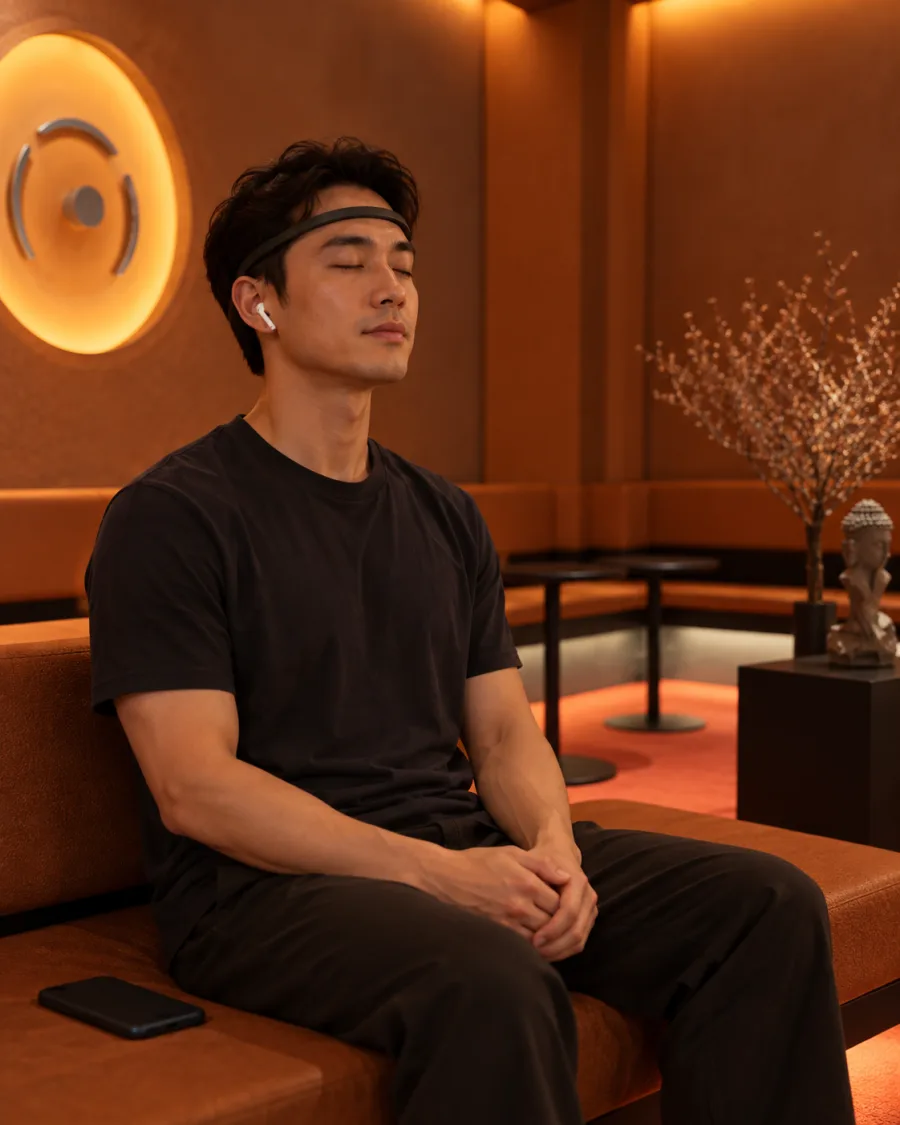
We offer it as a relaxation experience, not as a treatment. We make no medical claims for it, and the honest label is the one above: early evidence. If you are curious about your own data, we also keep a Muse 2 EEG headband that guests can try for a few minutes before and after a float. It only measures; it does not flash anything.
A float session takes the opposite approach: it removes light and sound almost completely instead of pulsing them. See how we grade every method on our Ōmni Evidence Scale page.
Where to try it in Saigon
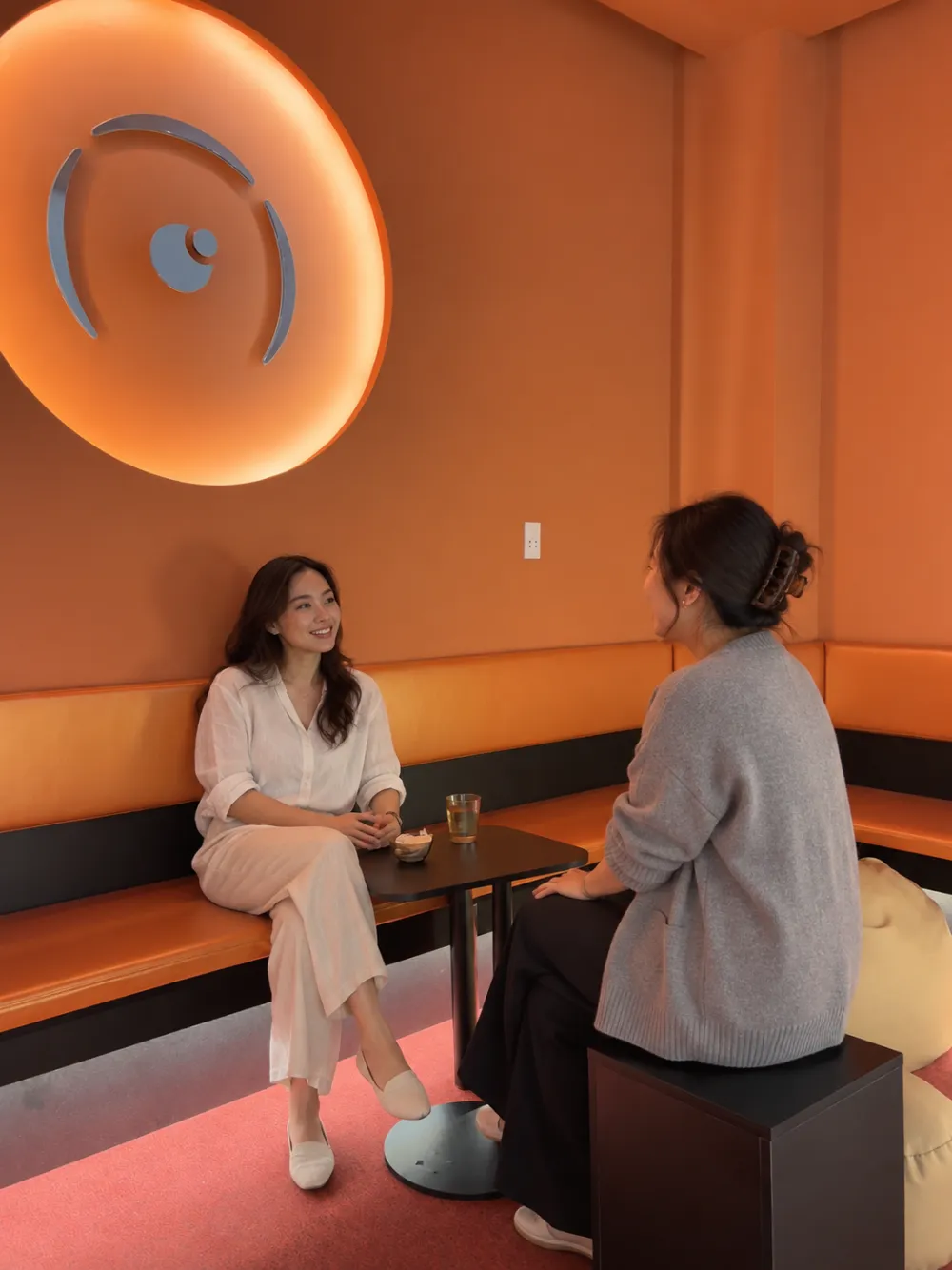
As of October 2026, our research did not find other public places in Vietnam offering Lucia, roXiva, Somadome or Dreamachine sessions, and we could not confirm an official Vietnamese distributor for home light-and-sound devices. Hand-carried devices may come without local support, so read the maker’s warnings carefully. If you would like to try a supervised session, Brainwaves Neuro Align is available at Ōmni Space, 16C Quốc Hương, Thảo Điền, open 9:00–21:00 daily. See all options on our services page, and if sleep is your main goal, our insomnia and float plan may help more.
New to brainwaves? Float Vietnam has a plain-language guide: what are brainwaves?
FAQ
Does audio-visual entrainment actually change brainwaves?
It changes the brain’s response in the moment: a steady flicker produces a matching signal on EEG, mainly over the visual areas. Whether it shifts your overall brain state, or has effects that last after the session, is still debated.
Is AVE the same as binaural beats?
No. Binaural beats use sound only: two slightly different tones, one in each ear. AVE adds pulsing light through closed eyelids. Some light-and-sound devices can play binaural beats as one of their sound options.
Is it safe?
Many people use it without problems, but some get a mild headache or feel groggy, especially in their first sessions. It is not safe for people with epilepsy or a history of seizures, and people prone to light-triggered migraine should avoid it.
Can AVE help me sleep?
Small studies report fewer insomnia symptoms after a few weeks of use, but the evidence is early. Ongoing sleep problems deserve a talk with a doctor.
Will a 40 Hz session prevent Alzheimer’s?
There is no proof of that. 40 Hz light and sound is being tested in controlled medical trials, and results so far are mixed. A relaxation session is not a treatment for memory loss.
What does a session at Ōmni involve?
After a health questionnaire, you lie back with your eyes closed, wearing light glasses and headphones, for 30 minutes. It is 450,000 VND per person on its own, or +200,000 VND per person with a float.
Sources
- Adrian & Matthews 1934, The Berger rhythm: potential changes from the occipital lobes in man, Brain 57 – abstract
- Walter 1956, Colour illusions and aberrations during stimulation by flickering light – Nature 177:710
- Dreamachine: throwing open the doors of perception – Science Museum
- Brion Gysin and Ian Sommerville’s dreamachine – designboom
- Dreamachine and the Perception Census – University of Sussex
- Norcia et al. 2015, The steady-state visual evoked potential in vision research: a review – Journal of Vision
- Huang & Charyton 2008, A comprehensive review of the psychological effects of brainwave entrainment – Alternative Therapies in Health and Medicine
- Rahmani, Romero Lauro & Pisoni 2025, Audio-visual entrainment neuromodulation: a review of technical and functional aspects – Brain Sciences
- Audio-visual entrainment (incl. Siever 2007 and Collura & Siever 2009 chapter references) – Wikipedia
- US patent 11536965, audio-visual entrainment, Mind Alive – Google Patents
- DAVID Delight Quick Start guide – Mind Alive
- Iaccarino et al. 2016, Gamma frequency entrainment attenuates amyloid load and modifies microglia – Nature
- Soula et al. 2023, Forty-hertz light stimulation does not entrain native gamma oscillations in Alzheimer’s disease model mice – Nature Neuroscience
- HOPE study of sensory stimulation in Alzheimer’s disease, NCT05637801 – ClinicalTrials.gov
- Photosensitive epilepsy – Epilepsy Society
- Photic- and pattern-induced seizures: a review for the Epilepsy Foundation of America – Aston University
- Muse 2 – InteraXon
Leave a Reply