
In short: Meditation in Hinduism is a line of practice that begins in the Upanishads, runs through Patañjali’s Yoga Sūtras and the Bhagavad Gītā, and is still very much alive today in japa (repeating a mantra such as Om), trāṭaka (steady gazing at one point), yoga nidra (deep, aware rest) and bhakti (loving devotion). The Sanskrit word for meditation is dhyāna: attention flowing in one unbroken stream towards an object. In these traditions the goal is not just relaxation, but stilling the mind to recognise one’s true self or to turn the whole heart towards God, depending on the school.
Read in Vietnamese: Thiền trong Ấn Độ giáo: từ Upanishad, Yoga Sūtra đến japa và dhyāna
If you have chanted “Om” at the end of a yoga class in Saigon, or seen 108 beads on someone’s wrist, you have touched the edge of a very old tradition. This guide follows Hindu meditation from the Upanishads to today, explains what Patañjali actually said, and ends with two practices to try at home, with respect for what they mean to Hindus.
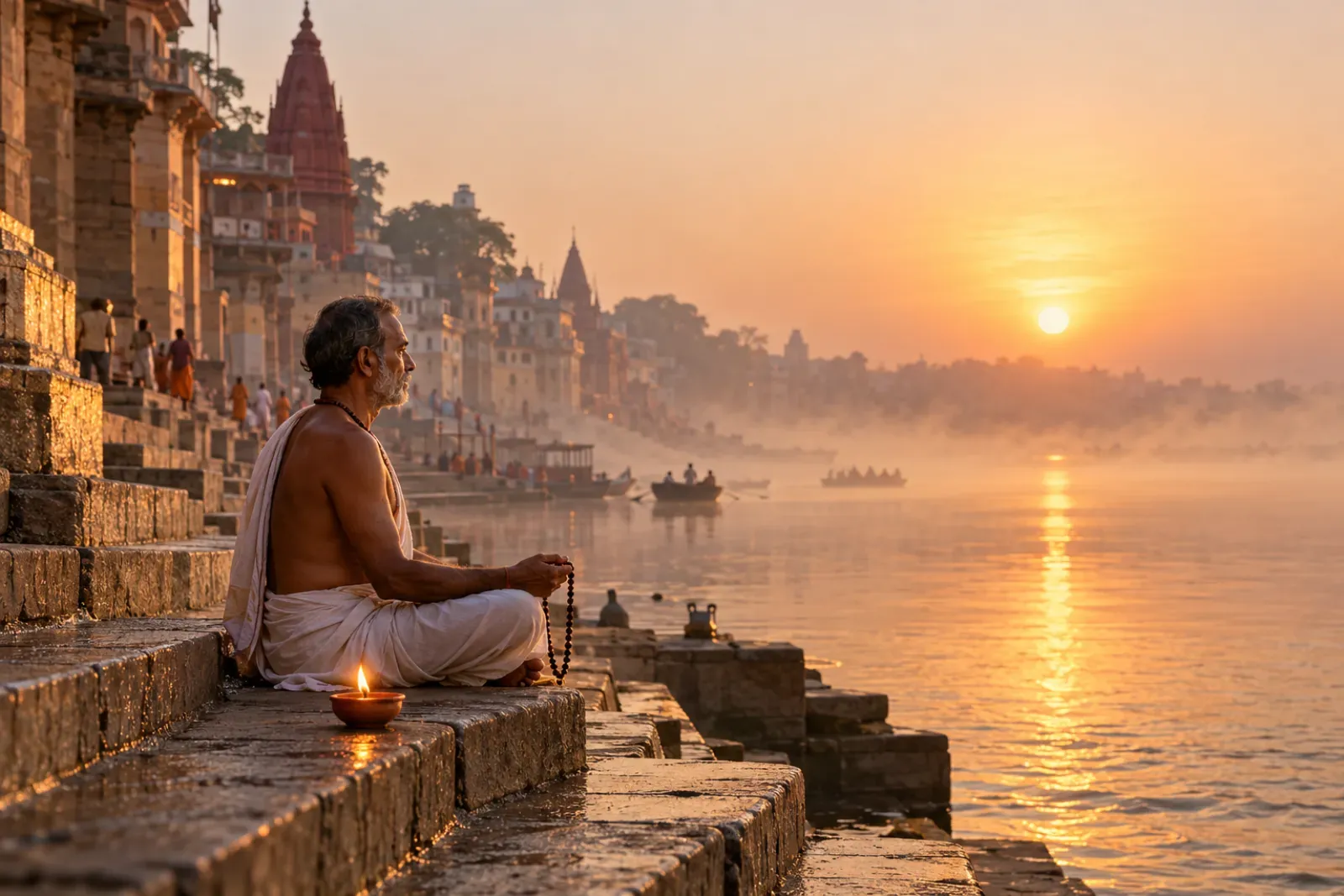
Where does meditation in Hinduism begin?
The first clear descriptions appear in the later Upanishads, above all the Katha and the Śvetāśvatara, in roughly the last centuries BCE. In the Katha Upanishad, Yama, the god of death, gives the boy Naciketas a simple definition: when the five senses and the mind are still, and the intellect no longer stirs, that is the highest state; holding the senses steady in this way is called yoga (union, a path of practice). The Śvetāśvatara Upanishad goes further into the body: keep the trunk, neck and head in line, regulate the breath, and choose a clean, quiet place to practise. The scholar Edwin Bryant (Rutgers University) sees these as the earliest references to yoga as a technique for realising Brahman (ultimate reality) within ātman (the deepest self).
The Māṇḍūkya Upanishad, the shortest of the principal Upanishads with just twelve verses, is devoted entirely to the syllable Om (AUM). In the traditional reading, the three sounds A, U and M correspond to waking, dreaming and deep sleep; the silence after Om is “the fourth” (turīya), pure awareness behind all three states. Om became the most sacred sound in Hinduism and the foundation of japa meditation.
Patañjali’s Yoga Sūtras: the eight limbs and what dhyāna means
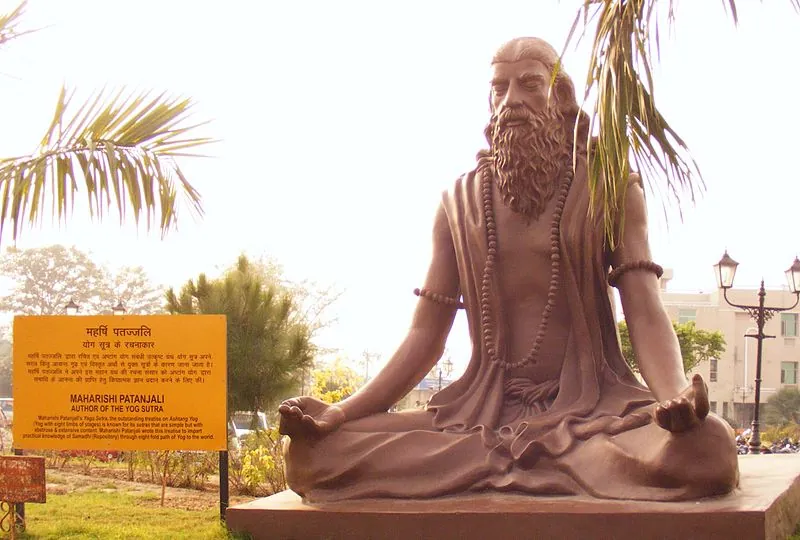
The Yoga Sūtras gathered existing yoga practices into a clearer eight-step path, in which dhyāna (meditation) is the seventh step. Little is known of Patañjali; most scholars date the text to around the start of the Common Era, some a few centuries earlier, but no later than the 5th century, when Vyāsa’s commentary appeared.
Sūtra I.2 is the most famous line: yogaś citta-vṛtti-nirodhaḥ, yoga is the stilling of the movements of the mind. Sūtra I.12 names the way in two words: abhyāsa (steady practice) and vairāgya (non-attachment).
| Limb | Sanskrit | Short meaning |
|---|---|---|
| 1 | Yama | Ethics towards others (non-harming, truthfulness…) |
| 2 | Niyama | Ethics towards oneself (purity, contentment, devotion to Īśvara…) |
| 3 | Āsana | A steady, comfortable seated posture |
| 4 | Prāṇāyāma | Regulating the breath |
| 5 | Pratyāhāra | Withdrawing the senses from outer objects |
| 6 | Dhāraṇā | Concentration: holding the mind in one place |
| 7 | Dhyāna | Meditation: attention flowing unbroken towards that object |
| 8 | Samādhi | Absorption: only the object shines, as if the mind forgets itself |
The last three limbs, defined in three consecutive verses at the start of chapter III, flow into one another. Dhāraṇā is placing the mind on one point, like shining a torch on one spot. When attention stops breaking off and flows continuously, that is dhyāna. When the flow becomes so deep that there is no longer a sense of “I am meditating”, only the object shining clearly, that is samādhi. These are not really three separate activities, but three depths of the same attention.
Notably, in almost two hundred verses, Patañjali gives only three to āsana, and asks only that the posture be “steady and comfortable”. Here āsana is a way of sitting so that the body does not get in the way of meditation, not the flowing sequences we see in studios.
What does the Bhagavad Gītā say about meditation in chapter 6?
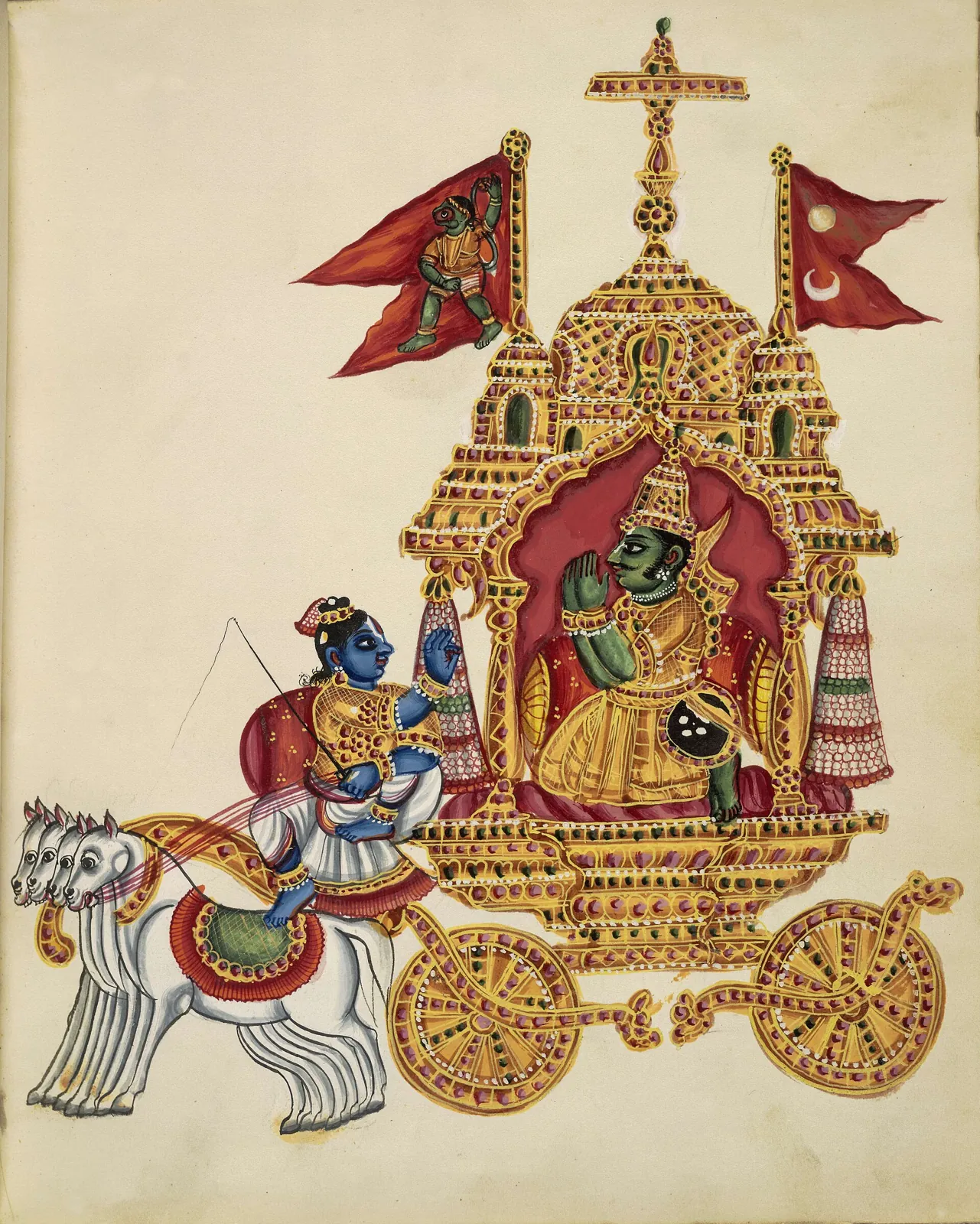
Chapter 6 of the Bhagavad Gītā, often called Dhyāna Yoga, gives concrete instructions, spoken by Krishna to Prince Arjuna in the epic Mahābhārata. Krishna advises choosing a clean place, setting a steady seat, holding the body, neck and head in one straight line, and resting the gaze gently towards the tip of the nose without looking around. He reminds Arjuna that eating or sleeping too much, or too little, makes yoga hard to accomplish. And he offers an important comfort for beginners: whenever the restless mind wanders, gently bring it back.
When Arjuna complains that the mind is restless and hard to hold, Krishna does not deny it. He simply says it can be trained through steady practice and non-attachment, the same two principles as Patañjali. The difference is that the Gītā places meditation within a relationship: the meditator turns the mind towards God, and in later chapters bhakti becomes a complete path of its own.
Which forms of meditation are still alive in Hinduism today?
Japa and mantra. Japa is repeating a mantra or sacred name, evenly, until the sound and the attention almost merge. A mantra is a sacred phrase or sound repeated in practice. Patañjali writes that the word expressing Īśvara is Om (I.27), and teaches repeating it while reflecting on its meaning (I.28). Practitioners often use a mala of 108 beads plus a larger sumeru bead; in the Vedic tradition you turn the mala around at the end of a round rather than crossing the sumeru.
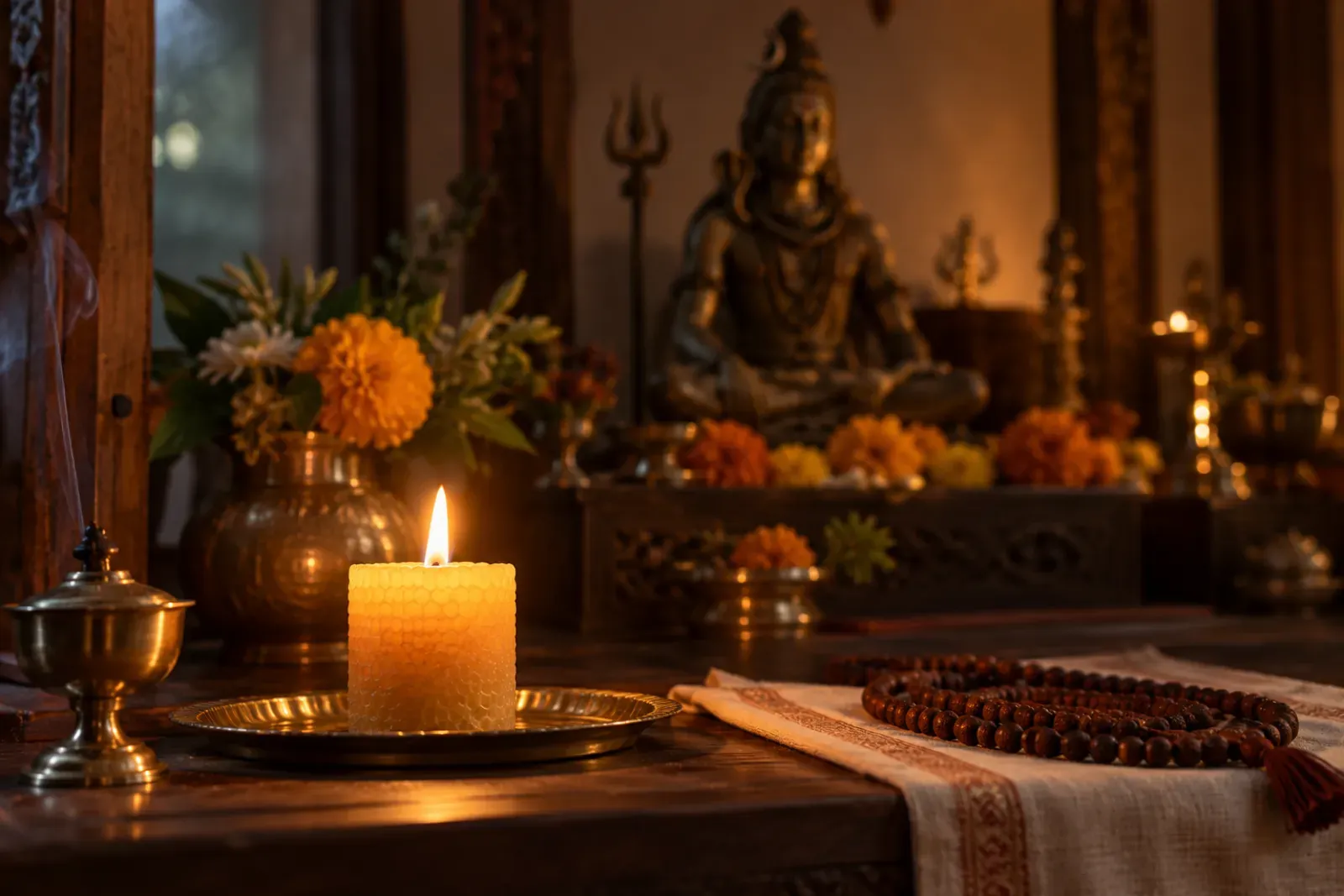
Trāṭaka. The Haṭha Yoga Pradīpikā of Svātmārāma, usually dated to around the 15th century, lists trāṭaka among the six cleansing practices. The practitioner keeps the mind calm and gazes without blinking at a small point until tears come. Today the most common object is a candle flame in a dark room.
Yoga nidra. A state of deep rest with awareness, in which you follow spoken guidance through each part of the body. Its modern form is linked to Swami Satyananda Saraswati, who founded the Bihar School of Yoga in Munger in 1963 and published the book Yoga Nidra in 1976. Our hub has a separate guide to NSDR and yoga nidra.
Bhakti. For a great many Indians, meditation is bound up with love for a deity: singing kīrtan (group devotional songs), repeating the names of Krishna, Rāma or Śiva, or sitting quietly before a home altar. Here concentration comes from affection and devotion more than from willpower.
Kundalini. Some haṭha and tantric lineages teach that an energy lies coiled at the base of the spine and can be awakened. The Haṭha Yoga Pradīpikā says it awakens “by the favour of a guru”, so the tradition treats it as a practice for a teacher’s direct guidance, not for learning alone from a book or video.
How is original yoga different from modern posture yoga?
Original yoga is a path to liberation centred on meditation; modern posture yoga is physical training that largely took shape in the 20th century. Same name, different purpose.
According to Mark Singleton in Yoga Body (Oxford University Press, 2010), the flowing sequences of postures in today’s studios carry many marks of Western gymnastics and the early 20th-century physical culture movement. A key figure was T. Krishnamacharya, who taught in Mysore in the 1930s and 1940s. Edwin Bryant also observes that seeing yoga mainly as postures is essentially a modern, Western phenomenon.
Singleton is not trying to “debunk” modern yoga: a class on the mat can still be a good doorway back into the body. The meditation lies in the limbs from pratyāhāra to dhyāna.
How to practise japa and dhyāna in the yoga tradition
The two practices below follow the order of the Yoga Sūtras and the Bhagavad Gītā. Anyone can learn the technique, but it helps to know that for Hindus, Om is a sacred sound connected with God, and japa is a prayer, not a relaxation trick. If that meaning does not fit your own beliefs, you can choose a sacred word from your own tradition instead.
Practice 1: japa with Om on the breath (10–15 minutes)
- Sit. Choose a clean, quiet corner. Sit on a cushion or a chair with your back upright but not stiff. If you have a mala, hold it in your right hand.
- Set an intention. Take a few slow breaths. In the tradition, this is the moment to turn towards Īśvara. You can also silently name what you want to nurture, such as peace.
- Chant on the out-breath. On each exhale, sound a long “Om”, low and warm. Feel the vibration spread from the chest up into the head. After a few minutes, lower it to a whisper, then repeat it only in the mind. If you use a mala, move one bead per Om, starting from the bead next to the sumeru.
- Reflect on the meaning. Sūtra I.28 teaches repeating and reflecting. Now and then, notice the silence after each Om, “the fourth” of the Māṇḍūkya.
- When the mind wanders, notice it and gently come back to the next Om, as Krishna advises.
- Finish. After one round of 108 beads, usually 10–15 minutes, sit still for another minute before getting up.
Common mistakes: chanting too fast, forcing the voice, and getting discouraged when the mind keeps running off. Japa only asks you to notice and come back, again and again.
Practice 2: dhyāna through Patañjali’s limbs (15–20 minutes)
- Āsana (2 minutes). Sit in full lotus, half lotus, cross-legged or on a chair. Keep the trunk, neck and head in line, eyes half closed. If something hurts, change position. Steady and comfortable matters more than looking good.
- Gentle prāṇāyāma (3 minutes). Make the out-breath a little longer than the in-breath, for example in for four counts, out for six. Do not hold the breath for long: extended breath retention is an advanced practice that needs a guru’s guidance. This step only smooths the breath.
- Pratyāhāra (2 minutes). Listen to the sounds around you, feel the seat beneath you, then let them recede into the background, like traffic heard from a distance. Do not block them; simply stop following them.
- Dhāraṇā (5 minutes). Place your attention on one point: between the eyebrows, at the heart, or the breath at the tip of the nose. When the mind wanders, bring it back to exactly that spot.
- Dhyāna (5–8 minutes). Gradually the returns become less frequent; attention rests on the object by itself. Do not force it. It is normal for dhyāna to come and go.
- Coming out. Take a few deep breaths, move your fingers, and open your eyes slowly.
Beginners can start with 10 minutes a day by shortening steps 4 and 5, then build up to 20. The most common mistake is treating dhyāna as something you must achieve, and straining for it. Patañjali places vairāgya right next to practice: a session that is all dhāraṇā, noticing the mind wander and bringing it back, is still a complete session. For simpler starting points, see our breathwork guide and the wider history of meditation across traditions.
From Patañjali to everyday life today
From this tradition we inherit slow breathing in yoga classes, yoga nidra before sleep, beads on the wrist, and above all Patañjali’s map: from the body, through the breath and the senses, and only then to the mind.
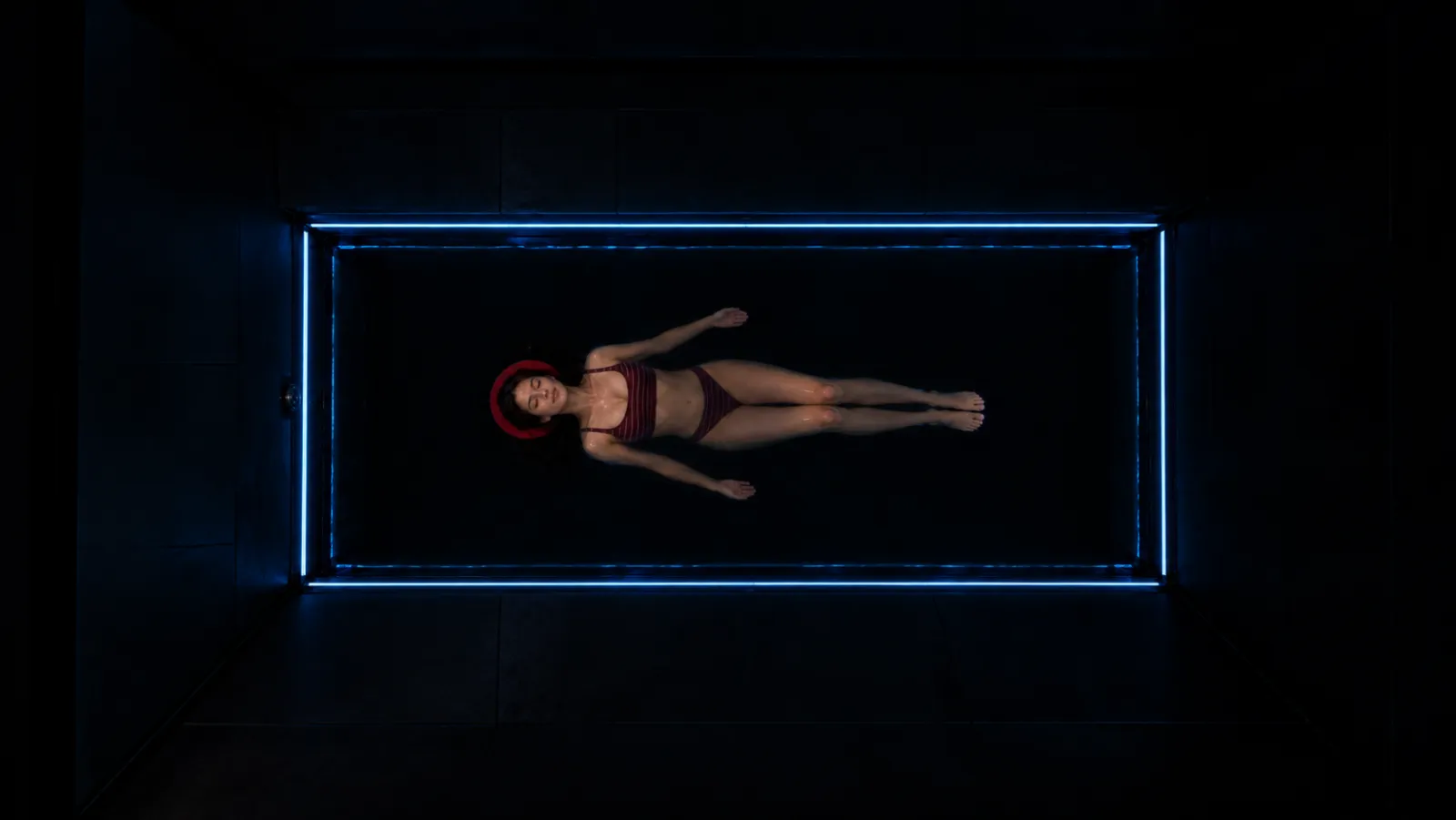
Floating touches the middle of that map. At Ōmni Space in Thảo Điền you lie in about 25 cm of water with around 500 kg of dense, mineral-rich Epsom salt, at 33–34 °C, close to skin temperature, in a dark, quiet private float room. With the body held and light and sound gone, it is a little like a room prepared for pratyāhāra. It works like a lift to the first floors of meditation, but it is not a shortcut to samādhi and does not replace the path Patañjali laid out. Withdrawing the senses is, in the end, the work of the mind, not of the room. You can start from our meditation hub.
Float PlanRunning on empty?Take the one-minute Float Plan quiz: tell us how you feel and what you need, and get a simple plan for your first session.Make my Float PlanFrequently asked questions
What is japa meditation?
Japa is the repetition of a mantra or sacred name, aloud, in a whisper or only in the mind. Practitioners often count with a mala of 108 beads. The Yoga Sūtras (I.27–28) teach repeating Om while reflecting on its meaning.
What is dhyāna?
Dhyāna is the Sanskrit word for meditation and the seventh of Patañjali’s eight limbs: concentration on one object that stops breaking off and flows continuously, like a stream that is no longer interrupted. In Pāli the word is jhāna; in China it became chan, which gave us thiền in Vietnamese and zen in Japanese.
Can non-Hindus practise japa with Om?
Anyone can practise the technique. But Om is a sacred sound in Hinduism, connected with God, so its meaning goes beyond the sound itself. If it does not fit your beliefs, choose a sacred word from your own tradition, such as the Jesus Prayer for Christians or dhikr, the remembrance of God’s name, for Sufis.
Is yoga the same as meditation?
Not quite. In the Yoga Sūtras, posture is only the third limb, a way to sit steadily before moving on to pratyāhāra, dhāraṇā and dhyāna. Posture yoga is good preparation; meditation in Patañjali’s sense begins when you sit still and let attention flow unbroken towards one object.
Written by the team at Ōmni Space – Float Saigon in Thảo Điền. General information on history and culture; dates for ancient texts are scholarly estimates. Checked on 5 November 2026.
Sources
- Bryant E. “Yoga (Patañjali)”. Internet Encyclopedia of Philosophy.
- Patañjali, Yoga Sūtras, chapter 1 (Sanskrit with several translations). sanskritdocuments.org.
- Patañjali, Yoga Sūtras, chapter 3 (Sanskrit with several translations). sanskritdocuments.org.
- Bhagavad Gītā 6.12–13, 6.16, 6.26, 6.35, translated by Swami Mukundananda.
- Bhagavad Gītā 6.11. Gita Supersite, IIT Kanpur.
- Svātmārāma, Haṭha Yoga Pradīpikā, translated by Pancham Sinh (1914), chapters II–III.
- “Japa Mala”. New World Encyclopedia.
- Singleton M. (2010). Yoga Body: The Origins of Modern Posture Practice. Oxford University Press.
- Campbell A. Review of Yoga Body by Mark Singleton.
- Māṇḍūkya Upanishad. Shlokam.
Leave a Reply