
In short: That heavy feeling is often stress showing up in the body: shoulders creeping upward, a tight jaw, a breath you keep holding, sleep that never quite feels enough. Mental stress alone can tighten the muscles around your neck and shoulders. On land, a slow, long exhale can help you soften that grip. In a float, the water does the holding for you, and studies have found reductions in pain, tension and stress immediately after sessions.
Before you read on, try something. Are your shoulders inching towards your ears? Are your back teeth touching? Is your breath sitting somewhere high in your chest? For just one breath, let all three soften. That little sigh of relief is a glimpse of the weight you may have been carrying without noticing. Over the next five minutes, you will see how heavy you feel right now, where that weight tends to hide, and a few ways to put some of it down, on land and in the water.
How heavy are you feeling right now? A one-minute check-in
This is only a check-in, not a test. Score each line from 1 (light as air) to 5 (very heavy), and trust your first answer.
- Shoulders and jaw: how tight do they feel right now?
- Breath: how short or held is it?
- Mind: how many “tabs” are open in your head?
- Sleep: how far short of rested did you wake up this week?
- The 3 pm slump: how heavy does your body feel by mid-afternoon?
Add them up. 5 to 10: travelling light; whatever is working, keep it going. 11 to 17: you are carrying a fair load; even a few minutes of letting go each day can make a difference. 18 to 25: you have probably been holding quite a lot for a while. It may be time to put something down.

Where everyday weight hides in your body
Feeling “heavy” is not only a mood. Stress can show up physically, often in muscles you can actually feel tightening.
- Stress makes your muscles brace. The American Psychological Association explains that muscles tense under stress to guard against injury, then release again when the stress passes. When stress keeps going, those muscles can stay partly braced, and long-term tension around the shoulders, neck and head is linked to headaches and back pain.
- You can tense up without lifting a thing. In a Swedish lab study, 62 women did mental arithmetic and a tricky colour-word test while sensors measured their trapezius, the muscle running from the neck across the shoulders. Both tasks clearly increased muscle activity, along with blood pressure and stress hormones. No physical load at all, just a busy mind.
- The load adds up. Neuroscientist Bruce McEwen called it allostatic load: the wear and tear that builds when the body’s stress systems stay switched on for too long. Put simply, one stressful day may be manageable; it is the backlog that starts to feel heavy.
- Sleep debt sneaks up on you. In a classic study, adults who slept six hours a night for two weeks performed as poorly as people kept awake for up to two nights straight, yet barely felt sleepier. You can feel “fine” while still running on a deficit.
- Desks and long flights. Hours in one position keep the same muscles working all day (see our desk back and neck pain guide), while a long-haul flight can add stiff legs and a body clock that no longer knows what time it is (see our jet lag guide).
Sound familiar? The deadline suddenly pulled forward by a day. The inbox that somehow refills while you are answering it. Eleven hours in a plane seat, followed by a taxi through rush hour. The 3 pm slump. None of these feels dramatic on its own; stack them together, though, and it starts to feel like carrying a backpack you forgot you were wearing.

When “heavy” is a reason to see a doctor
Most everyday heaviness improves with rest. Sometimes, though, it deserves a proper check first. Please see a doctor if:
- you have felt tired most days for two weeks or more, even after resting, eating well and drinking enough;
- your mood has been low, or you have lost interest in things you usually enjoy, most of the day, nearly every day, for more than two weeks;
- tiredness comes with unexplained weight loss, or someone hears you gasp or choke in your sleep;
- you feel short of breath, have chest pain, a racing or irregular heartbeat, or feel you might faint (get urgent help);
- an arm or leg suddenly feels heavy, weak or numb, or one side of your face droops: these can be signs of a stroke, so call 115 in Vietnam straight away.
Getting checked is a kind thing to do for yourself. A float can be a form of deep rest alongside good care, never a replacement for it.
Letting go on land: a one-minute reset
You can start right now, at your desk, in a Grab or waiting at the airport gate. Use the same long-exhale rhythm from our breathwork guide: in for 4, hold for 2, out for 6, pause for 4. Four rounds take about a minute.
- Round 1: breathe in through your nose for 4, hold for 2, then during the slow 6-count exhale, let your shoulders fall away from your ears.
- Round 2: as you breathe out, unclench your jaw and let your tongue rest.
- Round 3: on the next out-breath, soften your hands and your belly.
- Round 4: as you exhale, notice the chair or the floor carrying your weight, and let it.
Why make the exhale longer? In a 2023 Stanford trial, five minutes a day of exhale-focused breathing for a month lifted mood more, and slowed breathing more, than spending the same amount of time meditating. Prefer moving your attention through the body instead? Try a body scan, a slow sweep from head to toe that helps you notice where you are still gripping.
Letting go in the water: the water holds you, so you don’t have to hold anything
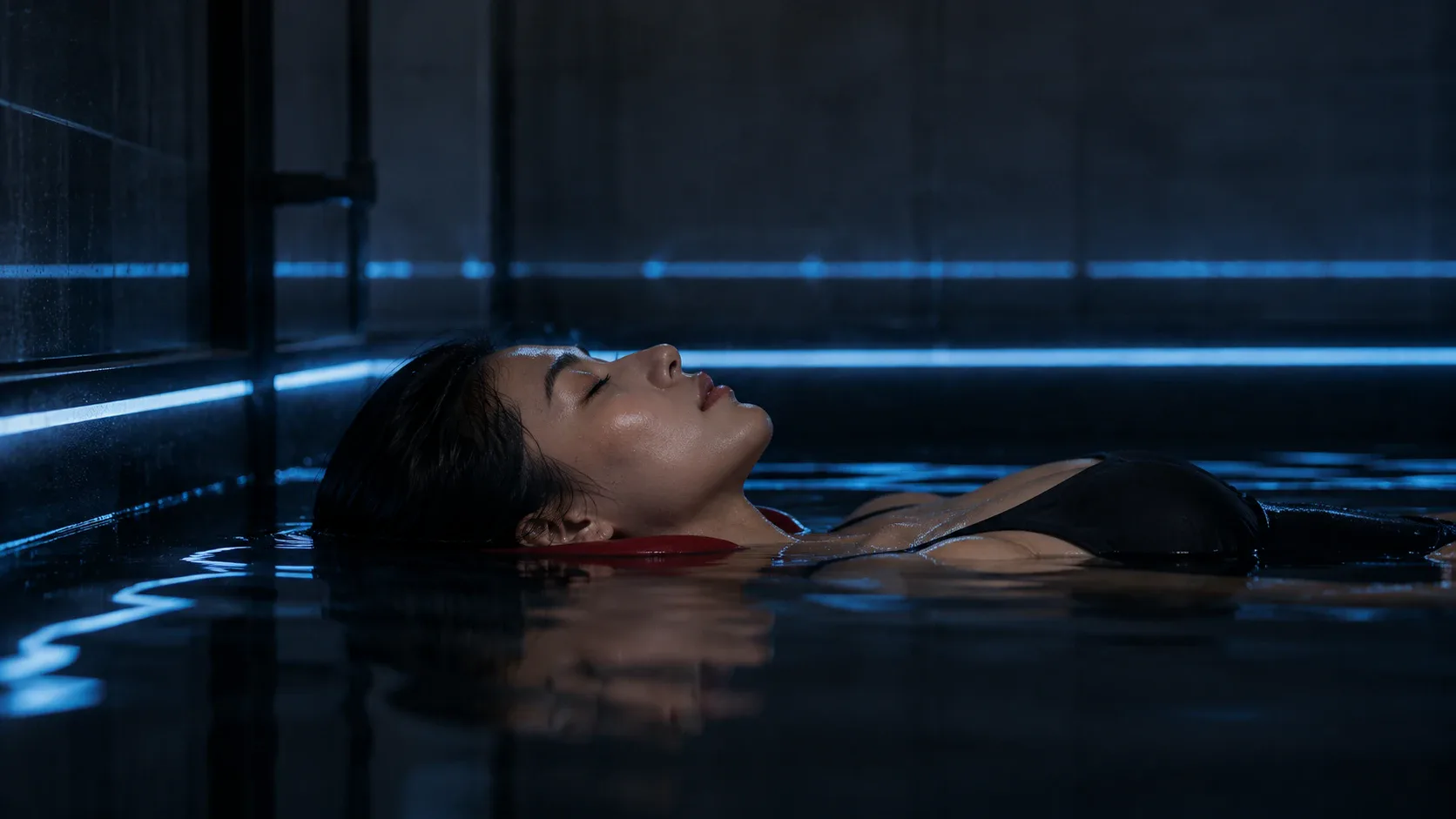
On land, some part of your body is always working against weight: your neck holds up your head, and even in bed your body presses into the mattress. In a float you lie back in about 25 cm of water with around 500 kg of dense, mineral-rich Epsom salt, warmed to 33–34 °C, close to skin temperature. The water supports you from head to toe without effort. Your neck and spine no longer have the same job to do, while the dark, quiet room asks very little of your attention. Want a small taste first? Press and hold the circle on our first-float page.
A float often unfolds in stages: first you settle in and notice how surprisingly light your legs feel; then the body becomes still, and you may begin to notice your own breathing or heartbeat; thoughts continue for a while, then often become quieter; and as your sense of time softens, many guests step out convinced that only 15 or 20 minutes have passed.
Pain can ease immediately after a float. In a 2021 German trial with 99 people living with chronic pain, pain eased clearly right after each float session, alongside lower anxiety and greater relaxation. The relief had not lasted to week 12 or 24, so this study supports a short-term effect rather than a lasting one; our guide to how often to float can help you think about a rhythm that works for you.
The muscles can let go, too. In a 2018 randomised study, 31 people very sensitive to anxiety floated for 90 minutes and, compared with a control session, reported clearly lower anxiety and muscle tension and more relaxation. Their blood pressure also fell during the float.
Stress can feel lighter. In a Swedish randomised trial, 65 working adults who floated 12 times over seven weeks reported less stress, anxiety and pain, and better sleep, than a waiting group. In a 2018 US study, 50 people with anxiety or stress-related conditions also felt clearly less anxious after one float, a promising result, though the study did not include a comparison group.
Float therapy is still a young but active research field. Randomised controlled trials have reported effects on anxiety, stress, muscle tension and sleep, while new clinical studies are still under way.
Ōmni Evidence Scale: Strong evidence, for float and stress. We rate it Strong because, alongside these trials, user experience is overwhelmingly positive: in a 2025 survey of regular floaters, 92% reported relaxation and 77% less stress, echoed by thousands of reviews, Reddit threads and forums, and by athletes and public figures who float. See how we rate evidence on the Ōmni Evidence Scale.
Ōmni Evidence Scale: Promising, for float and stress-related muscle pain in the short term. Small trials found pain and tension easing immediately after floating, but those effects did not persist for months without further sessions.
Ōmni Evidence Scale: Early evidence, for float and burnout or long-lasting fatigue. The only burnout study is tiny and combined floating with talk therapy; if feeling heavy has become feeling worn out, see our burnout recovery plan.
Put it down at Ōmni Space in Thảo Điền
Ōmni Space – Float Saigon is at 16C Quốc Hương, Thảo Điền, open 9:00–21:00 every day, with the last float starting at 20:00. Your room is completely private, with its own shower and an open pool behind glass. You control the light, every guest receives earplugs, and a Halo neck pillow is there if your neck wants extra support. There is no single “right” way to float; our English-speaking team walks you through everything before you begin.
Allow about 30 extra minutes for a guide and showers. Prices are on our price page. New to floating? Start with what float therapy is and before your first float.
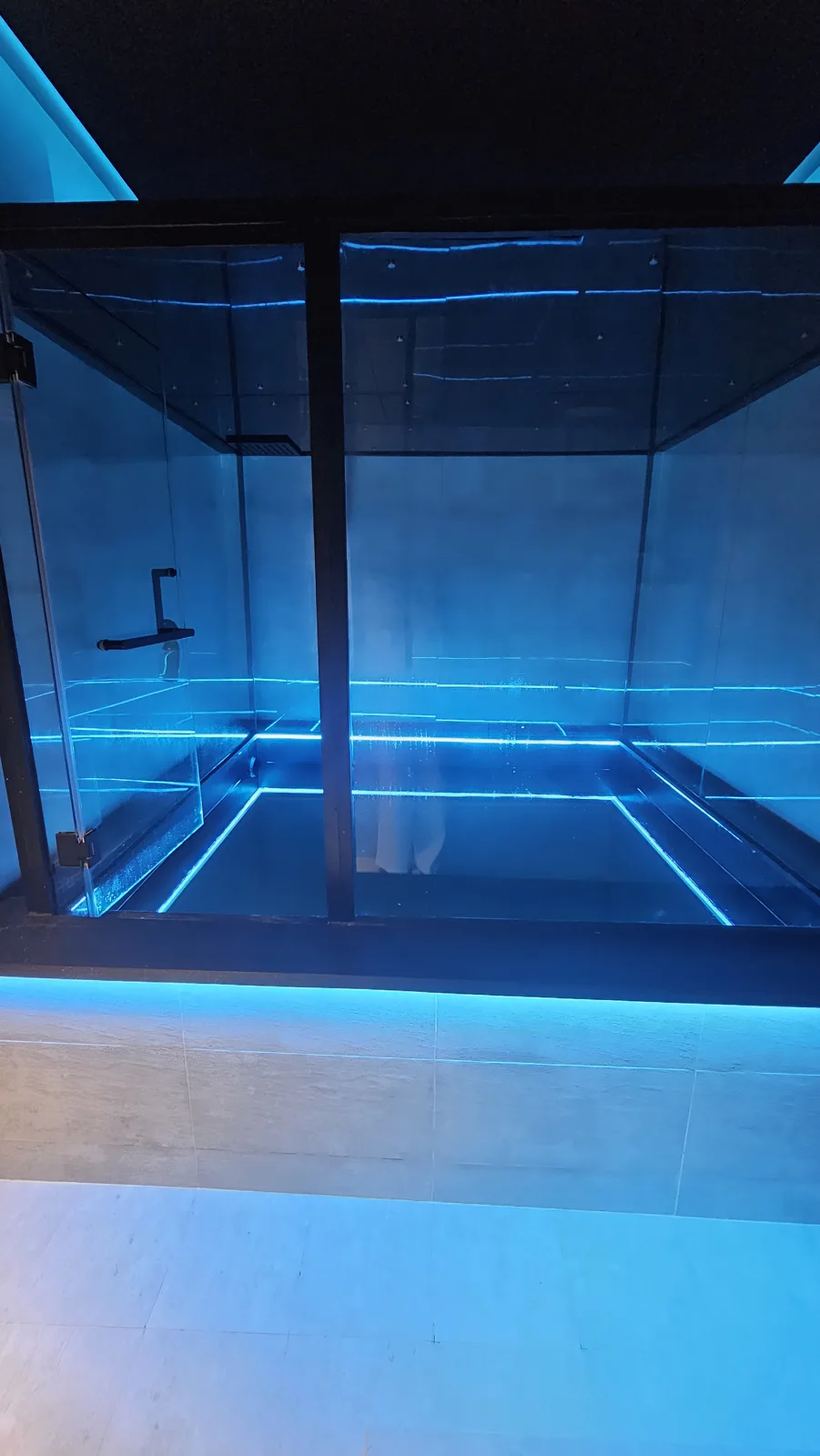
Afterwards, there is no need to rush. Take your time in the orange lounge. Many guests describe feeling lighter and looser for the rest of the day, and sleeping better that night.

Still holding on? Press and hold, and get a feel for what letting go is like →
FAQ
Why does my body feel heavy and tired?
Often, part of that heaviness is stress being held in your muscles, combined with short sleep, long hours in one position or travel. If you have felt tired most days for two weeks or more despite resting, see a doctor.
How can I let go of tension in my body quickly?
Try one minute of long exhales: in for 4, hold for 2, out for 6, pause for 4. With each out-breath, let your shoulders drop, unclench your jaw and notice the chair carrying your weight.
Can a float help when my body feels heavy?
It may help you feel lighter and more relaxed. The water supports your body, while the dark, quiet room reduces what your mind has to respond to. In trials, participants reported lower pain, muscle tension and stress immediately after floating.
How long does the light feeling last after a float?
Many guests say they feel loose and light for the rest of the day. Research suggests the clearest effects appear immediately after each session, which is why some people choose to float regularly.
How often should I float to stay lighter?
Start with a few floats close together, then every two to four weeks, or whenever you notice that sense of weight beginning to build again.
Do I need to do anything special in the water?
No. There is no wrong way to float. Lie back, use the Halo pillow if you like, choose whether the lights stay on or off, and let the water do the holding. You do not need to swim.
Written by the team at Ōmni Space – Float Saigon in Thảo Điền. General information, not medical advice; checked on 27 October 2026.
Sources
- American Psychological Association. Stress effects on the body.
- Lundberg U, Kadefors R, Melin B, Palmerud G, Hassmén P, Engström M, Dohns IE (1994). Psychophysiological stress and EMG activity of the trapezius muscle. International Journal of Behavioral Medicine 1(4): 354–370.
- McEwen BS (1998). Protective and damaging effects of stress mediators. New England Journal of Medicine 338(3): 171–179.
- Van Dongen HP, Maislin G, Mullington JM, Dinges DF (2003). The cumulative cost of additional wakefulness: dose-response effects on neurobehavioral functions and sleep physiology from chronic sleep restriction and total sleep deprivation. Sleep 26(2): 117–126.
- Mayo Clinic. Fatigue: when to see a doctor.
- NHS. Symptoms of depression in adults.
- NHS. Tiredness and fatigue.
- NHS. Symptoms of a stroke.
- Balban MY et al. (2023). Brief structured respiration practices enhance mood and reduce physiological arousal. Cell Reports Medicine 4(1): 100895.
- Loose LF, Manuel J, Karst M, Schmidt LK, Beissner F (2021). Flotation restricted environmental stimulation therapy for chronic pain: a randomized clinical trial. JAMA Network Open 4(5): e219627.
- Feinstein JS et al. (2018). The elicitation of relaxation and interoceptive awareness using floatation therapy in individuals with high anxiety sensitivity. Biological Psychiatry: Cognitive Neuroscience and Neuroimaging 3(6): 555–562.
- Kjellgren A, Westman J (2014). Beneficial effects of treatment with sensory isolation in flotation-tank as a preventive health-care intervention: a randomized controlled pilot trial. BMC Complementary and Alternative Medicine 14: 417.
- Feinstein JS et al. (2018). Examining the short-term anxiolytic and antidepressant effect of Floatation-REST. PLoS One 13(2): e0190292.
- Kjellgren A, Sundequist U, Norlander T, Archer T (2001). Effects of flotation-REST on muscle tension pain. Pain Research and Management 6(4): 181–189.
- Hilpert K, Chis Ster I (2025). Experiences and perceptions of regular floatation-REST users: results from an online survey. Journal of Clinical Images and Medical Case Reports 6(5): 3600.
Leave a Reply