Tag: Recovery by the Senses

  • Why do whispers give some people tingles? ASMR, brown noise and the calm brain

    Why do whispers give some people tingles? ASMR, brown noise and the calm brain

    In short: ASMR (autonomous sensory meridian response) is that pleasant tingle some people feel starting at the scalp and travelling down the neck when they hear whispering, tapping or slow, careful sounds. It is not just in your imagination: in a lab study, people who experience ASMR showed a small drop in heart rate while watching ASMR videos. But the research is still young, and people who do not get the tingles tend to get little from it. Brown, pink and white noise work differently: they help mask sounds that might wake or distract you. Evidence for using them as a sleep aid is very weak, no study has tested brown noise on its own, and a 2026 lab study found that pink noise shortened dream (REM) sleep. If you enjoy these sounds, keep the volume low and treat them as a gentle ritual, not a treatment.

    Part of the Ōmni Recovery Library · Recovery by the Senses

    Maybe you fall asleep every night to someone whispering into a microphone. Maybe you work with an endless loop of brown noise in your headphones. Maybe your partner finds the whole thing a little strange. You are far from alone: ASMR is one of YouTube’s best-known genres, while “brown noise” went viral on TikTok in 2022. So what exactly causes the tingles? Why did Korea embrace ASMR so enthusiastically? What have scientists actually measured? And what can the different colours of noise really do?

    Ōmni Evidence Scale: Early evidence, for ASMR helping people who feel the tingles relax (a few small lab studies and large self-selected surveys). Early evidence, for white or pink noise as a sleep aid (many studies, very low certainty). No good evidence yet, for brown noise specifically. Strong evidence, for float and stress. See how we rate evidence on the Ōmni Evidence Scale.

    What is ASMR, exactly?

    People who experience ASMR describe a soft, static-like tingling that begins at the crown of the head and moves down the back of the neck, sometimes spreading into the shoulders, arms and back, often with a wave of calm. Certain sounds and sights tend to trigger it: whispering, close personal attention, crisp noises such as tapping or crinkling, and slow, deliberate movements, like someone folding towels or brushing hair.

    The sensation is old; the label is new. In 2007, someone on a health forum started a thread called “Weird Sensation Feels Good”, and other people immediately recognised the experience. In 2010, Jennifer Allen gave it the deliberately clinical-sounding name autonomous sensory meridian response and started a Facebook group around it. YouTube did the rest. Not everyone can feel ASMR, though: plenty of people can watch exactly the same video and feel nothing, while some simply find whispering irritating.
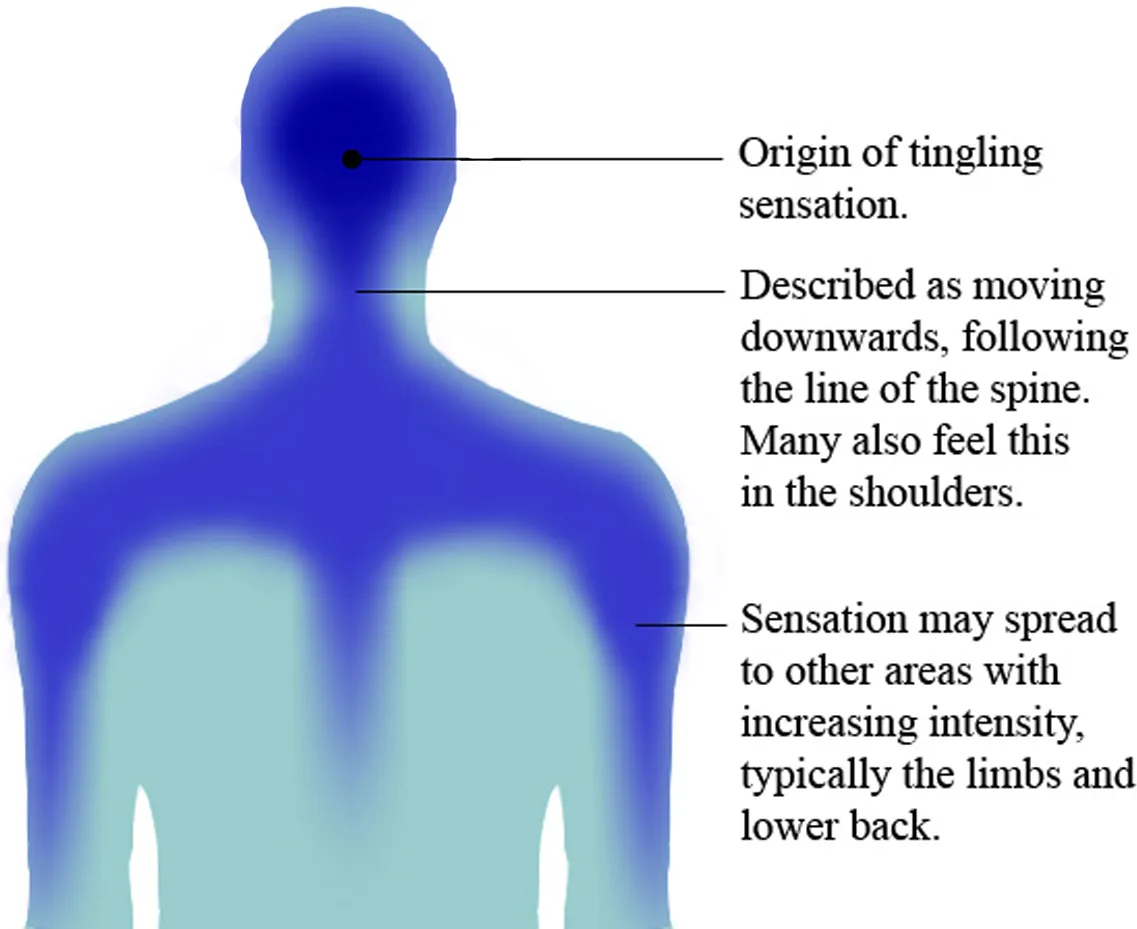
    Diagram of a person seen from behind showing where the ASMR tingle starts at the top of the head and spreads down the neck, shoulders and back
    Where the ASMR tingle usually travels: from the crown of the head down the spine, sometimes into the limbs. Illustration: Emma L. Barratt and Nick J. Davis (PeerJ, 2015), Wikimedia Commons, CC BY 4.0.

    Why ASMR is so big in Korea

    Korea took ASMR and brought it firmly into the mainstream. Korea JoongAng Daily reported in 2017 that ASMR became popular there as celebrities and established YouTubers began making their own videos: the girl group Apink released an ASMR teaser for an album in 2016, and singer Choi Yoo-jung of I.O.I recorded a whispered version of a song title that passed 13 million views. Viewers told the paper they used the videos to relax, fall asleep and focus while studying. Korean creators also became known for eating sounds, a crunchy cousin of mukbang, alongside role-plays and gentle care scenes.

    By 2020, as the Los Angeles Review of Books described, ASMR had travelled well beyond individual YouTubers. The Korea Cultural Heritage Foundation’s K-Heritage TV channel runs a playlist of wordless ASMR films set in traditional kitchens, workshops and temples, while Hyundai Card used ASMR videos of wind, waves and haenyeo divers to promote the island of Gapado. Busy days, study pressure and short nights are part of the backdrop (a 2016 OECD survey found Koreans slept the least in the OECD); whatever the reason, for many Koreans, a whisper through the headphones has simply become part of winding down.

    What science says about ASMR

    Serious research only began in 2015, so the evidence base is still small. Here is what researchers have found so far.

    • People use it to relax and sleep. In the first large survey, by Barratt and Davis at Swansea University, 475 people who experience ASMR answered questions online. 98% used it to relax, 82% to help them sleep and 70% to deal with stress, and 81% preferred watching before bed. The most common triggers were whispering (75%), personal attention (69%), crisp sounds (64%) and slow movements (53%).
    • The body calms, a little. In a 2018 study from the University of Sheffield, people who feel ASMR had heart rates about 3.4 beats per minute lower while watching ASMR videos than while watching a control video, alongside a small rise in skin conductance, a sign of emotional engagement. People who did not feel ASMR showed no such change in mood. The authors compared the heart-rate drop with music-based stress reduction.
    • The brain may be wired a little differently. A small 2017 brain-scan study compared 11 people with ASMR and 11 without: among those with ASMR, the default mode network, the brain’s “resting” network, was less tightly connected. Interesting, but tiny.
    • Calm and focus at the same time. A 2022 study of 38 young adults found heart rate fell in everyone during an ASMR video, while brain-wave changes suggested focused attention alongside relaxation.

    The limitations matter: most participants came from ASMR communities, many findings rely on self-report, and no long-term trial has tested ASMR for sleep or stress. The fairest reading is simple: if you get the tingles, ASMR can be a pleasant, low-risk way to wind down, with a small measurable calming effect.

    White, pink and brown noise: what they are

    “Coloured” noises are steady, random sounds with no melody. What changes from one colour to another is how their energy is distributed across pitches:

    • White noise has equal power at every frequency. It sounds like hissing static or a fan.
    • Pink noise has more power in the low frequencies. It sounds softer, a little like steady rain.
    • Brown noise (named after Brownian motion, not the colour) leans even further toward the bass. It sounds like a deep waterfall, heavy surf or the rumble inside an aeroplane.

    Brown noise exploded on TikTok in 2022, with many people, especially people with ADHD, saying it was the first time their brain had felt “quiet”. The basic idea behind all three is masking: a steady background sound makes sudden noises such as a horn, a door or a snore stand out less.
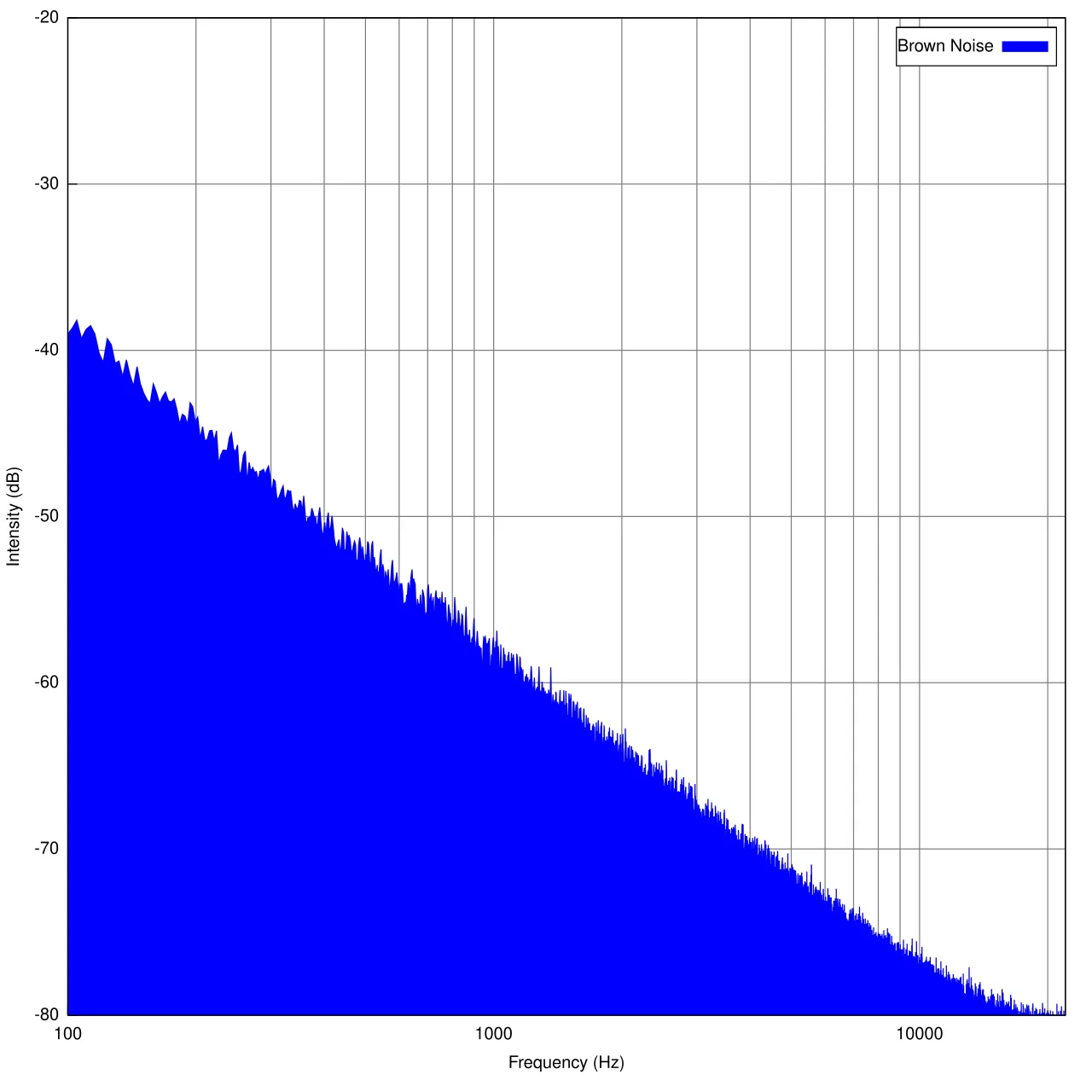
    Graph of the brown noise spectrum: sound intensity falls steadily from low to high frequencies
    Brown noise: most of its energy sits in the low frequencies and falls steadily as the pitch rises, which is why it sounds like a deep rumble. Graph: Warrakkk, Wikimedia Commons, CC BY-SA 3.0.

    What science says about noise for sleep and focus

    • Sleep: very low certainty. A 2021 systematic review of 38 studies on continuous white or similar noise and sleep rated the evidence that it improves sleep as very low quality. Some studies found better sleep; others found worse.
    • Pink noise and dream sleep. In a 2026 study at the University of Pennsylvania, 25 healthy adults slept seven nights in a sleep lab. Pink noise played all night reduced REM (dream) sleep, and against traffic and aircraft noise, plain foam earplugs worked better than pink noise.
    • A different, precisely timed technique. In a 2013 study in Neuron, short bursts of pink noise played exactly in time with the brain’s deep-sleep waves strengthened those waves and improved memory the next morning. That is a precise lab technique, not the same as leaving a noise app running all night.
    • Focus and ADHD. A 2024 meta-analysis of 13 studies (335 young people) found white and pink noise gave a small boost on lab attention tasks for young people with ADHD or many ADHD symptoms, but slightly worsened performance in those without. The authors found no studies on brown noise at all.

    So for now, brown noise is a much-loved sound without direct research behind it. It may still be useful in the simplest way any steady sound can be: by helping mask a noisy street.

    The risks, briefly

    Volume is the main concern. When researchers measured 14 infant “sleep machines” at full volume, every one was louder than the 50 dBA limit recommended for hospital nurseries at 30 cm, and three exceeded 85 dBA, a level that can damage hearing over a long night. For adults, the principle is the same: keep the sound low, place the device away from your head and avoid sleeping with headphones turned up. A 2026 lab study suggests all-night pink noise can shorten REM sleep, while a Korean sleep specialist interviewed in 2017 warned that some people can become reliant on videos to fall asleep. And if whispering or mouth sounds simply irritate you instead of relaxing you, that is reason enough to skip ASMR.

    Light, sound and silence at Ōmni

    We are a float centre, so this next part is naturally our side of the story. If you are curious about what sound can do to the mind, we offer two ways to explore that further, both in Thảo Điền.

    Guided Brainwaves is our light-and-sound session: you lie back with your eyes closed, wearing glasses that pulse soft light and headphones that play matching sound, designed to guide the mind toward slower, calmer states. Think of it as a cousin of the sounds above, but with a steady rhythm rather than random noise. Research on this approach, called audio-visual entrainment, is still small and mixed, which we explain in our guide to audio-visual entrainment; we offer it as a relaxation experience. It is not suitable for people with epilepsy or migraines triggered by flashing light; prices are on the Guided Brainwaves page.
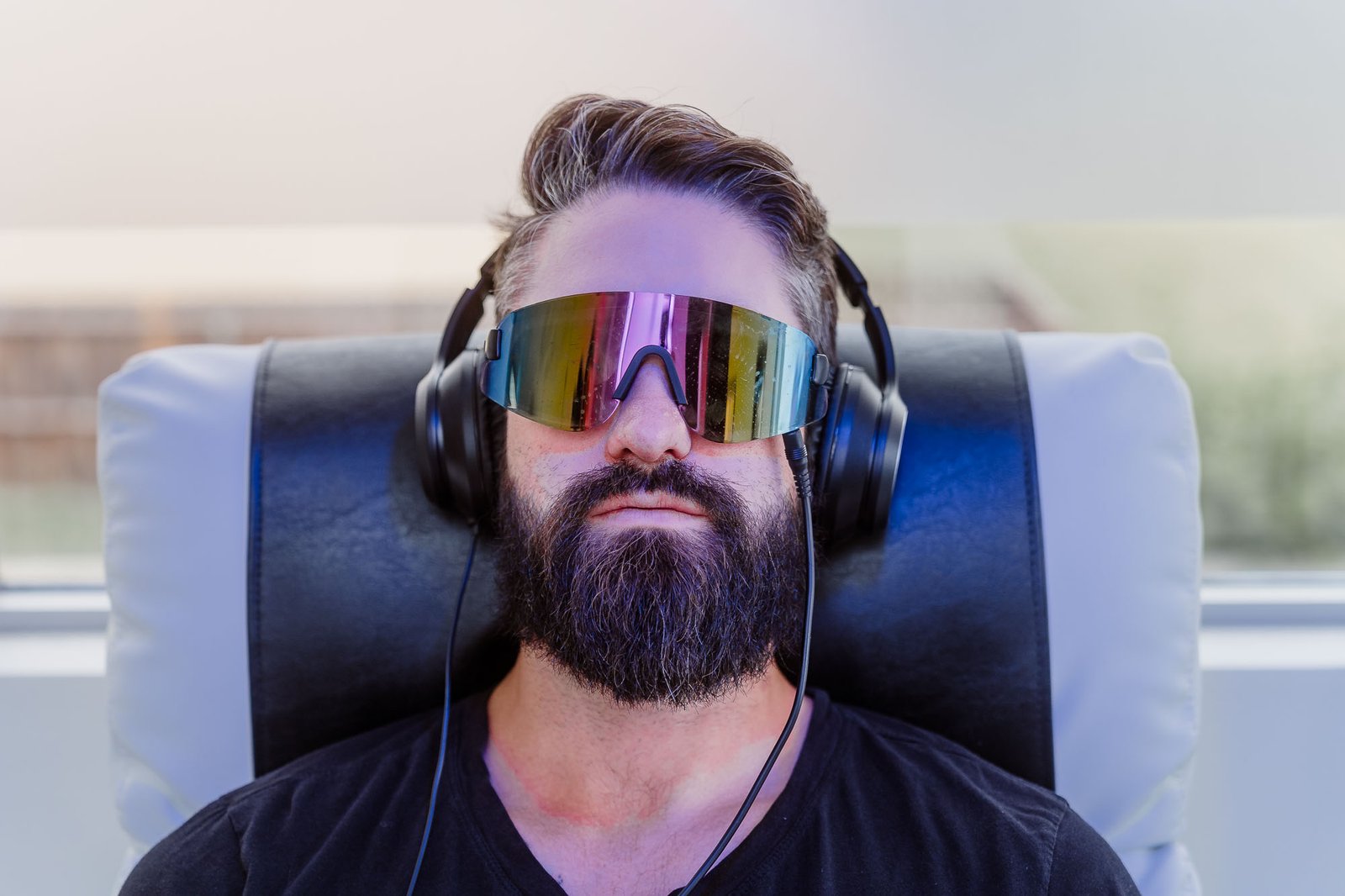
    A guest relaxing in a reclining chair wearing light-and-sound glasses and over-ear headphones
    Guided Brainwaves: soft light through closed eyelids and matching sound in the headphones. Image: Ōmni Space.

    Or you can go in the opposite direction, toward quiet. In a float room, you lie back in about 25 cm of water holding around 500 kg of dense, mineral-rich Epsom salt, warmed to 33–34 °C, close to skin temperature. With earplugs in and the lights off, there is nothing left to mask: the water supports you, and the only sounds are your breath and heartbeat. Float has been explored across hundreds of scientific studies. A 2005 meta-analysis of 27 flotation REST studies found positive effects on stress-related body measures and well-being, and a Swedish randomised pilot trial found that 65 working adults who floated 12 times over seven weeks reported less stress and anxiety and better sleep than a waiting group.

    Ōmni Evidence Scale: Strong evidence, for float and stress. We rate it Strong because, on top of these trials, user experience is overwhelmingly positive: in a 2025 survey of regular floaters, 92% reported relaxation and 77% less stress, echoed by thousands of reviews, Reddit threads and forums, and by athletes and public figures who float.
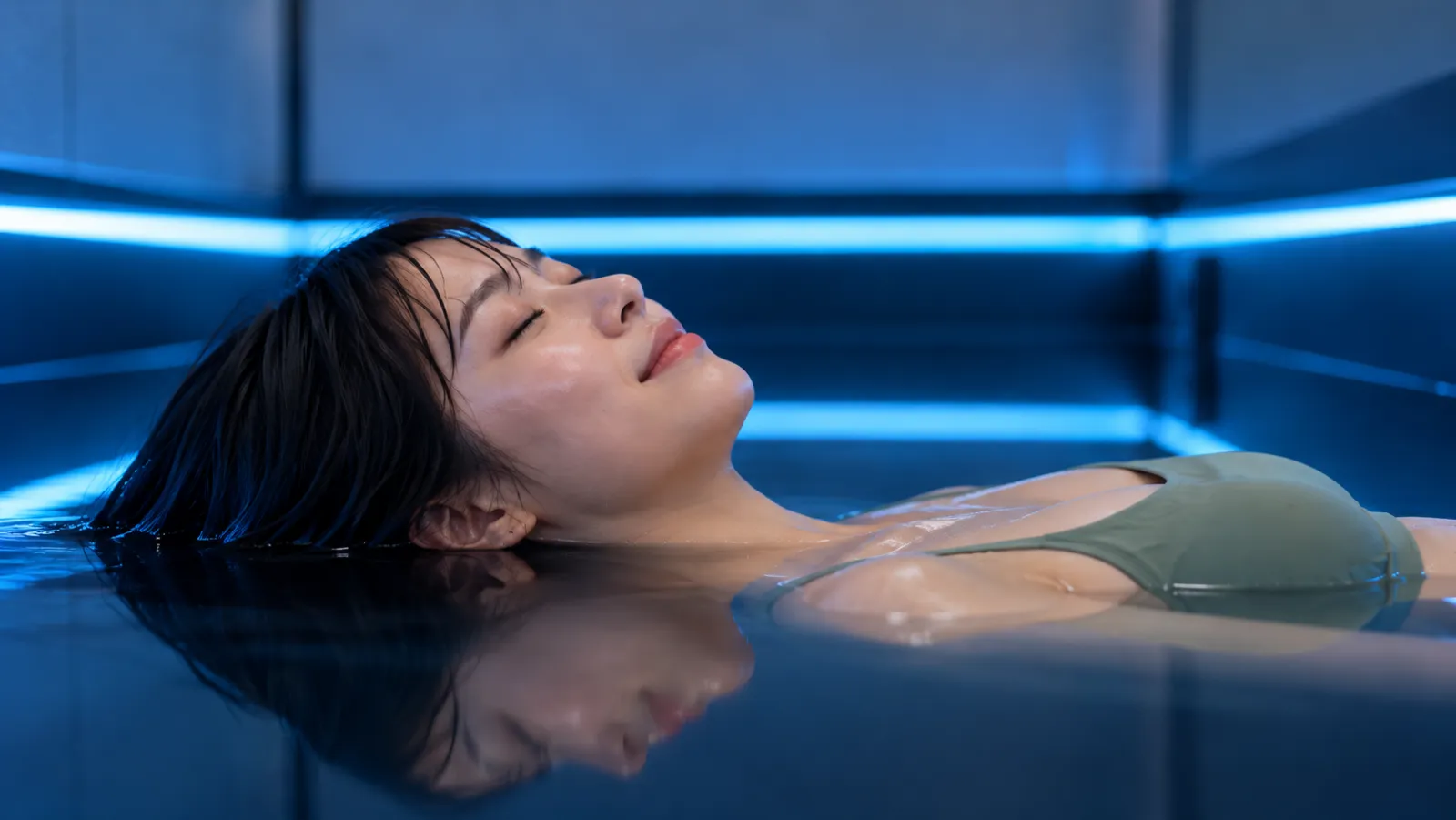
    A woman floating with eyes closed and a calm face in soft blue light at Ōmni Space
    No whispers, no noise machine: just water, warmth and your own breathing. Image: Ōmni Space.

    Ōmni Space in Thảo Điền comes from the team behind Float Vietnam, the country’s pioneer float centre since 2017. A single float costs 1,500,000 VND for 60 minutes or 2,000,000 VND for 90 minutes; the couple room, one large square pool for two, adds 700,000 VND for the second person. Every float room is private, with its own shower. If rhythmic sound interests you, you may also enjoy our pieces on binaural beats and 432 Hz music and sound healing in Saigon; new to floating? Start with what float therapy is.

    Ōmni Space – Float Saigon is at 16C Quốc Hương, Thảo Điền. We are open 9:00–21:00 daily; the last float starts at 20:00, and walk-ins are welcome until 18:00.

    Float PlanRunning on empty?Take the one-minute Float Plan quiz: tell us how you feel and what you need, and get a simple plan for your first session.Make my Float Plan

    FAQ

    Why do whispers give some people tingles?

    Nobody knows exactly. People who experience ASMR respond to soft, close, careful sounds such as whispering and tapping with a tingle that moves from the scalp down the neck, often alongside a sense of calm. Brain-scan studies hint that their resting brain networks may be connected a little differently, but those studies are very small.

    Is ASMR good for sleep and stress?

    For people who feel the tingles, it does seem to help them relax: heart rate dropped by about 3 beats per minute in one lab study, and most ASMR fans use it before bed. No long-term trial has tested it as a sleep or stress treatment.

    Is brown noise better than white noise?

    Many people find brown noise more pleasant because it sounds deeper and softer. But a 2024 meta-analysis found no studies of brown noise at all, and evidence for white or pink noise as a sleep aid remains very low certainty.

    Is it safe to sleep with noise on all night?

    Keep the volume low and the sound source away from your ears. Some infant sleep machines can exceed safe levels at full volume, and a 2026 lab study found that all-night pink noise reduced REM sleep. Earplugs worked better against traffic noise.

    Does Ōmni Space offer anything like ASMR?

    Not ASMR itself. Our private float rooms in Thảo Điền start at 1,500,000 VND for 60 minutes, and we also offer Guided Brainwaves, a light-and-sound relaxation session.

    Written by the team at Ōmni Space – Float Saigon in Thảo Điền, Vietnam’s pioneer float centre since 2017. We sell floats and Guided Brainwaves sessions, not ASMR or noise apps. General information, not medical advice; sources checked on 30 October 2026.

    Sources

    1. Barratt EL, Davis NJ (2015). Autonomous Sensory Meridian Response (ASMR): a flow-like mental state. PeerJ 3: e851.
    2. Poerio GL, Blakey E, Hostler TJ, Veltri T (2018). More than a feeling: autonomous sensory meridian response (ASMR) is characterized by reliable changes in affect and physiology. PLOS ONE 13(6): e0196645.
    3. Smith SD, Fredborg BK, Kornelsen J (2017). An examination of the default mode network in individuals with autonomous sensory meridian response (ASMR). Social Neuroscience 12(4): 361–365.
    4. Engelbregt HJ, Brinkman K, van Geest CCE, et al. (2022). The effects of autonomous sensory meridian response (ASMR) on mood, attention, heart rate, skin conductance and EEG in healthy young adults. Experimental Brain Research 240(6): 1727–1742.
    5. Dictionary.com. ASMR: meaning and origin (checked 30 October 2026).
    6. Kwon Y, Bae H, Korea JoongAng Daily (13 January 2017). In ASMR, shrimp and celery help listeners relax.
    7. Marshall C, Los Angeles Review of Books (29 March 2020). Everything turns into ASMR in Korea, even cultural heritage.
    8. Riedy SM, Smith MG, Rocha S, Basner M (2021). Noise as a sleep aid: a systematic review. Sleep Medicine Reviews 55: 101385.
    9. Basner M, Smith MG, Cordoza M, et al. (2026). Efficacy of pink noise and earplugs for mitigating the effects of intermittent environmental noise exposure on sleep. Sleep 49(5): zsag001.
    10. Ngo HV, Martinetz T, Born J, Mölle M (2013). Auditory closed-loop stimulation of the sleep slow oscillation enhances memory. Neuron 78(3): 545–553.
    11. Nigg JT, Bruton A, Kozlowski MB, et al. (2024). Systematic review and meta-analysis: do white noise or pink noise help with task performance in youth with attention-deficit/hyperactivity disorder or with elevated attention problems? Journal of the American Academy of Child & Adolescent Psychiatry 63(8): 778–788.
    12. Hugh SC, Wolter NE, Propst EJ, et al. (2014). Infant sleep machines and hazardous sound pressure levels. Pediatrics 133(4): 677–681.
    13. van Dierendonck D, te Nijenhuis J (2005). Flotation restricted environmental stimulation therapy (REST) as a stress-management tool: a meta-analysis. Psychology & Health 20(3): 405–412.
    14. Kjellgren A, Westman J (2014). Beneficial effects of treatment with sensory isolation in flotation-tank as a preventive health-care intervention: a randomized controlled pilot trial. BMC Complementary and Alternative Medicine 14: 417.
  • What happens to you in the quietest room on Earth?

    What happens to you in the quietest room on Earth?

    In short: According to Guinness World Records, the quietest place on Earth is the anechoic test chamber at Orfield Laboratories in Minneapolis, measured at −24.9 dBA on 19 November 2021. In a room this quiet, you do not hear “nothing”: you begin to hear yourself — your heartbeat, your breathing and often a faint ringing generated by your own ears and brain. No study has tested an anechoic chamber as a recovery tool, although short, comfortable periods of silence do appear calming. A float offers a gentler version of the idea: a dark, quiet private room and warm water that effortlessly holds you, for 60 or 90 minutes.

    Part of the Ōmni Recovery Library · Recovery by the Senses

    Maybe your days have a soundtrack you barely notice anymore: motorbike horns, a neighbour’s karaoke, the steady hum of an air conditioner. Then, every so often, you catch yourself wishing it would all simply stop. What would real silence actually feel like? Engineers have built rooms that come remarkably close, and what people notice inside them is surprisingly intimate. Here is what the record numbers really mean, what happens to body and mind when almost all outside sound disappears, what science can and cannot tell us, and how to find a gentler kind of quiet in Saigon.

    Ōmni Evidence Scale: No good evidence yet, for an anechoic chamber as a recovery tool (nobody has tested it). Early evidence, for short silences calming the body (small lab studies). Strong evidence, for float and stress. See how we rate evidence on the Ōmni Evidence Scale.

    What is an anechoic chamber?

    “Anechoic” simply means “without echo”. An anechoic chamber is designed so that sound does not bounce back from the walls, floor or ceiling. Every surface is covered with deep wedges of sound-absorbing material, usually fibreglass or foam, pointing into the room like the teeth of a giant comb. Instead of reflecting around the space, sound waves enter those wedges and are absorbed. The room often sits inside a second heavy shell, sometimes mounted on springs, so traffic, footsteps and lift motors stay outside too.

    These rooms were never designed for wellness. Companies and universities use them to hear and measure products with extraordinary precision, from hearing aids to motorbikes and washing machines. The profound quiet is really a side effect of very clever engineering.

    A large anechoic room lined on every wall with rows of sound-absorbing wedges, with a metal grid floor and a small measuring platform
    The largest anechoic room at the Technical University of Denmark: every surface absorbs sound instead of reflecting it. Photo: Arnaud Dessein, Wikimedia Commons, CC BY-SA 3.0.

    The record: how quiet is the quietest room on Earth?

    Guinness World Records lists the anechoic test chamber at Orfield Laboratories in Minneapolis, Minnesota, as the quietest place on Earth, with a background level of −24.9 dBA measured on 19 November 2021. It was so quiet that a single microphone could not measure it directly: the microphone’s own electrical noise was louder than the room. The team therefore cross-correlated two Brüel & Kjær type 4145 microphones to tease the chamber’s level out from beneath the instruments’ own noise.

    The title has changed hands over the years. According to Guinness, Orfield’s room first set the record in 2004 at −9.4 dBA and improved it to about −13 dBA in 2012 (Orfield gives −13.4 dB). In 2015, an anechoic chamber in Building 87 at Microsoft’s headquarters in Redmond, Washington, took the record at −20.35 dBA. In 2021, Orfield reclaimed it with −24.9 dBA and has held it since. Guinness describes the Orfield room as stopping 99.99% of sound, using fibreglass wedges about 1 metre (3.3 feet) deep, double walls of insulated steel and around 30 cm (a foot) of concrete.

    What does a negative decibel mean?

    Zero decibels does not mean “no sound”. It is a reference level close to the faintest sound a healthy young ear can detect, which means a room can genuinely measure quieter than zero. The World Health Organization’s guideline for a sleeping room is about 30 dBA. Every 10 dB represents ten times the sound energy, so the Orfield chamber contains hundreds of thousands of times less sound energy than that quiet bedroom. At that point, the most noticeable source of sound in the room is often you.

    What happens to you inside: “you become the sound”

    When the outside world becomes quiet enough, your hearing seems to turn up its sensitivity, rather like your eyes adjusting to a dark room. In the Orfield chamber, visitors have described hearing blood moving through their veins and even the movement of their eyelids when they blink. Founder Steven Orfield told Guinness that in a quiet room you hear your heartbeat, sometimes your lungs and your stomach. His wonderfully concise summary was: “In the anechoic chamber, you become the sound.” After about 30 minutes inside, he could even hear the mechanical valve in his own heart working, loudly.

    Composer John Cage encountered the same basic revelation in 1951, inside an anechoic chamber at Harvard University. He entered looking for silence and, as he later wrote, heard “two sounds, one high and one low”. The engineer told him the high one was his nervous system and the low one his blood circulating. That explanation is doubtful, since you cannot hear nerves firing; the high tone was probably the faint ringing many ears produce in silence (more on that below). But Cage’s larger conclusion endured: for a living person, absolute silence may be impossible to experience. The encounter helped shape 4′33″, his piece in which the performer plays nothing and the audience instead hears the room itself.

    The experience also varies from person to person. Some visitors become unusually aware of internal sounds and sensations, while others describe the chamber as one of the calmest places they have ever been. What is consistent is that when almost everything outside you disappears, the normally quiet details inside you become much easier to notice.

    Black and white photo from 1949: a woman sits in a chair in an anechoic chamber lined with wedges, facing a large loudspeaker, holding a response button
    A hearing test in an anechoic chamber at AT&T, 1949. The volunteer presses a button to indicate which of two sounds is louder. Photo: Radio-Electronic Engineering magazine (May 1949), Wikimedia Commons, public domain.

    The “nobody lasts 45 minutes” story

    You may have seen the claim that nobody can stay in the quietest room on Earth for more than 45 minutes. That number spread through 2012 news stories after a challenge in which people sat inside the chamber in darkness and one person stayed for 45 minutes. It was never an official endurance record or a medical limit: Guinness measures the room, not the people inside it. A VICE journalist later stayed 48 minutes in the Danish chamber pictured above, and Orfield Laboratories now books “silent sessions” by appointment.

    What science says about very deep silence

    Nobody has run a trial testing anechoic chambers for stress or recovery. What researchers have studied instead is what happens to perception when sensory input falls dramatically, and what shorter periods of silence appear to do to the body.

    • Silence makes ears “hear” sounds. In a classic 1953 study, Heller and Bergman placed 80 adults with normal hearing in a soundproof booth, and the large majority reported buzzing, ringing or humming despite no external source being present. In 2008, an Italian-led team placed 53 young adults in an anechoic chamber for four minutes: 83% heard at least one sound, and adding a switched-off loudspeaker raised that only to 92%, suggesting that expectation played a relatively minor role. In deep silence, the auditory system becomes remarkably good at revealing its own background activity.
    • Remove sight as well, and perception gets creative. In a 2009 study, Mason and Brady placed volunteers in a brief period of complete isolation from sound and light. Both groups reported more unusual perceptions than outside it, with the strongest effects among people already more prone to hallucinations. It belongs to the same broader family of perceptual effects explored in long darkness retreats.
    • Short pauses calm the body. In a 2006 study in the journal Heart, 24 people listened to different styles of music with a random two-minute pause. During that pause, heart rate, blood pressure and breathing fell, even below their starting level. It is a small study, but it supports a pleasantly simple idea: sometimes a break in the input is restful in itself.
    • Mice grew new brain cells in silence. In a 2015 study, mice given two hours of silence a day had more new neurons in the hippocampus a week later than mice exposed to other sounds. Interesting, certainly, but still a clue rather than evidence for humans.

    Taken together, the picture is fairly clear at one level and still open at another: deep silence changes what we perceive, while short, comfortable periods of quiet appear calming. Whether the world’s quietest room itself helps recovery remains unknown.

    The risks, briefly

    For a healthy visitor, a supervised half hour in an anechoic chamber is considered low risk. The most noticeable effects tend to be heightened awareness of internal sounds and body sensations, which settle again once ordinary sensory input returns. People prone to hallucinations may experience stronger perceptual effects during deep isolation. Visits to rooms such as Orfield’s are arranged by appointment, with staff nearby, and you can leave whenever you choose.

    Float: a kinder kind of quiet

    A float room is not an anechoic chamber — and for rest, that is part of the appeal. It is quiet enough for the outside world to recede, while warmth, water and soft darkness give your nervous system something gentle to settle into. You lie back in about 25 cm of water holding around 500 kg of dense, mineral-rich Epsom salt, warmed to 33–34 °C, close to skin temperature. The water supports your body, so the muscles normally working to hold you upright can soften. With earplugs in and the lights off, your breath and heartbeat may become easier to notice, much as Cage discovered in silence, but within an environment designed from the beginning for rest.

    Anechoic chamberFloat room
    Built forMeasuring products and hearingRest
    SoundBelow 0 dBA in record-holding rooms; no echoes at allQuiet, with earplugs; you can still hear your breath
    Your bodyStanding or sitting on a mesh floorResting in warm, buoyant water
    LightUsually on; some visits in darknessYou choose: soft light or complete darkness
    Typical feelingExtreme sensory quiet and heightened awarenessDeep relaxation, with a calm, dreamy quality
    Evidence for recoveryNo good evidence yetStrong evidence, for stress

    Float has been explored across hundreds of scientific studies. A 2005 meta-analysis of 27 flotation REST studies found positive effects on stress-related body measures and well-being, while a Swedish randomised pilot trial found that 65 working adults who floated 12 times over seven weeks reported less stress and anxiety and better sleep than a waiting group. At the Laureate Institute for Brain Research in the US, 50 people living with anxiety or stress-related conditions felt markedly less anxious after a single one-hour float, in a study without a control group. Curious about what may be happening on the brain side? Read what happens to your brainwaves in a float tank, or Float Vietnam’s What Is Sensory Deprivation?

    Ōmni Evidence Scale: Strong evidence, for float and stress. We rate it Strong because, alongside these trials, user experience is overwhelmingly positive: in a 2025 survey of regular floaters, 92% reported relaxation and 77% less stress, echoed by thousands of reviews, Reddit threads and forums, and by athletes and public figures who float.

    Still, dark water in a float pool, with a thin line of soft blue light running along the wall just above the surface
    Still water, soft light, almost no sound: Ōmni’s gentler version of a quiet room. Image: Ōmni Space.

    What we think at Ōmni (and, yes, what we sell)

    We are a float centre, so you should absolutely weigh this part accordingly. But we love the anechoic-chamber story because it reveals something simple and surprisingly beautiful: when the outside world becomes quiet, you start noticing what was already there. For everyday life in a loud city, though, we prefer a quiet that holds you rather than one designed to test equipment. Ōmni Space in Thảo Điền comes from the team behind Float Vietnam, the country’s pioneer float centre since 2017. Each float room is private, with its own shower; you lock the door from the inside, choose the light yourself, and we provide earplugs and towels. A single float costs 1,500,000 VND for 60 minutes or 2,000,000 VND for 90 minutes; the couple room, one large square pool for two, adds 700,000 VND for the second person. Want to explore the idea of quiet a little further? Read why silence is the new necessity of modern life. New to floating? Start with what float therapy is.

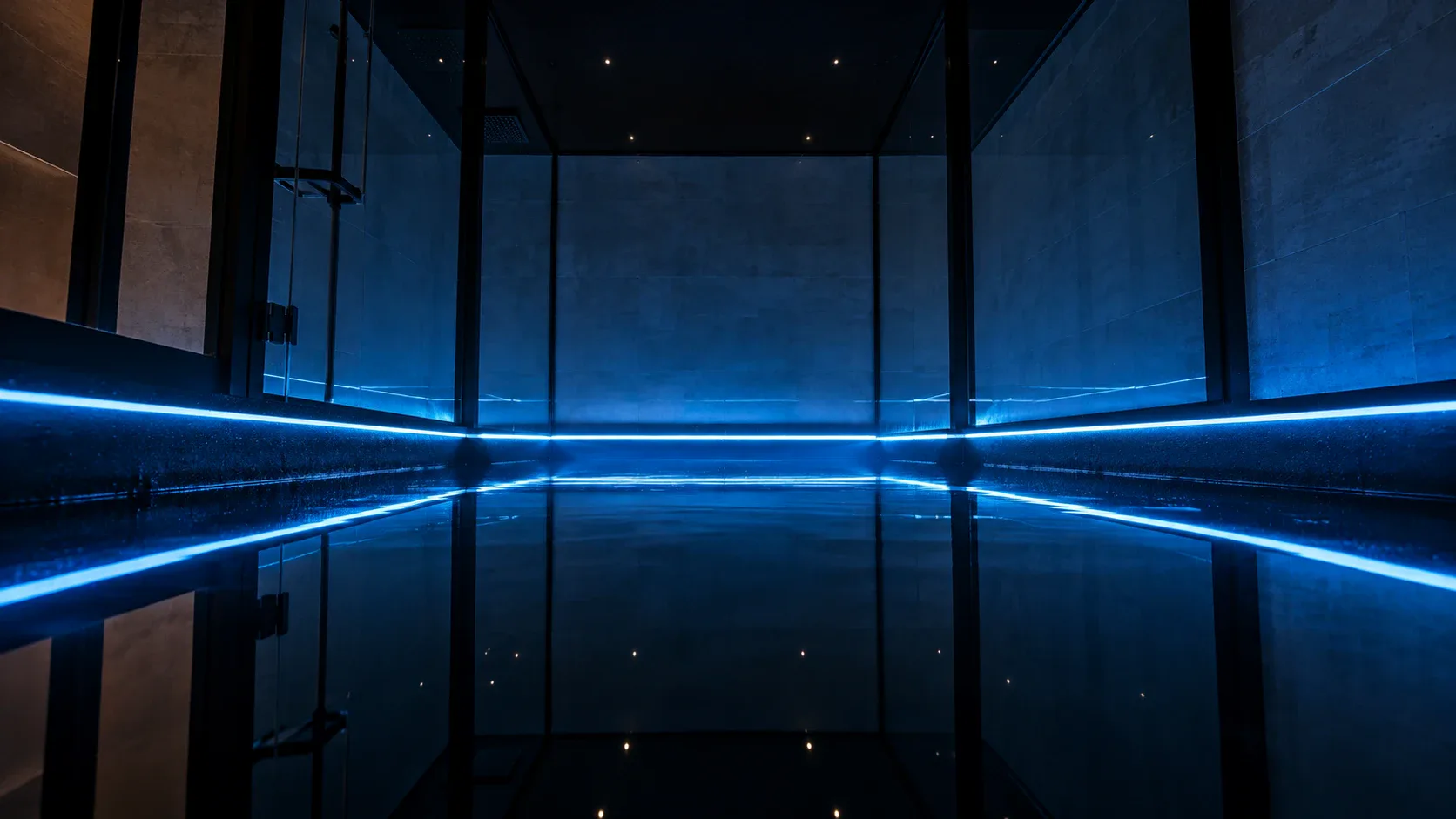
    An empty private float room at Ōmni Space, a pool of still water lit by soft blue LED lines
    A private float room at Ōmni, just before the lights go off. Photo: Ōmni Space.

    Ōmni Space – Float Saigon is at 16C Quốc Hương, Thảo Điền. We are open 9:00–21:00 daily; the last float starts at 20:00, and walk-ins are welcome until 18:00.

    Float PlanRunning on empty?Take the one-minute Float Plan quiz: tell us how you feel and what you need, and get a simple plan for your first session.Make my Float Plan

    FAQ

    Where is the quietest room on Earth?

    Guinness World Records lists the anechoic test chamber at Orfield Laboratories in Minneapolis, USA, measured at −24.9 dBA on 19 November 2021. Microsoft’s chamber in Redmond previously held the record from 2015 with −20.35 dBA.

    What do you hear in an anechoic chamber?

    Mostly yourself: your heartbeat, breathing, stomach and even the movement of your eyelids. Many people also notice a faint ringing generated by the ear and brain when external sound becomes extremely quiet.

    Is it true nobody can stay longer than 45 minutes?

    No. The claim grew from 2012 news stories about one person who stayed for 45 minutes during a challenge. It is neither an official endurance record nor a medical limit.

    Is total silence good for you?

    Short, comfortable pauses do appear calming: in one small study, two minutes of silence lowered heart rate and blood pressure. Very deep silence changes perception in unusual ways, but nobody has tested an anechoic chamber itself as a recovery tool.

    How is a float room different from an anechoic chamber?

    It is designed for rest: quiet, dark if you choose, with your body supported by warm, buoyant salt water for 60 or 90 minutes. Float has strong evidence for stress.

    Written by the team at Ōmni Space – Float Saigon in Thảo Điền, Vietnam’s pioneer float centre since 2017. We sell floats, not anechoic chamber visits. General information, not medical advice; sources checked on 30 October 2026.

    Sources

    1. Guinness World Records. Quietest place: Orfield Laboratories, −24.9 dBA, 19 November 2021 (checked 30 October 2026).
    2. Newman V, Guinness World Records (27 August 2024). Inside quietest place on Earth where you can hear your blood pumping and eyes blinking.
    3. Orfield Laboratories. Anechoic chamber (checked 30 October 2026).
    4. Krøjby K, VICE (29 September 2017). I locked myself in a soundproof room to see how long I would last in absolute silence.
    5. Cage J (1961). Silence: Lectures and Writings. Middletown, CT: Wesleyan University Press.
    6. Berglund B, Lindvall T, Schwela DH, eds. (1999). Guidelines for Community Noise. World Health Organization.
    7. Heller MF, Bergman M (1953). Tinnitus aurium in normally hearing persons. Annals of Otology, Rhinology & Laryngology 62(1): 73–83.
    8. Del Bo L, Forti S, Ambrosetti U, et al. (2008). Tinnitus aurium in persons with normal hearing: 55 years later. Otolaryngology–Head and Neck Surgery 139(3): 391–394.
    9. Mason OJ, Brady F (2009). The psychotomimetic effects of short-term sensory deprivation. Journal of Nervous and Mental Disease 197(10): 783–785.
    10. Bernardi L, Porta C, Sleight P (2006). Cardiovascular, cerebrovascular, and respiratory changes induced by different types of music in musicians and non-musicians: the importance of silence. Heart 92(4): 445–452.
    11. Kirste I, Nicola Z, Kronenberg G, et al. (2015). Is silence golden? Effects of auditory stimuli and their absence on adult hippocampal neurogenesis. Brain Structure and Function 220(2): 1221–1228.
    12. van Dierendonck D, te Nijenhuis J (2005). Flotation restricted environmental stimulation therapy (REST) as a stress-management tool: a meta-analysis. Psychology & Health 20(3): 405–412.
    13. Kjellgren A, Westman J (2014). Beneficial effects of treatment with sensory isolation in flotation-tank as a preventive health-care intervention: a randomized controlled pilot trial. BMC Complementary and Alternative Medicine 14: 417.
    14. Feinstein JS, Khalsa SS, Yeh H, et al. (2018). Examining the short-term anxiolytic and antidepressant effect of Floatation-REST. PLOS ONE 13(2): e0190292.