
In short: Floating feels a little like your body has stopped weighing anything. Dense, mineral-rich water supports you from head to heel, so the muscles that normally keep you upright can finally ease off. Warm water close to skin temperature softens the boundary between body and water, and the mind often grows quieter with it. For most of us, it is about as close as we will get to weightlessness while staying firmly on Earth.
You have never weighed nothing. Not for a single minute. Even as you read this, your back is pressing into a chair and small muscles along your spine are quietly keeping your head balanced on top. Gravity never takes a day off, which means your body never really does either. So what happens when warm water takes over that job for a while? Here is what your body tends to feel, minute by minute, what the mind does with all that sudden quiet, and how to make the most of your first weightless hour.
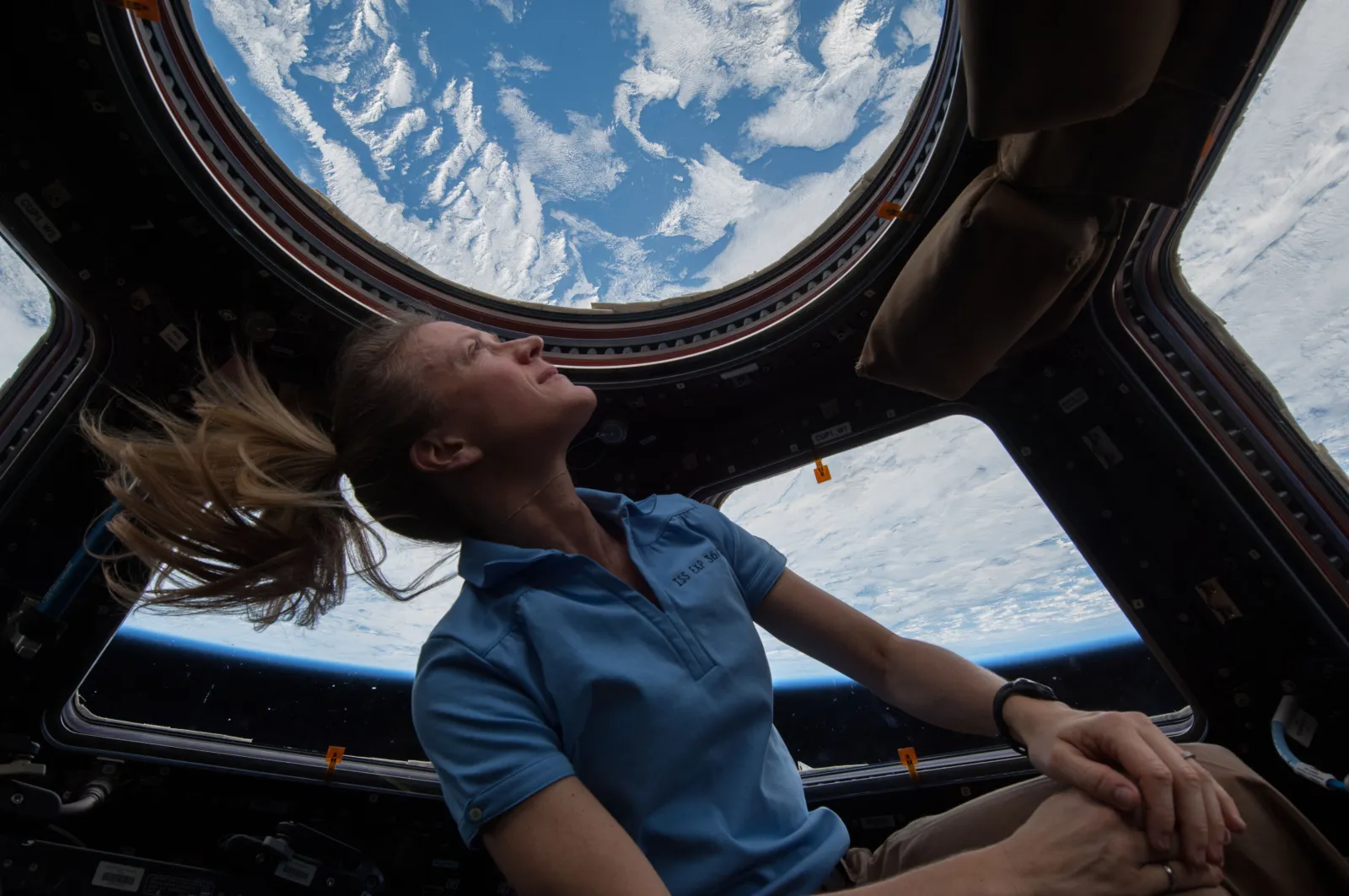
Even in bed, your body is still supporting itself
Lying down certainly feels restful, but the mattress is still pushing back against your head, shoulder blades, hips and heels, and you turn through the night to spread that pressure around. When you sit or stand, deep postural muscles through your back, neck and legs keep working in the background all day to hold you upright.
Space scientists have a word for what even a bed cannot remove: support. Russian space medicine recreates aspects of spaceflight on Earth using “dry immersion”, where a volunteer lies in warm water while wrapped in a thin waterproof film. Unlike bed rest, it removes all solid support, creating what researchers call “supportlessness”. In those studies, the postural muscles of the lower leg lost a large part of their tone within the first six hours. The body responds quickly when it no longer has to hold itself up. A float is neither dry immersion nor astronaut training, of course, but the underlying idea is similar: remove the floor beneath the body, and there is much less to brace against.
Why you float without even trying
Each float pool at Ōmni holds about 25 cm of water with around 500 kg of dense, mineral-rich Epsom salt. The water is much denser than your body, so it brings you naturally to the surface without effort: your face, chest and toes stay above the water, and there is nothing you need to do to keep yourself there.
The other half of the experience is temperature. The water stays at 33–34 °C, close to skin temperature, so after a few minutes your skin has much less reason to keep reporting “warm” or “cool”. Researchers at the Laureate Institute for Brain Research describe the float environment as turning down signals from almost every sense at once: sight, sound, temperature, touch, gravity and even the sense of where your limbs are. With so little information arriving, the line between your body and the water can begin to feel surprisingly faint.
What your body feels, stage by stage
No two floats unfold in exactly the same way, but many first sessions move through the four stages we describe on our travellers’ page. Here is what your body may begin to notice along the way.
- First 10 minutes: settling in. The water takes your weight from head to heel and supports your whole back at once. One of the first surprises is often how strangely light your legs feel. You may drift gently and brush the wall now and then; as the water settles, that usually settles too.
- 10–15 minutes: the body goes still. With so little left to support, the muscles along your spine, shoulders and neck can begin letting go one by one. Your neck no longer has to carry the weight of your head in the usual way, which may help ease some of the tension gathered there through the day.
- Breath and heartbeat come forward. You may suddenly notice your breathing more clearly, or even feel your heartbeat. In a 2018 crossover trial with 31 people, a 90-minute float clearly raised awareness of heart and breath sensations, while anxiety and muscle tension fell and relaxation rose, compared with a control session. Blood pressure also dropped during the float.
- The edges blur. The sense of exactly where your body ends can begin to soften, almost as though it is dissolving into the water. A 2021 brain-scan study titled “Taking the body off the mind” found that after a 90-minute float, brain networks involved in mapping the body and the sense of self were less tightly linked. Resting in a zero-gravity chair produced a similar pattern, so this is an early clue about deep rest rather than proof of something unique to floating.
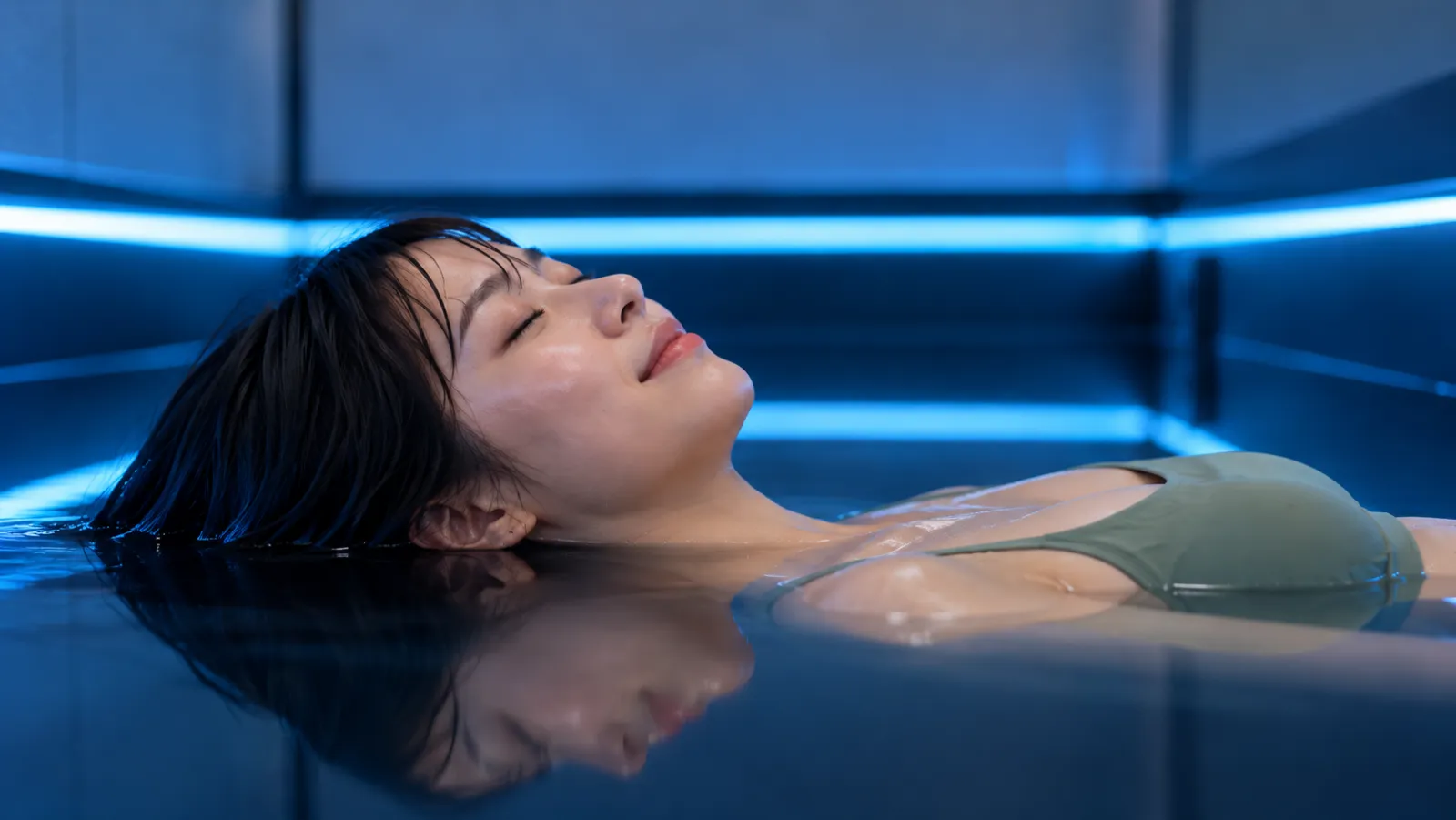
What happens in the mind when the body goes quiet
Around the 20-minute mark, thoughts often begin arriving with a little more space between them, until what remains can feel unusually still. Time can stretch in strange ways too: many people step out convinced that only 15 or 20 minutes have passed. In a Swedish interview study, floaters described profound relaxation alongside an altered sense of time. Some drift into a dreamy state, deeply relaxed while still aware; some doze off for a while, with the water continuing to support them. A float can feel like deep rest without the heaviness that sometimes follows sleep.
Some of that calm has also been measured in research. In a Swedish randomised trial, 65 working adults who floated 12 times over seven weeks reported less stress, anxiety and pain, and better sleep, than a waiting group. In a 2018 study, 50 people with anxiety or stress-related conditions felt clearly less anxious after one hour-long float, with more serenity and happiness (a promising result, though that study had no comparison group). You can explore the research further in our float therapy for anxiety guide.
Float therapy is still a young but active area of research: randomised controlled trials have found clear effects on anxiety, stress, muscle tension and sleep, while new clinical studies are still under way.
Ōmni Evidence Scale: Strong evidence, for float and stress. We rate it Strong because, alongside these trials, user experience is overwhelmingly positive: in a 2025 survey of regular floaters, 92% reported relaxation and 77% less stress, echoed by thousands of reviews, Reddit threads and forums, and by athletes and public figures who float. See how we rate evidence on the Ōmni Evidence Scale.
Ōmni Evidence Scale: Early evidence, for changes in body awareness and brain activity during a float. These findings come from single small studies, and rest without water produced some of the same brain changes.
So, is it actually like being in space?
Not quite — although there is a small resemblance. Astronauts on the International Space Station are not beyond gravity: at that height Earth’s pull is still about 90% of what you feel on the ground. They float because the station and everyone inside it are continuously falling around the planet together. In a float, gravity is still fully present, but the water pushes upward as gravity pulls downward, supporting you evenly across your whole back.
| In orbit (space station) | In a float | In a training pool (NASA) | |
|---|---|---|---|
| Gravity | About 90% of Earth’s, but you are in free fall | Full Earth gravity | Full Earth gravity |
| What holds you | Nothing: you and the station fall together | Dense Epsom water lifts you to the surface | Buoyancy is adjusted so you neither sink nor rise |
| Position | Any way up | On your back, face above the water | Any way up, in a full spacesuit |
| What it is for | Living and working in space | Deep rest for body and mind, 60–90 minutes | Rehearsing spacewalks |
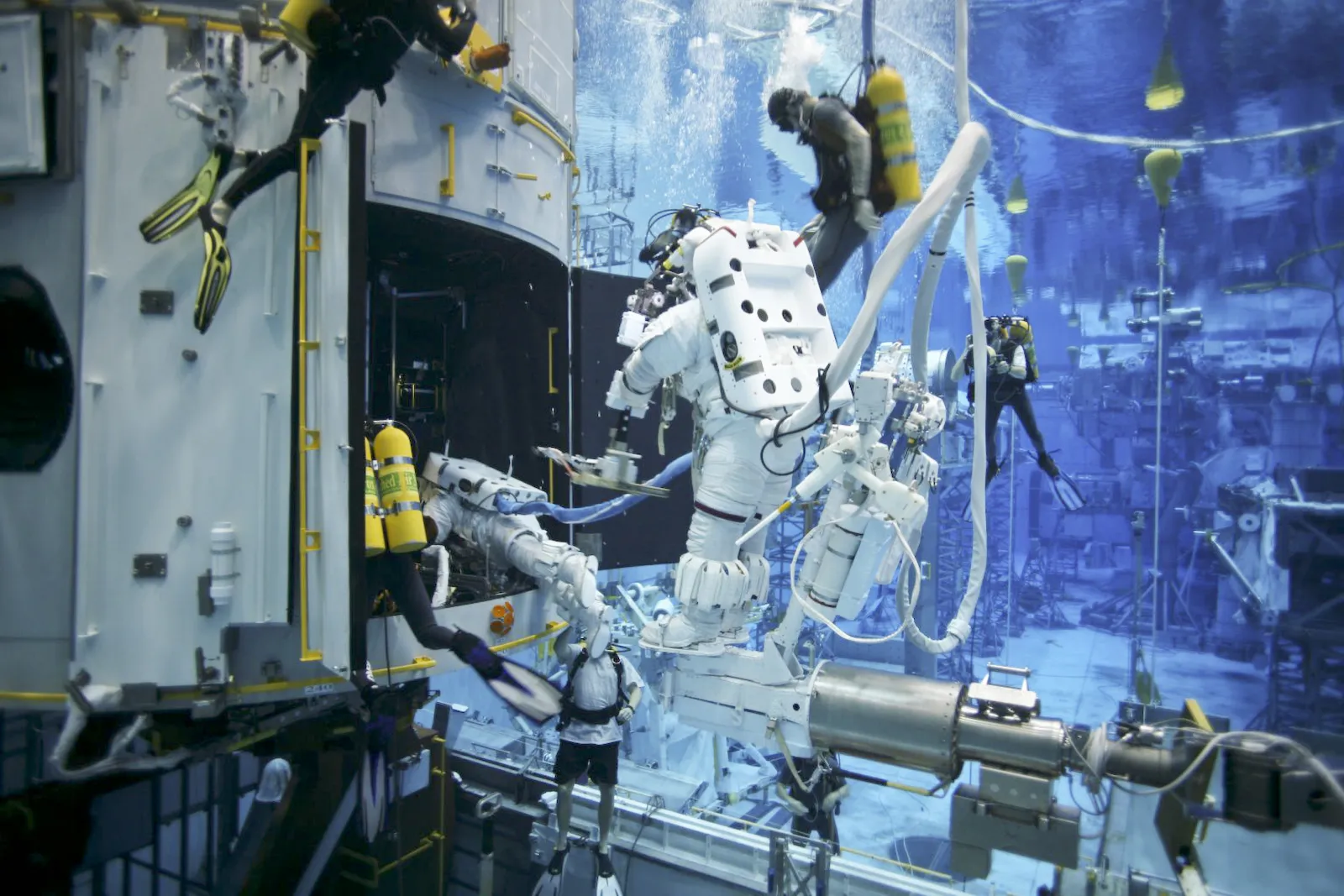
NASA’s Neutral Buoyancy Laboratory in Houston, a pool of about 6.2 million US gallons, is where crews rehearse spacewalks underwater. A float is not training you for anything. It simply gives your body an hour in which it no longer has to work so hard at holding itself up.
How to get more from your first weightless hour
- Let your head go last. The neck is often the final part of the body to trust the water; after all, it has been holding your head up your entire life. Breathe out slowly and let the back of your head settle until your ears are under. A Halo neck pillow is there if you would like a little extra support.
- Try two arm positions. Let them rest by your sides, or loosely above your head. There is no correct position — only the one your body prefers.
- Light on or off is yours. You control the switch, so you can choose total darkness or a soft blue glow at any point.
- Let the drift happen. If you gently touch the wall, you can push away softly or simply leave yourself there. The water settles, and eventually you tend to settle with it.
- Come back slowly. Afterwards many people feel light and unhurried — the “float glow” — and many sleep better that night. Give yourself a little time in the lounge with a glass of water before heading back out.
Your back and neck may notice the difference the same day. In one of the largest float trials so far, from Germany in 2021 with 99 people living with chronic pain, pain dropped clearly right after each float session. The relief had not lasted to weeks 12 and 24, so repeated sessions may matter if you want to maintain the short-term effect; see how often should you float and our back and neck pain guide.
Ōmni Evidence Scale: Promising, for float and stress-related muscle tension and pain in the short term. Trials found that pain eased right after floating, but the relief did not persist for months without further sessions.
One useful distinction: “weightless” describes the feeling here, not a medical effect.
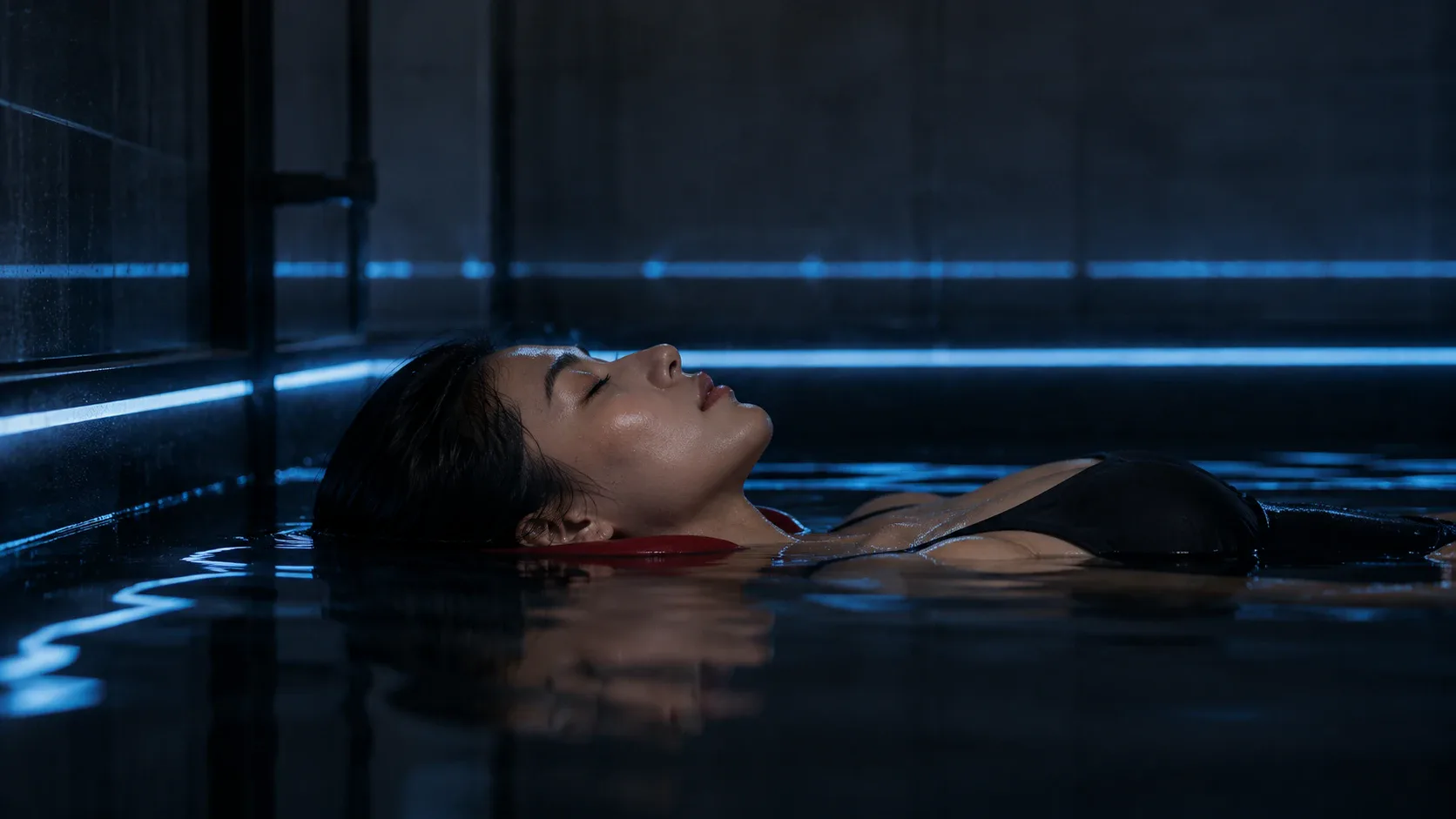
Where to experience weightlessness in Saigon
Ōmni Space – Float Saigon is at 16C Quốc Hương, Thảo Điền, Ho Chi Minh City, open 9:00–21:00 every day (last float starts at 20:00). Each private room has an open float pool behind glass, with no pod and no lid, soundproof doors and its own shower. Earplugs and a Halo neck pillow are ready for you, and our English-speaking team will walk you through everything first. Allow about two hours for the whole visit. You can find prices on our price page; you may also want to read before your first float and why we chose an open float room over a pod.
Have you ever felt almost weightless? See how a float fits your trip →
FAQ
What does floating feel like?
A little like weighing almost nothing. Dense Epsom water supports your whole body, your legs can feel surprisingly light, and water close to skin temperature softens the sense of where your body ends. Many people describe a deep calm and an unusual stretching of time.
Is a float like zero gravity in space?
Not exactly. Astronauts float because they are in free fall around Earth. During a float, gravity is still fully present, but the water pushes upward as gravity pulls downward, leaving your muscles with much less to support. It is about as close as most of us will get to a feeling of weightlessness on Earth.
Do I need to swim, or could I sink?
No swimming is needed. The water is about 25 cm deep with around 500 kg of Epsom salt, so your face, chest and toes naturally stay above the surface without effort.
Can I fall asleep while floating?
Many people doze for a while, and that is perfectly fine: the water continues to support you. A float is more about deep rest than ordinary sleep, and many people finish feeling clear and calm.
What should I do with my neck and arms?
Let the back of your head rest into the water, breathe out slowly, and use the Halo neck pillow if it feels more comfortable. Your arms can stay by your sides or rest loosely above your head.
How long does the light feeling last afterwards?
Many guests feel light and unhurried for the rest of the day and report sleeping better that night. Studies found that pain dropped right after each session, although longer-lasting effects were not seen at weeks 12 and 24.
Written by the team at Ōmni Space – Float Saigon in Thảo Điền, who opened Vietnam’s first float centre in 2017. General information, not medical advice; checked on 27 October 2026.
Sources
- Navasiolava NM, Custaud MA, Tomilovskaya ES et al. (2011). Long-term dry immersion: review and prospects. European Journal of Applied Physiology 111(7): 1235–1260.
- Tomilovskaya E, Shigueva T, Sayenko D, Rukavishnikov I, Kozlovskaya I (2019). Dry immersion as a ground-based model of microgravity physiological effects. Frontiers in Physiology 10: 284.
- Feinstein JS, Khalsa SS, Yeh H et al. (2018). The elicitation of relaxation and interoceptive awareness using floatation therapy in individuals with high anxiety sensitivity. Biological Psychiatry: Cognitive Neuroscience and Neuroimaging 3(6): 555–562.
- Al Zoubi O, Misaki M, Bodurka J et al. (2021). Taking the body off the mind: decreased functional connectivity between somatomotor and default-mode networks following Floatation-REST. Human Brain Mapping 42(10): 3216–3227.
- Feinstein JS et al. (2018). Examining the short-term anxiolytic and antidepressant effect of Floatation-REST. PLoS One 13(2): e0190292.
- Kjellgren A, Westman J (2014). Beneficial effects of treatment with sensory isolation in flotation-tank as a preventive health-care intervention: a randomized controlled pilot trial. BMC Complementary and Alternative Medicine 14: 417.
- Kjellgren A, Lyden F, Norlander T (2008). Sensory isolation in flotation tanks: altered states of consciousness and effects on well-being. The Qualitative Report 13(4): 636–656.
- Loose LF, Manuel J, Karst M, Schmidt LK, Beissner F (2021). Flotation restricted environmental stimulation therapy for chronic pain: a randomized clinical trial. JAMA Network Open 4(5): e219627.
- Hilpert K, Chis Ster I (2025). Experiences and perceptions of regular floatation-REST users: results from an online survey. Journal of Clinical Images and Medical Case Reports 6(5): 3600.
- NASA. What is microgravity? (updated 2025).
- NASA Johnson Space Center. Neutral Buoyancy Laboratory.
Leave a Reply