
In short: A darkness retreat means spending several days in a completely dark room, with meals passed through a light-proof hatch. It began as an advanced Tibetan meditation practice and made headlines in 2023, when NFL quarterback Aaron Rodgers spent four days in the dark in southern Oregon. Scientists have studied dark, quiet rooms since the 1950s, but research on multi-day retreats remains thin: a handful of small studies without proper control groups, while the first randomised pilot is still under way. What we do know is that prolonged darkness reliably brings visual hallucinations and strong emotions, which is why serious programmes include daily check-ins. A float gives you darkness, silence and near-weightlessness for 60 or 90 minutes, with the best-studied evidence in this family of practices. We run a float centre, so we are not neutral—and we will be clear about that as we go.
Read in Vietnamese: Nhập thất trong bóng tối (Float Vietnam)
Part of the Ōmni Recovery Library · Recovery by the Senses
Maybe you saw the Rodgers story and had the same thought: four days with no light, no phone, no clock? Part of you probably winced; another part may have wondered what you would find in there. That curiosity is worth taking seriously. So this article looks at where darkness retreats came from, what scientists have actually measured in dark rooms over seventy years, what the risks are, and how an hour in a float compares when you want a taste of the dark without giving up a week of your life.
Ōmni Evidence Scale: Early evidence, for feeling better after a multi-day darkness retreat (a few small studies, none with a proper control group). No good evidence yet, for claims that darkness makes the brain release DMT. Strong evidence, for float and stress. See how we rate evidence on the Ōmni Evidence Scale.
What exactly is a darkness retreat?
Picture a small room with a bed, a toilet, a mat and water. The door closes, and not a sliver of light gets in. Then you stay there for days. Food arrives through a hatch designed so no light slips in with it. No clock, no screen. The method is almost startlingly simple: remove light, and see what the mind does with all that empty space.
The Tibetan roots: mun tsam and yangti
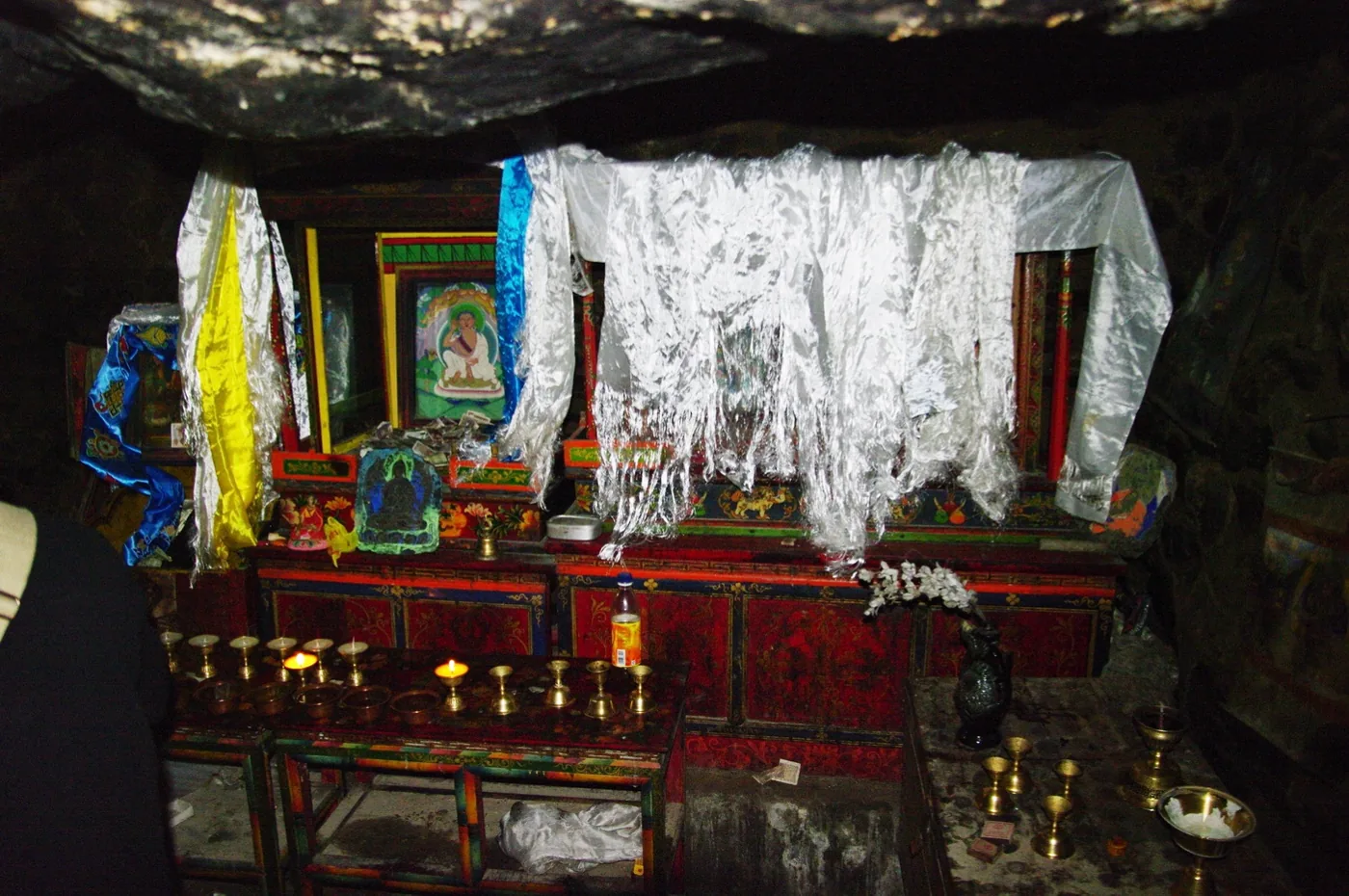
In Tibet, dark retreat is called mun mtshams (roughly “mün tsam”), and in the Nyingma school it belongs to Dzogchen, the “Great Perfection” teachings, where it is also known as yangti yoga. Writing in Tricycle, the teacher Justin von Bujdoss describes retreats that usually last from seven to forty-nine days and are reserved for senior practitioners who have received instructions from an experienced teacher. Relaxation is not the point. The visions that arise in darkness are used to recognise the nature of the mind, while the practice also serves as a rehearsal for the bardo, the passage through death. The Bön tradition has its own version, and Bön centres such as Shenten Dargye Ling in France still guide 49-day retreats.
How darkness retreats made headlines in 2023
Darkness retreats broke into sports news in February 2023. Aaron Rodgers announced on The Pat McAfee Show that he would spend four days and four nights in isolation and darkness while deciding his football future, and was reported to have stayed at Sky Cave Retreats in southern Oregon. CNN described the set-up there: earth-sheltered cabins with a bed, toilet and bath, three meals a day delivered through a light-proof box, about 250 USD a night, doors that are never locked, and an emergency light switch behind a childproof guard.
Dark rooms in the lab: from “sensory deprivation” to REST
Science became curious about darkness long before social media did. In 1954, psychologists at McGill University in Canada paid students to spend days lying in a quiet cubicle wearing translucent goggles, gloves and cardboard cuffs. Many found it hard to think clearly and began to see things. Around the same time, neuroscientist John C. Lilly at the US National Institute of Mental Health floated in a tank of warm water in darkness to ask a wonderfully strange question: would the brain simply switch off when ordinary input disappeared? It did not. In a 1956 report, he described a mind that stayed active, drifting into dreamlike states and vivid imagery. Lilly’s tank is the direct ancestor of the float rooms you can book today.
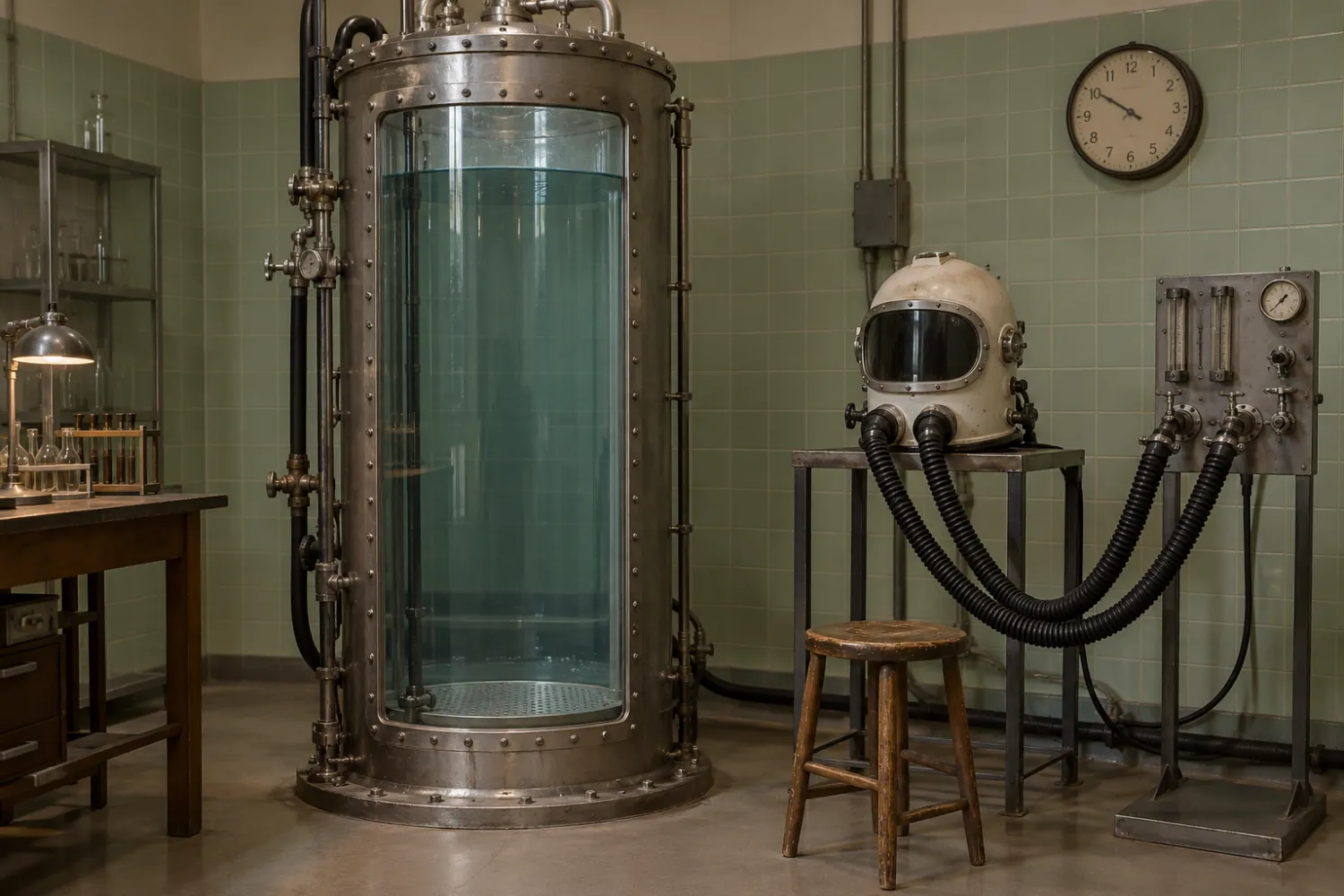
Canadian psychologist Peter Suedfeld then made an observation that changed the field. Early experiments often primed volunteers to expect something unpleasant before they had even begun—for example, by handing them a “panic button”. Once those cues were removed, most people experienced a dark, quiet room as calm rather than distressing. Suedfeld and his colleague Roderick Borrie gave the field a new, less ominous name: REST, Restricted Environmental Stimulation Technique (later also “Therapy”). REST comes in two forms. Chamber REST is a dark, silent room where you lie on a bed—essentially a short darkness retreat. Flotation REST adds warm, buoyant Epsom salt water, reducing touch and the pull of gravity as well. In Suedfeld’s lab, chamber REST was used to help people stop smoking, and in a 1990 review of around twenty papers he reported consistently positive results.
What science actually says about days in the dark
Surprisingly little—and most of what we know is about perception rather than health.
- Seeing things is normal. When researchers in Boston blindfolded 13 healthy adults for 96 hours, 10 reported visual hallucinations ranging from flashes of light to faces and landscapes, while still knowing the images were not real. Even 15 minutes in a dark, soundproof room produced unusual perceptions in some volunteers, especially those already prone to unusual experiences.
- Short chamber sessions look encouraging. In Slovakia, 120 university students who spent a single three-hour session in a dark, quiet chamber reported less perceived stress and information overload a week later than 60 matched students who did not; sleep and rumination did not change.
- Multi-day retreats are barely studied. Marek Malůš of the University of Ostrava told CNN that his preliminary research on four-day stays found improvements in mindfulness, self-esteem, depression and anxiety, while stressing that more study is needed. Those studies had no proper comparison group, and the participants had chosen, and paid, to attend.
- The first randomised pilot is still running. At SWPS University in Warsaw, about 30 students are spending three days and nights in darkness, randomised to one or three psychological check-ins a day. Its estimated completion date is November 2026, so there are no results yet.
And what about the famous claim that darkness makes the pineal gland pour out melatonin, then DMT? Tulane University’s David Blask, a melatonin researcher, told CNN that the idea that darkness therapy builds up melatonin is “totally false”. No human study has measured DMT rising during a darkness retreat. The fact that people feel different in prolonged darkness is well established; the chemistry story often wrapped around that experience is not.
Ōmni Evidence Scale: Early evidence, for wellbeing after darkness retreats. A short chamber session has one decent controlled study; multi-day retreats have only small studies without a control group so far. No good evidence yet, for “pineal activation” or DMT claims.
The risks, briefly
Days of darkness are a powerful intervention, not simply a very long nap. Hallucinations are expected, the sense of time can dissolve, sleep often comes in fragments, and old emotions or memories may surface while you are alone. The Warsaw pilot screens out people with a history of psychosis, bipolar disorder, epilepsy or current suicidal thoughts, and its whole design asks how often participants need a psychologist to check in. Tibetan teachers make much the same point in their own language: prepare properly, have a teacher, and begin with hours rather than weeks. If you go, choose a place with screening, daily contact, a door you can open and a light you can switch on.
Float: a shorter, more accessible taste of the dark
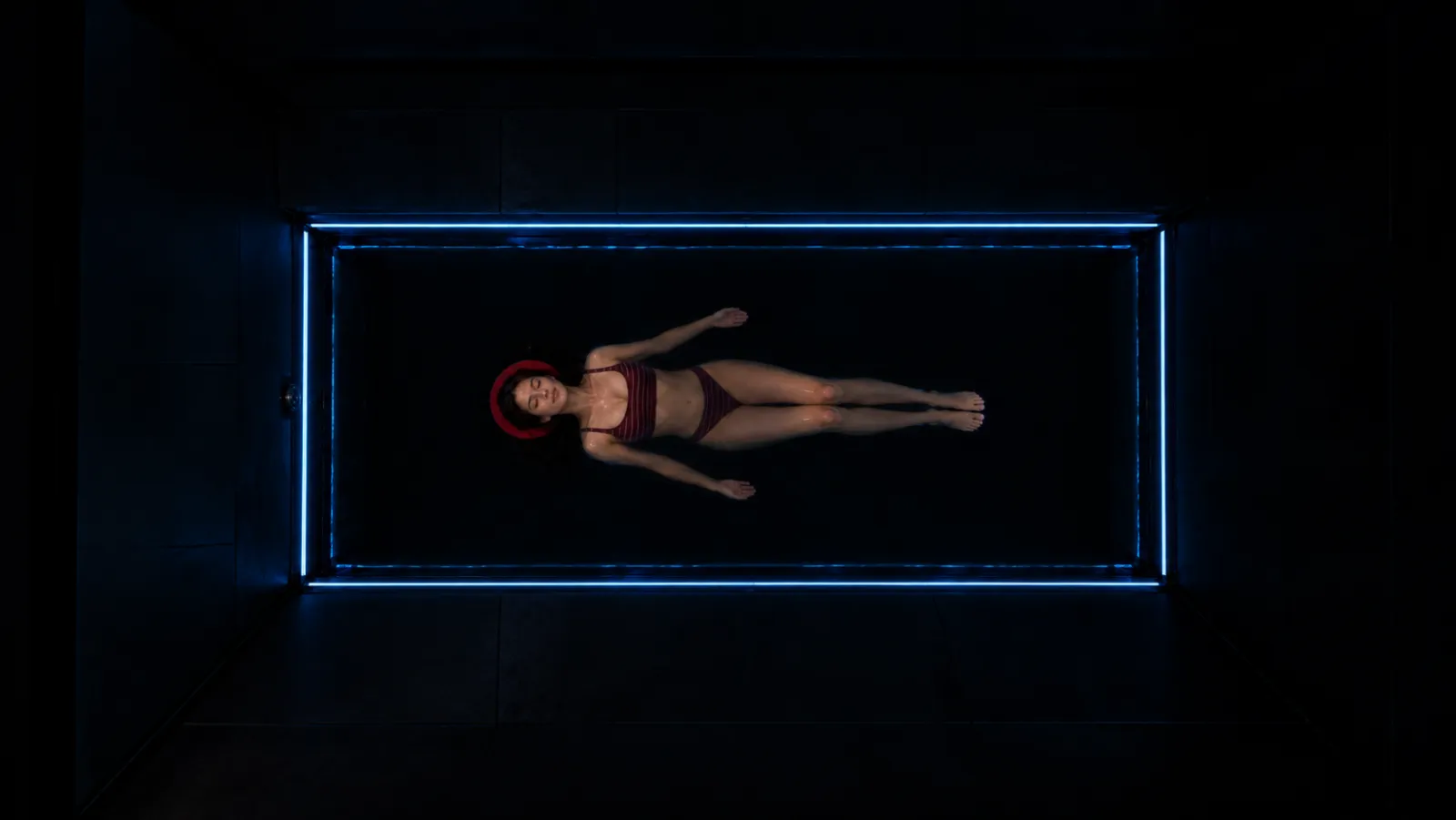
A float is flotation REST—the cousin of the darkness retreat that grew directly from Lilly’s tank. You lie back in about 25 cm of water holding around 500 kg of dense, mineral-rich Epsom salt, warmed to 33–34 °C, close to skin temperature. The water supports your whole body while the room becomes dark and quiet. So alongside darkness and silence, you also get the unusual sensation of weightlessness.
| Darkness retreat | Float | |
|---|---|---|
| How long | Usually 3 days or more; traditionally up to 49 | 60 or 90 minutes |
| What is reduced | Light, plus contact with people and time cues | Light, sound, touch and the feeling of gravity |
| Body clock | Drifts without daylight | Untouched: you are back in the day within the hour |
| Typical experience | Long, broken sleep, visions, strong emotions | Deep relaxation, time feels different, a calm, dreamy mind |
| Leaving | Possible, but you have committed to days | Whenever you like |
| Evidence | Early evidence | Strong evidence, for stress |
Float has been explored across hundreds of scientific studies. A 2005 meta-analysis of 27 flotation REST studies found positive effects on stress-related body measures and well-being, while a Swedish randomised pilot trial found that 65 working adults who floated 12 times over seven weeks reported less stress and anxiety and better sleep than a waiting group. At the Laureate Institute for Brain Research in the US, 50 people living with anxiety or stress-related conditions felt markedly less anxious after a single one-hour float, in a study without a control group.
Ōmni Evidence Scale: Strong evidence, for float and stress. We rate it Strong because, alongside these trials, user experience is overwhelmingly positive: in a 2025 survey of regular floaters, 92% reported relaxation and 77% less stress, echoed by thousands of reviews, Reddit threads and forums, and by athletes and public figures who float.
To be fair to the tradition, a float is not thögal, and if your goal is the Tibetan path, find a teacher. But if what you want is simply to turn down the stream of input for a while and hear your own mind more clearly, a float lets you explore that space in an afternoon.
What we think at Ōmni (and, yes, what we sell)
We are a float centre, so keep that in mind as you read this part. Ōmni Space in Thảo Điền comes from the team behind Float Vietnam, the country’s pioneer float centre since 2017. We do not offer darkness retreats and have no plans to: spending days in darkness deserves proper screening, supervision and a teacher, and that is not what we do. What we offer is the shorter version. Each float room is private, with its own shower, and you can make it completely dark and quiet. A single float costs 1,500,000 VND for 60 minutes or 2,000,000 VND for 90 minutes; the couple room, one large square pool for two, adds 700,000 VND for the second person. If you want to explore the quieter side of the session, our guide to quieting the mind in a float walks you through it.
For a deeper look at the body-clock studies and the DMT question, read Float Vietnam’s What Is a Darkness Retreat?, also available in Vietnamese as Nhập thất trong bóng tối. New to floating? Start with what float therapy is.
Ōmni Space – Float Saigon is at 16C Quốc Hương, Thảo Điền. We are open 9:00–21:00 daily; the last float starts at 20:00, and walk-ins are welcome until 18:00.
Float PlanRunning on empty?Take the one-minute Float Plan quiz: tell us how you feel and what you need, and get a simple plan for your first session.Make my Float PlanFAQ
What happens during a darkness retreat?
You spend several days in a fully light-sealed room, with meals passed through a light-proof hatch. Most people sleep a lot but in fragments, lose track of time, and begin seeing lights or images after a day or so.
Is there scientific evidence for darkness retreats?
Only early evidence. A three-hour dark-room session lowered perceived stress in one controlled study, but multi-day retreats have only small studies without a control group, and the first randomised pilot is due to finish in November 2026.
Does darkness make your brain release DMT?
No human study has shown that. A melatonin researcher interviewed by CNN called the idea that darkness therapy builds up melatonin “totally false”, while claims about DMT are still based on theory rather than measurements.
Is a float the same as a darkness retreat?
They are related, but they are not the same. A float lasts 60 or 90 minutes and adds warm, buoyant salt water, reducing touch and the feeling of gravity alongside light and sound, and you can leave whenever you like.
Does Ōmni Space offer darkness retreats?
No. We offer private float rooms in Thảo Điền, from 1,500,000 VND for 60 minutes, giving you darkness and silence for an hour or ninety minutes. Our team is happy to talk you through the experience on site.
Written by the team at Ōmni Space – Float Saigon in Thảo Điền, Vietnam’s pioneer float centre since 2017. We sell floats, not darkness retreats. General information, not medical advice; sources checked on 30 October 2026.
Sources
- von Bujdoss J (2023). Embracing the darkness. Tricycle: The Buddhist Review, Fall 2023.
- Shenten Dargye Ling. Personal thögal (dark) retreats (checked 30 October 2026).
- Kafanov L, CNN (26 February 2023). NFL star Aaron Rodgers went to a darkness retreat to contemplate his future. What is that and how does it work?
- Bexton WH, Heron W, Scott TH (1954). Effects of decreased variation in the sensory environment. Canadian Journal of Psychology 8(2): 70–76.
- Lilly JC (1956). Mental effects of reduction of ordinary levels of physical stimuli on intact, healthy persons. Psychiatric Research Reports 5: 1–9.
- University of British Columbia. Suedfeld’s research involving reduced stimulation environments: chamber and flotation REST (checked 30 October 2026).
- Suedfeld P, Borrie RA (1999). Health and therapeutic applications of chamber and flotation restricted environmental stimulation therapy (REST). Psychology & Health 14(3): 545–566.
- Suedfeld P (1990). Restricted environmental stimulation and smoking cessation: a 15-year progress report. International Journal of the Addictions 25(8): 861–888.
- Merabet LB, Maguire D, Warde A, et al. (2004). Visual hallucinations during prolonged blindfolding in sighted subjects. Journal of Neuro-Ophthalmology 24(2): 109–113.
- Mason OJ, Brady F (2009). The psychotomimetic effects of short-term sensory deprivation. Journal of Nervous and Mental Disease 197(10): 783–785.
- Bartolen I, Soláriková P (2025). Assessing impact of chamber restricted environmental stimulation therapy on stress and sleep quality among university students: an intervention study. BMC Psychology 13: 796.
- ClinicalTrials.gov NCT07429617. Effect of darkness retreat on worry and rumination in a non-clinical population: a pilot study. SWPS University, Warsaw (record checked 30 October 2026).
- van Dierendonck D, te Nijenhuis J (2005). Flotation restricted environmental stimulation therapy (REST) as a stress-management tool: a meta-analysis. Psychology & Health 20(3): 405–412.
- Kjellgren A, Westman J (2014). Beneficial effects of treatment with sensory isolation in flotation-tank as a preventive health-care intervention: a randomized controlled pilot trial. BMC Complementary and Alternative Medicine 14: 417.
- Feinstein JS, Khalsa SS, Yeh H, et al. (2018). Examining the short-term anxiolytic and antidepressant effect of Floatation-REST. PLOS ONE 13(2): e0190292.
Leave a Reply