



Float vs. Meditation: Different Paths to the Same State of Mind
Float therapy vs. meditation: how do they compare? Learn how both induce theta brainwaves, quiet the Default Mode Network (DMN), reduce stress, and lead to calm and clarity, different paths to the same state of mind.
12/9/20253 min read


Meditation has been practiced for thousands of years to calm the mind and cultivate awareness. Float therapy, on the other hand, is a modern innovation that uses science and technology to create a similar inner state.
At first glance, they look different. But when we look deeper, float therapy and meditation often lead to the same state of mind: calm, clarity, and presence.
The Goal: Quieting the Mind
Both meditation and floating share one intention: to quiet the endless mental chatter and help you reconnect with yourself.
Meditation: You use something as an object of attention like breath, bodily feeling, mantra, or awareness of thoughts as an anchor. Over time, this trains your brain to reduce distractions and maintain focus.
Float Therapy: The environment itself—silence, darkness, and weightlessness—removes distractions for you. The tank does the “heavy lifting,” so your mind naturally shifts inward.
How the Brain Responds
Scientific research shows that both meditation and floating affect the Default Mode Network (DMN)—the part of the brain responsible for daydreaming, self-talk, and rumination.
In Meditation: Long-term practice reduces DMN activity, which is why experienced meditators often feel peaceful and centered.
In Floating: Studies using fMRI scans suggest floating can quiet the DMN after just a single session, even for beginners.
(Sources: Taking the body off the mind: Decreased functional connectivity between somatomotor and default‐mode networks following Floatation‐REST - PMC, Raichle, 2015 – Annual Review of Neuroscience)
Both practices are also analyzed for their ability to promote lower-frequency brainwave states, which are intrinsically linked to deep relaxation and altered states of consciousness. The general progression involves moving from the high-frequency Beta waves of normal cognitive engagement toward Alpha waves, associated with calm, wakeful relaxation.


The key convergent state is the increase in Theta wave activity, which is strongly associated with deep relaxation, dreaming, and profound meditative states. EEG studies have confirmed that flotation therapy significantly increases theta brain wave activity. A notable difference is the speed of induction: studies have shown that a rapid, profound Theta activity can be produced in as little as 15 to 20 minutes during a single 60 minute float session. This rapid induction mirrors the deep meditative states that might typically require years of practice for an experienced meditator to reliably access. While long-term meditators consistently exhibit increased Alpha and Theta coherence, the induction is necessarily gradual, requiring continuous, effortful focus.
The Experience
Meditation: Often practiced seated, in stillness or with gentle focus. It requires discipline, patience, and repetition. Some people struggle with restlessness or find it hard to sit quietly.
Floating: You lie effortlessly in warm, salty water. No gravity, no external noise, no effort required. The stillness is built into the environment.
For many people, floating feels like “cheating at meditation” you reach a deep state without the years of practice.
Unique Benefits of Each
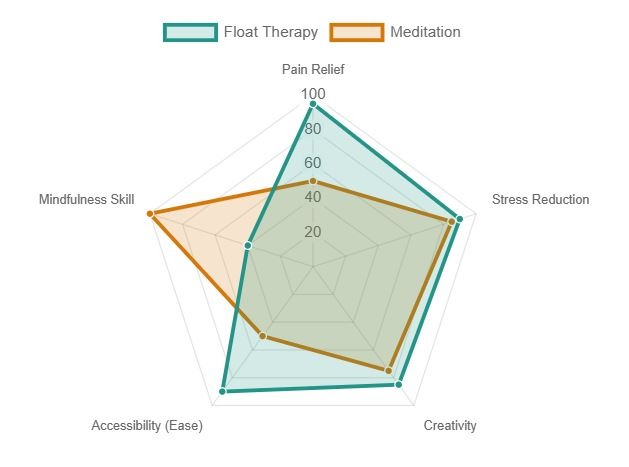
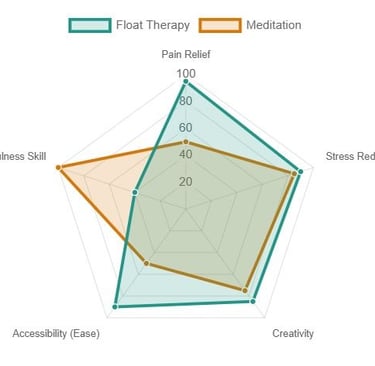
Meditation:
Can be done anywhere, anytime
Builds long-term mindfulness
Enhances emotional regulation and compassion
Floating:
Provides immediate deep relaxation
Supports physical recovery (muscle repair, joint release)
Delivers consistent, distraction free environment
Together, they form a powerful duo: floating can accelerate meditation, and meditation can help seasoned floaters deepen their inner journey.
Which One Is Right for You?
If you:
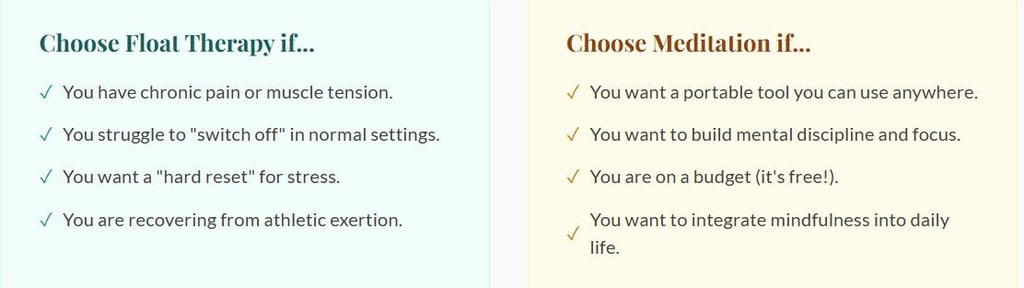
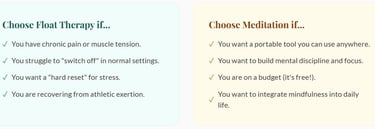
Want a daily practice → Start with meditation.
Struggle to “switch off” your mind → Try floating for a jumpstart.
Are seeking physical recovery + mental clarity → Floating may be your best first step.
Value a lifelong tool for awareness → Meditation is essential.
The truth is, you don’t have to choose. Many people use both—float therapy as the reset button, and meditation as the daily practice.
Float Your Way Into Meditation
At Omni Space in Thảo Điền, we see floating as the bridge between modern life and timeless meditation. For beginners, it’s the easiest way to taste silence. For seasoned meditators, it’s a chance to go even deeper.
👉 Book your float session today and experience how effortlessly your mind can arrive at stillness.
Experience true silence through engineered stillness.
Contact Us:
Since 2017
Pioneers of Float Therapy in Việt Nam
+84-326896369
info@omnispacevn.com
